


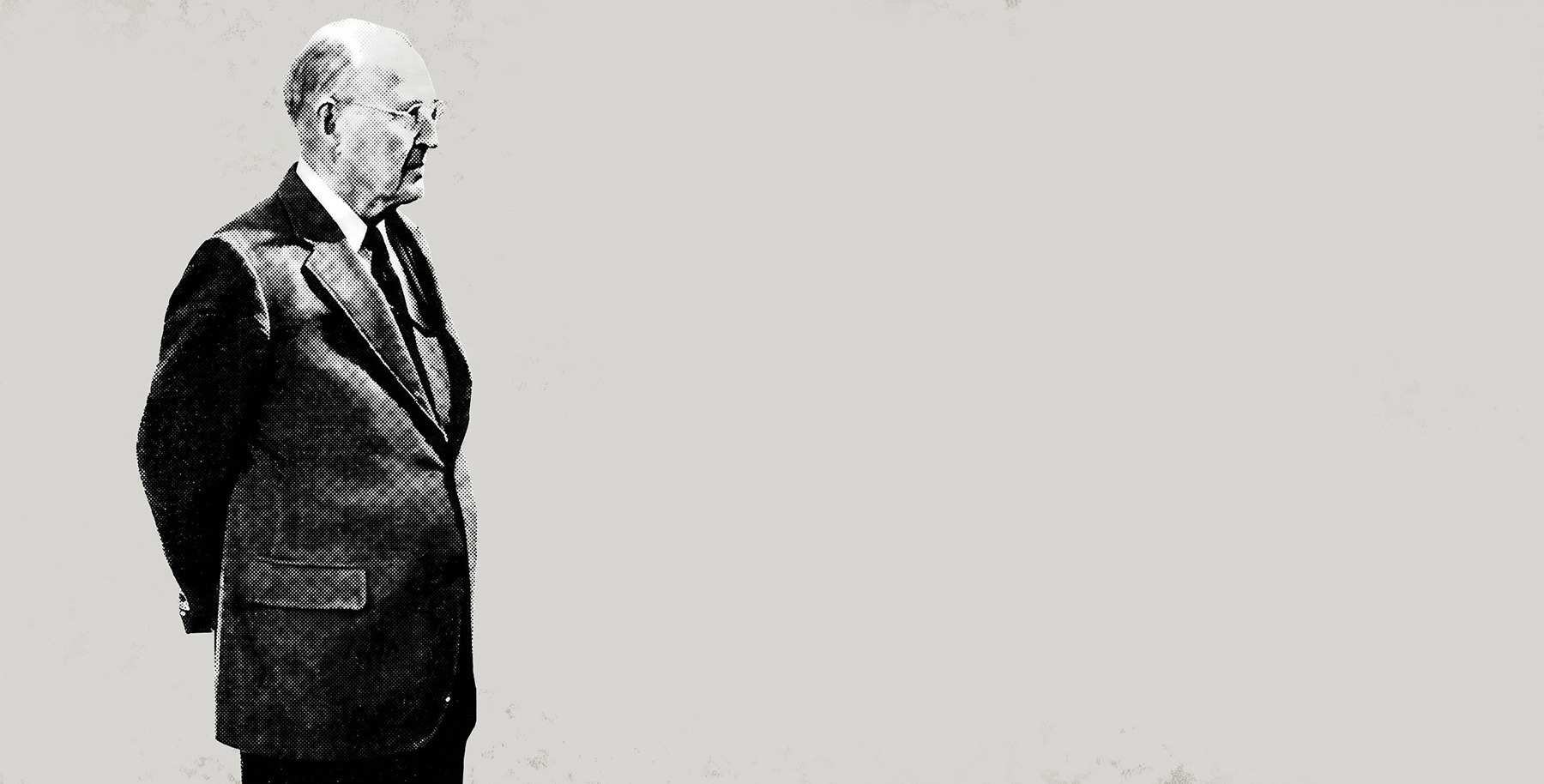
“An Interview with Andrew Lytle”: Interviewed by Warren Smith and Michael Jordan.
Originally published in The Chattahoochee Review 08.4, 1988.1
"If we can become craftsmen again, we can restore the sense of the divine."
Andrew Lytle held the annual week-long John O. Eidson Visiting Professorship at the University of Georgia in 1984, succeeding Cleanth Brooks in that position. He was interviewed ostensibly for publication in Stillpoint, the student Literary magazine. Warren Smith, then the editor of Stillpoint, wrote his MA thesis on Lytle. Michael Jordan is now writing a doctoral dissertation on Donald Davidson.
Smith and Jordan: You have often said that the term “Agrarian” did not encompass all the ideas of the twelve men represented in I’ll Take My Stand. What are those ideas, and is there a better term or phrase to express them?
Lytle: Well, I can’t exactly say what the better phrase is, but I felt, later on in life, that Agrarian was too restricted to just farming. What we were trying to defend was the whole cultural inheritance of Christendom. Of course, farming is the source of all society and life because it’s bread and meat, as well as other things. But we were not particularly concerned with agronomy or just farming, except to note that farming the land was the physical basis of all society.
In fact, culture comes from colo, colere, colui, coltum, which means the way you till the ground, and around tilling the ground and working the land and growing fruit and crops and things, you learn and pass on from generation to generation the manners and mores of a given society. In other words, a shopkeeper will not have the same kind of manners and mores as, say, a peasant farmer. Out of farming the land grows the larger sense of what the human condition is.
Red Warren and Allen Tate wanted to entitle the work Tracts Against Communism. I went along with them because we were the youngest and the best friends. But that was too political, just as Agrarian seemed somewhat too agricultural. It was an attitude towards Nature: don’t loot it, don’t destroy it, but cherish it and cultivate it and take care of it because nature and human nature are all part of the whole habits of life.
Question: It sounds like Agrarianism urges an attitude very similar to the Christian notion of stewardship. But Cleanth Brooks has said that while the Agrarian position is essentially a religious worldview, not enough emphasis was placed on religion by the original twelve. Is this true?
Lytle: Yes. I think it’s true. You see, we made the mistake of letting Allen Tate write on religion, and he reduced religion to philosophy — the half-horse business, you know. Now you see, that was part of the temperature of the times. I can say this in defense of not emphasizing it too much: when you emphasize religion consciously, it’s already gone. So obviously we had some sense of religion. We still operated out of a religious world.
But you see, we were just making a public protest. When we wrote, our backs were to the wall. We didn’t think of ourselves as prophets, though now we seem to be prophets. The liberals laughed at us. They had pictures of us with our heads in mules’ asses. They had us using privies. Now, there’s nothing wrong with privies. Allen Tate said he didn’t mind using an indoor toilet so long as he didn’t have to kneel down and worship it every time he used it.
The main point we were trying to make is that without a communion of things — people doing things together out of a common inheritance and a common way of making a living — you cannot really be happy. As John Ransom said in I’ll Take My Stand, the thing we do most is work, and when it’s an evil, as the industrial system says it is, you work hard so you can take a vacation. But then you work hard there, too, so you never have any fun.
Think of doing one thing all your life: screwing this into that. There are people in some factories who do that. And some of them are manacled; they put a part here, and if they don’t move their hands back quick enough, they’ll get smashed, so they have a machine that drags their hands back for them.
A point I would make is that the creative process is the only thing in us that is divine. We were not begotten; we were made. And the artist puts into his artifact himself — not his personality, but the thing in him that is eternal. That’s what God did. And if we become craftsmen again, we can restore the sense of the divine.
Question: So the critique of the Agrarians is that we have lost our sense of ourselves as craftsmen and have become—.
Lytle: Specialists. Specialism. It’s a terrible thing. It denies the whole body politic. For example, when I had my eye trouble, a doctor gave me something called Diamox. It made me feel so bad that it was a heroic act to take my foot out of my bed and put on my shoes. So I stopped taking it. When I got to a doctor down here, he said the drug could kill you. Well, I knew it would. That young man up there in Lexington was experimenting on me. He said “Well, it hurts some people.” It was a drug that was supposed to take the water out of the upper part of the body. Well, I said what about the lower part? In the body, you know, this is not separate from that. The water was causing my blindness, and the drug was supposed to take the water out of my eye. That’s the stupidity of the specialist.
Question: But we are pushed toward specialism from our earliest educational experiences. How do we resist this pushing? What kind of education should young men and women be trying to get?
Lytle: Reading, writing, and arithmetic, all the basic things. I suppose I received the best of educations at Sewanee Military Academy. I got grounded in Latin, four years of Latin, history, English, a foreign language, and mathematics. In college, you reach out into more private disciplines, such as chemistry and all the sciences. But all you get there is the knowledge of what things are and sort of where they are. You can’t learn the whole history of the world in four years, when you’re also doing other things. Getting to know each other.
There are three things you’ve got to do when you go to college. You’ve got to first discipline the mind. Then you’ve got to know how to drink. And then make love. Those are the three basic things in education. It’s true. That’s what you should concern yourself with.
Question: Make love?
Lytle: Yes! Courtship, and all of that. Your basic concern is to live in the order and discipline of a community. If you don’t discipline yourself in the basic matters that concern you, then someone else will. That’s tyranny. That’s the servile state…
"The defeated South, after the First World War, had come up against materialism through industrialism. So you had the two opposites come together, and the friction caused certain people to become aware of their inheritance." - Andrew Nelson Lytle
Question: Discipline of the mind, then of the body, and then discipline within a social setting so as to live in order in a community. These are pretty lofty goals for both teacher and student.
Lytle: Of course, every man learns in his own way. And teaching is a craft.
At Sewanee students used to have to wear a coat and tie to class. They would come in barefooted, but they’d wear a coat and tie. When the weather got warm, they’d try to get away with taking off the coat and I’d say, “Now gentlemen, literature is greater than either the student or the professor, and you can only meet it formally. Put your coats on.” But, again, every man learns in his own way.
But anyway, I don’t see how you can teach anything you don’t like. If you love it, the students will love it. I’ve found that to be the case. And if you love it, you’ve got to find a way to transmit it.
I don’t understand, for example, these people who write a biography of a person they don’t like. It seems a silly thing to do, something done by a bad-natured person who wants to get back at a person who is dead because he didn’t like him.
Question: The modern university has gotten away from some of the things you’re talking about. Instead of a university, where men and women achieve a level of communion and get the chance to plug in, so to speak, to the tradition of men who came before them, it’s become a multiversity. Everyone’s doing his own thing. Is this an acceptable situation?
Lytle: It’s not. That’s because society has disintegrated. When you have a community, everybody moves based on certain beliefs, divine and natural. The family is the best description of that. You cannot have thousands of people in school, as in the large state universities today — thirty and forty thousand. It’s just too many. Now that doesn’t mean you can’t get an education there. If you’re lucky, there will be certain teachers there who can teach and who love their subjects. But it’s this Educationist business, with a capital E, which teaches methods and no subject, that’s destroying education in this country. Disciplines require their own methods. Certainly you’re not going to use the same methods in teaching French that you use in teaching chemistry. That’s just confusion.
Question: Speaking of confusion: you often write of the relationship between confusion and order both in the individual and in society. And often you trace confusion to a confusion of tongues, a confusion in the use of language.
Lytle: Well, yes. Just look at any newspaper, or take one word: temperance, for example. Temperance means that when you approach the objects of the world that are tempting, be temperate about them. That is, don’t go whole hog; don’t get drunk every day, just take a drink. But the moment you say you can’t do something at all, when you replace temperance with prohibition... you see, that violates the language. And you can see the tremendous power of the crying world that has grown out of prohibition.
That’s just one example, and an obvious one. You see, the word was the creative act of God. It has to do with life and a confusion of words is death. Now, of course, we all die. And whether you actually die alone, or in genocide, with a hundred million people, you always die alone. That’s why when we talk about the atom bomb or nuclear explosion it doesn’t matter about the individual, each individual, unless it hurts too bad. What we’re really concerned with is the death of society. And the word is the discipliner and orderer of society. We cannot have communion if we do not know the meaning of language.
Question: So the confusion of language is just as destructive as any possible holocaust. And perhaps this is why you have dedicated yourself so painstakingly to fiction though much of your training was in history?
Lytle: Fiction is the best way to make present and understandable history. For the simple reason that you have to recreate people acting in their predicament. When I came along, historians could not write. They thought of themselves as scientists, and scientists are illiterate and don’t write. My dear friend Frank Owsley wrote three basic books: State Rights in the Confederacy, King Cotton Diplomacy, and Plain Folk of the Old South. When I taught Civil War at Southwestern, I used the first book, and I read a paragraph that didn’t make any sense to me at all. I presented it to him, the author, and he didn’t know what it meant either!
I remember that Ambassador Dodd, who was ambassador to Germany under Hitler and was head of the history department at the University of Chicago, wrote a book on Jefferson Davis. He was held suspect because it was a decent book; you could read it. The words meant what they said, more or less. He was held suspect by his fellow historians. History, you can know it best — if you have a good writer — through fiction. The fiction writer doesn’t have an ax to grind, to begin with. If he’s good he will make people act in their predicament, and he will resolve it in some way before it’s over. Of course this is a prejudiced view, if I may say so.
Question: This blending of history and fiction — fiction as history, you might call it — has certainly been a hallmark of your fiction and that of other Southern writers.
Lytle: What you have now, I think, is this: for the past fifty years literature has been dominated by Southerners. There’s no doubt about it. But most of the publishing is in the Northeast, where a provincial kind of sentimentality seems to dominate. And publishing is on the stock exchange up there, so when Post Toasties buys a great publishing house, they may know about Post Toasties, but what do they know about reading literature and publishing? It comes down to materialism, absolutely. It’s getting to be that university presses and small presses in the South and elsewhere are the only hopes. There’s great confusion as to the status of letters now because all the older people who had maintained it are dying off. The only one in the East now is Malcolm Cowley, who seems to live forever.
“What we were trying to defend was the whole cultural inheritance of Christendom.”
Question: Aside from this understanding of fiction as history, why have Southerners so dominated literature? What was special about the South?
Lytle: Allen Tate made the point. He compared the South to the 16th century. The defeated South, after the First World War, had come up against materialism through industrialism. So you had the two opposites come together, and the friction caused certain people to become aware of their inheritance, historic and otherwise, just as the Renaissance — which was a squandering of the inheritance of the high days of Christendom — met feudalism to produce the great Elizabethan plays. That’s what Allen Tate said, and it makes great good sense.
And add this: the South was defeated. There was still at that time some sense of this defeat. People had eaten their bread in sorrow. That was a very important characteristic of the South, I think, whereas the Yankees have gone from one sweet titty to another. But don’t forget this. People did and still do eat their bread in sorrow. That bread sometimes is a metaphysical bread. Those people in the Northeast have lost their sense of triumph. They’re all screwed up. They don’t know what they’re doing.
Question: Based on what you’ve said about publishing and about society in general do you ever wonder that your own work has gained such a high status?
Lytle: An artist concentrates. Your whole attention is on your work, making it show itself. Anything that comes in, such as how to pay the mortgage on the farm, will it get me a reputation, will it get me a good lay, as some people used to say — anything that intrudes will spoil what you’re doing. I would say that I’ve never let that intrude. I discovered that you just try to do the work. You don’t know whether anybody’s going to read the work or not. It’s like being what the priest once was: totally committed. You take the long risk of faith, the long risk of not being recognized. I’ve been through that period. It didn’t matter to me because I’m not ambitious in that way. I want to see the subject expose itself under the proper control of distance. That is the craft of fiction. And as I said, if we can become craftsmen again we can restore the sense of the divine.

Other Interviews


I trimmed a short portion of the interview for length and “reasons”.
I'm glad he puts drinking up there with mental discipline (and amorousness, he was a randy old feller) -- the more literate you are, the better you hold your liquor.
That Temperance at things tempting line will preach too.