


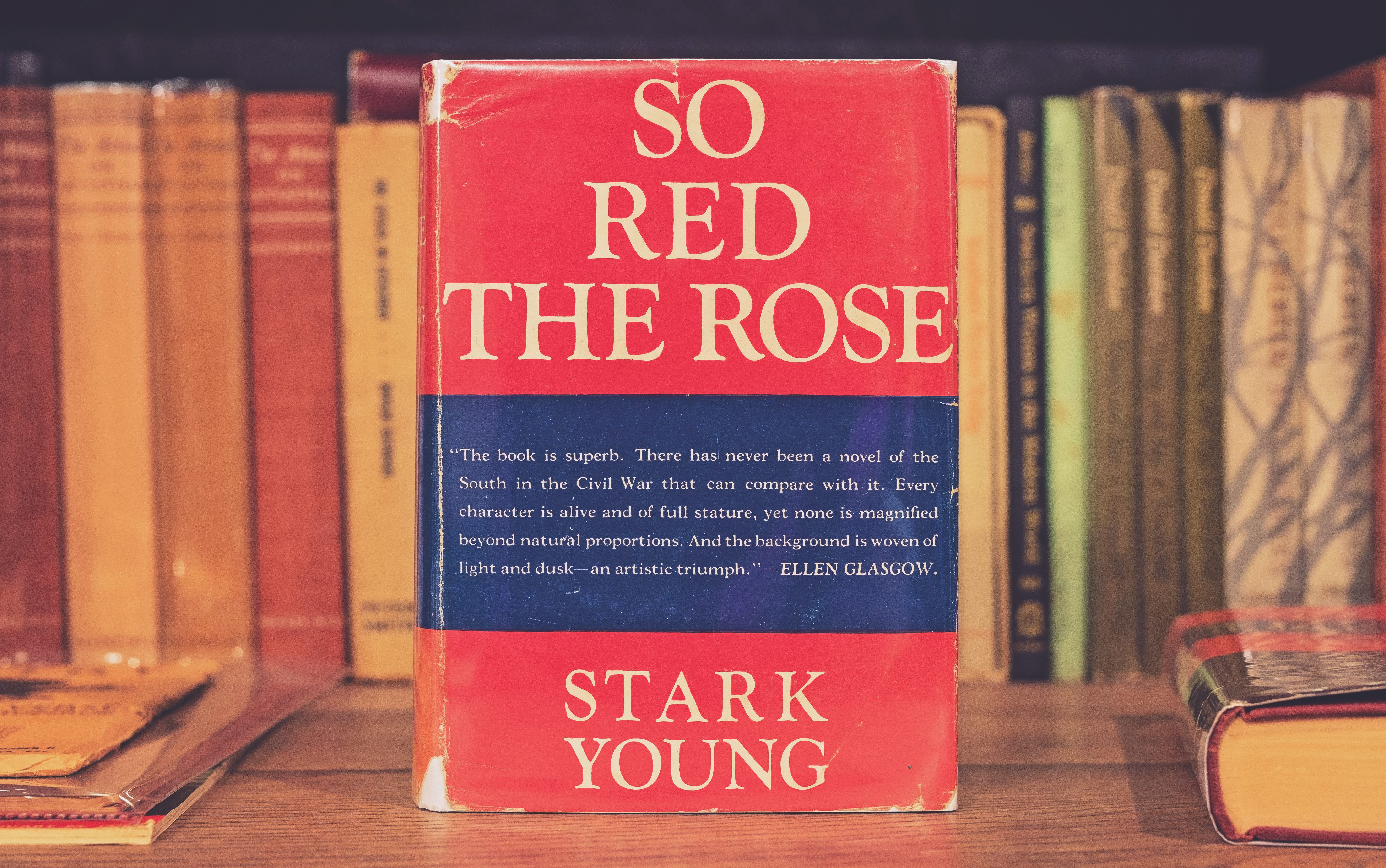
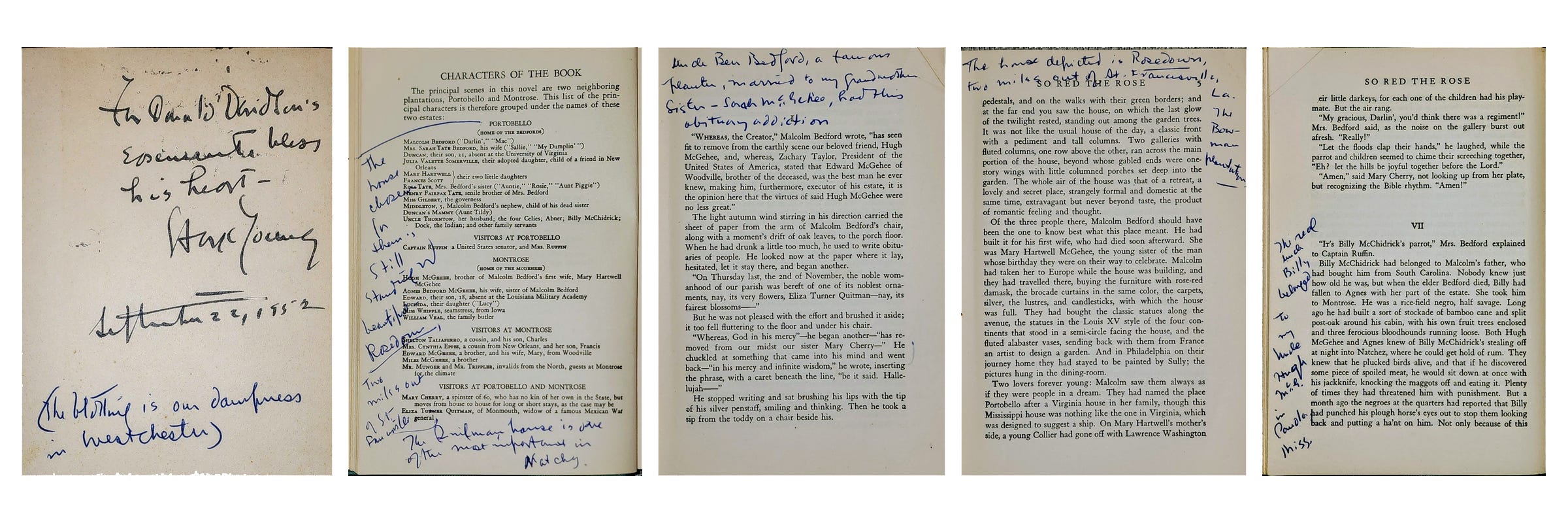
An escutcheon is the shield upon which a family bears its arms and guards its good name. Stark Young’s So Red the Rose, published in 1934, follows two Mississippi families through the Confederacy’s rise and fall. His inscription runs across the front free endpaper of my 1951 copy, the lines fattening and thinning as a fountain pen’s will. It reads:
For Donald Davidson’s escutcheon bless his heart —
Stark Young
September 22, 1952
Beneath, in blue ink:
(The blotting is our dampness in Westchester)
The dampness was Jennymead’s, the house near Waccabuc, New York, that Young shared with the architect William McKnight Bowman. Young was seventy that September. Davidson was fifty-nine. In January Scribner’s had asked Davidson to write the introduction to a new edition of the novel in its Modern Standard Authors series.
Earlier that month Young had written to Davidson at Ripton, Vermont, where the Agrarian spent his summers teaching at the Bread Loaf School of English:
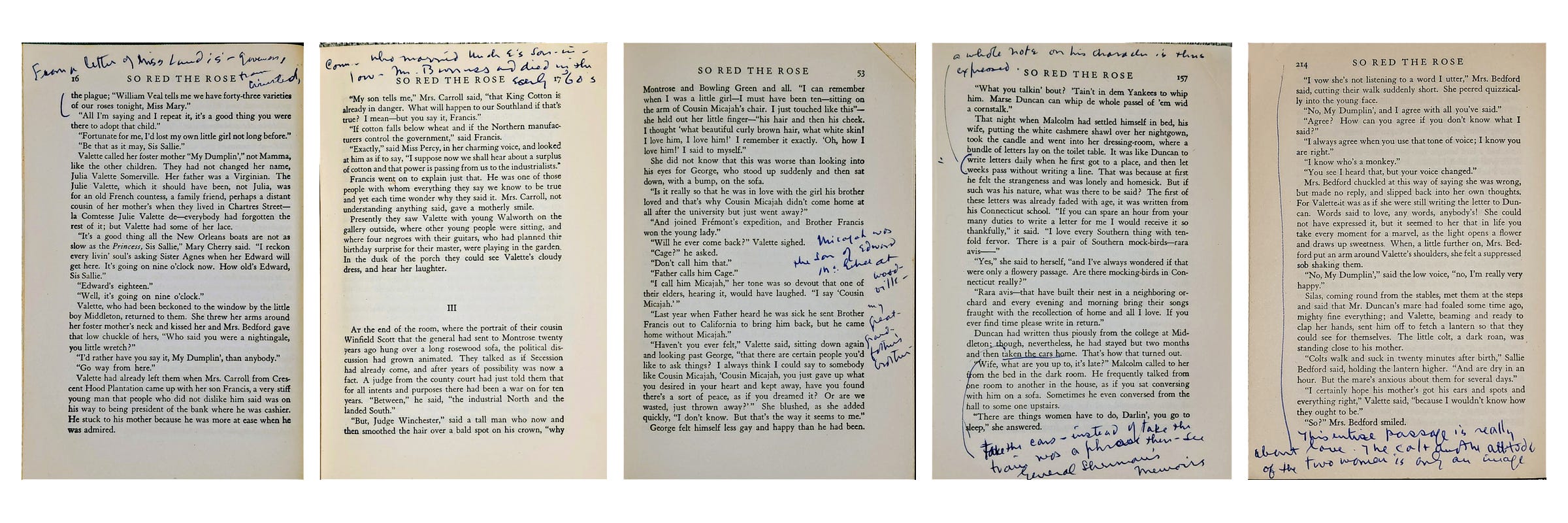
I have conceived a plan to send you a copy of So Red the Rose with transcriptions from my original copy, as to various people, incidents, technical intentions, writing these matters in the margins as I have done in that copy of my own. To save you trouble this would be excellent.
Davidson answered a week after the inscription, before the book had reached him, and said he looked forward to receiving it. The book reached Davidson. Some mixture of Providence and the invisible hand carried it the rest of the way to my shelf.
The two men had corresponded since 1929 but never met. “I never saw him,” Young told Ellen Glasgow in 1936, “but he has often been very kind.” On August 4, 1952, with the introduction ahead of him, Davidson wrote to Young, “I don’t know how it has happened that in all these years I’ve never actually met you, though I feel that I know you.”
Young’s side of their correspondence was published by John Pilkington in 1975. Davidson’s letters about the introduction, to Young and to his Scribner’s editor, Tom Walsh, I transcribed from his papers at Vanderbilt. Some appear here for the first time.
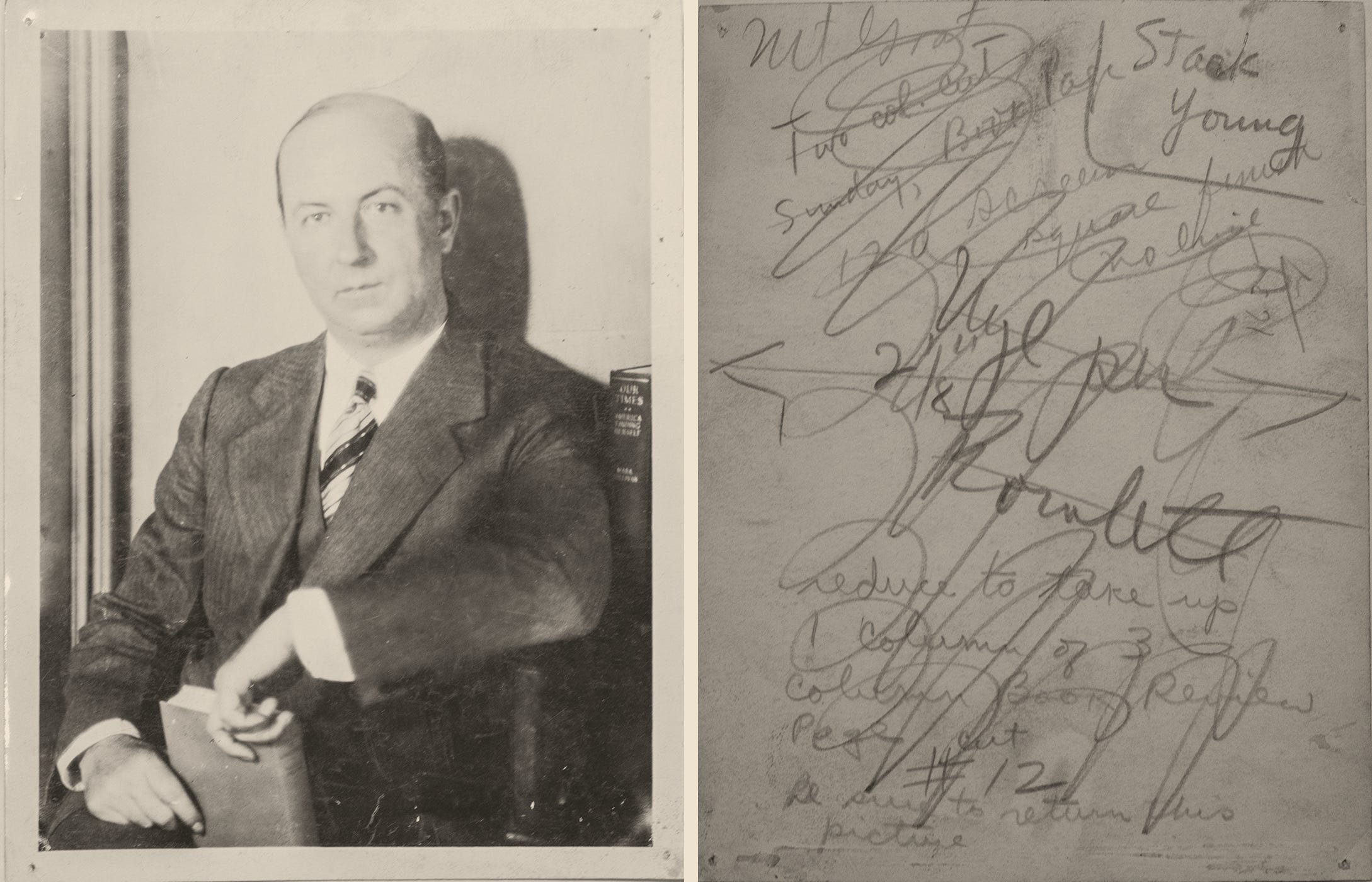
Stark Young was born on October 11, 1881, in Como, a railroad town in Panola County, Mississippi, about forty miles south of Memphis. His McGehee ancestors were among the first planters of the Como country, and in the 1850s his great-grandfather Hugh McGehee and his partners built the railroad that ran south from Memphis through the town. Young kept a Confederate bank note engraved with Hugh McGehee standing beside the locomotive that bore his name. Hugh’s brother Edward had settled at Woodville, in the southwest corner of the state, and fathered eighteen children. “Stark Young made no distinction among the levels of the cousin relations,” Pilkington wrote; “he thought of them all as ‘cousins.’”
His father, Alfred Alexander Young, ran away from home at fourteen to join the Confederate army, was fetched back by his own father, and enlisted more than a year later as a private in the Third Mississippi Cavalry. His regiment rode in support of Forrest. At the surrender he walked home from Alabama. He studied medicine afterward and practiced at Como.
Mary Clark Starks, Young’s mother, died of pneumonia in April 1890, when her son was eight. From 1890 to 1895 he lived a few doors down in the house of his great-uncle, another Hugh McGehee, the railroad builder’s son. Uncle Hugh let the family’s dwindling property look after itself and talked to the boy about the family, the living and the dead together. In So Red the Rose, the Hugh McGehee who is master of Montrose and head of one of its two families says, “It’s something to know that you were loved before you were born.”
The Mississippi of his boyhood, Young wrote in his memoir, The Pavilion, “was a country peopled with ghosts, warm, close, and human; the dead were often as present as the living.” In his introduction Davidson would quote the passage in which Young credits that talk with his education:
The things that I heard and saw, and that my elders had seen and talked about, gave me whatever education I may have acquired and whatever understanding of life and art. ... I used to dwell upon them, used to see and listen, and even now I can almost feel my soul rising and leaving my body to attend them. They had the character of fable and some essence was within them like flame.
He entered the University of Mississippi at fifteen and took a master’s degree at Columbia in 1902. He taught at Mississippi, then at the University of Texas, where he founded the Curtain Club and the Texas Review, then at Amherst, which he left in 1921 for New York. From 1922 to 1947 he wrote on the theatre for the New Republic, with a year out as drama critic of the New York Times. William Faulkner came to New York in the fall of 1921 at Young’s invitation, slept in Young’s apartment, and clerked in a bookstore Young found for him. In letters to his mother Faulkner called him “Mr. Stark.” At Young’s memorial, Pilkington wrote, the speakers agreed on his excellence as a drama critic, “probably the greatest of the century.” He came late to the novel; Heaven Trees appeared in 1926.
Early in 1929 Donald Davidson wrote to Young about the symposium that he, Allen Tate, John Crowe Ransom, and John Donald Wade were trying to assemble. The answer came in May on New Republic stationery: “I am by no means indifferent to your suggestion. ... To my way of thinking everything in your letter seems convincing.” Young had a novel due in September, “a modern Southern novel called ‘River House,’” and offered to send it.
Davidson reviewed River House for the Nashville Tennessean that October. Edwin Mims had begged to review it, Young heard, but Davidson kept the book for himself. Young copied Davidson’s covering note into a letter to Leonidas Payne, his old colleague at Texas:
You’re the only Southern writer who sees Southern life as a whole—because, (thank God!) you know the people, things and ways that count in the major part of Southern life.
The review’s first sentence went into a Scribner’s advertisement in the New York Times: “Of the many people writing novels about the South, Stark Young is, so far as I know, the only one who sees the Southern way of life as a whole and communicates it with the grace and conviction that it deserves.” Calling it “a swell review, enormously convincing because of the whole array of it,” Young asked Davidson to choose the sentence the advertisement should carry. On April 23, 1930, writing in pencil because “in this spring air sitting at a desk seems to me cramping,” he told Davidson that “what your article said and your letters said, gave me for the first time a genuine reality in connection with the South.” The same letter says the symposium’s statement of principles gave him “a sense of place in the world and of less loneliness in my own country, to recognize some sort of fellowship thus of the holy ghost—(is it in capitals?).”
Back in the summer of 1929, Tate had been less sure of Young. Answering Davidson from France with a tentative list of contributors and subjects, he paired “The Southern Way of Life” with “Perhaps Stark Young, if he can be prevented from including anecdotes of his grandmother.” Davidson made the case to Tate on October 26:
As for Stark Young, I think it would be extremely wise to have such a man as he is, if we can be sure he understands the full import of the affair and does not treat it simply as a literary or sentimental excursion. These points are in his favor: he knows the tone of Southern life at its best and writes extremely well; he comes from Mississippi originally, but has wandered widely enough not to be accused of narrow parochialism; we need at least one such eminent Southern writer, outside of our own circle, to strengthen our array, and he would put us in no danger, I think of being swallowed up by New York.
By December Tate had made up his mind: “He is an intelligent and highly cultivated fellow, and we mustn’t lose him.” The following February Ransom wanted “the beautiful English of his contribution.” Of the twelve, Pilkington noted, Young was the only one who then had a national reputation.
Young gave Davidson his terms on June 4, 1930: “To this collection, if you head and direct the enterprise, I will contribute with pleasure and feel myself honored and repaid.” Later in the letter came the condition: “At any rate I could do something for the book, provided always your hand is on its steering wheel—otherwise it will get into sheer wind or adolescent radicalism or something.”
“Not in Memoriam, But in Defense,” Young’s essay, closed I’ll Take My Stand. It opens:
If anything is clear, it is that we can never go back, and neither this essay nor any intelligent person that I know in the South desires a literal restoration of the old Southern life, even if that were possible; dead days are gone, and if by some chance they should return, we should find them intolerable. But out of any epoch in civilization there may arise things worthwhile, that are the flowers of it. To abandon these, when another epoch arrives, is only stupid, so long as there is still in them the breath and flux of life.
The essay ends on two lines of Spenser’s from the Mutability Cantos:
They are not changéd from their first estate;
But by their change their being do dilate.
Pilkington called the essay “a position paper for So Red the Rose, which he began to write shortly after the agrarian manifesto was published.”
On February 10, 1933, Young described his current project to Leonidas Payne:
The book is laid in Natchez from 1860 to the autumn of 1865, no scenes in other places but echoes from places here and there during the war. Sherman, Grant and Jefferson Davis are in it and what I can’t tell you about the history of the day is not worth telling! the letters and books I have read! I am making it a comment on civilization and living questions and the life of the affections and social standards, not a historical affair, but I need exact authenticity too. Pray for it. I want it to be a large, rich and beautiful canvas.
Maxwell Perkins, Young’s editor at Scribner’s, had already told his friend Elizabeth Lemmon that Young was “writing what we hope will be a great novel on the South, a regular War & Peace.” In August 1933 Young came through Nashville, and Tate drove over to see him between trains. “He is finishing up his new novel,” Tate reported to Andrew Lytle and Ransom, “and I think it will be a great piece of work.”
In 1952 Young told Davidson why he had chosen Natchez. John Chamberlain, who had reviewed River House for the New York Times, had said the real South was in Thomas Wolfe:
Natchez was chosen for this reason: people like John Chamberlain, whose head has so many holes that his hair is practically an air plant, would say, AS HE DID SAY, this is not the real South, the real South is in such writers as Tom Wolfe. ... I chose Natchez, I said, only because the houses are still standing and people like you, John, do perhaps recognize photographs.
The title took longer:
I struggled through about ninety items for a title, and finally one day I took up FitzGerald’s Rubaiyat saying to myself I will this day find a title here or die. I struck the two quatrains used in the book, on an opening page, and they seem to give a very happy suggestion of what the book is about. You might quote them: “I sometimes think that never blows so red” etc. that blood-stained soil, that flowering of the heart and pride and soul.
The first quatrain stands on the novel’s opening page:
I sometimes think that never blows so red
The rose as where some buried Cæsar bled;
That every hyacinth the garden wears
Dropt in her lap from some once lovely head.
By May 1934 the manuscript was done, and Young wrote Payne: “I myself am very much pleased with it and know that it is entirely out of the class with anything I have ever written. ... I feel that the writing of it was almost taken out of my hands.” Tate read the manuscript and called it “a marvelous piece of work ... the finest the South has ever had. ... This is the first time the Old South has been really alive since it fell.” Young also sent Payne the pages about himself from Davidson’s chapter “The Trend of Literature,” in the new collection Culture in the South: “Donald Davidson wrote the section and I got the highest praise of all the novelists who have ever written in the South.”
So Red the Rose came out in the last week of July 1934. George Garrett, introducing a 1992 reissue, wrote that it rose to second place on the fiction lists behind Anthony Adverse and “went through twenty printings in the year that followed.” By October 1 it had sold almost 35,000 copies, Perkins told Hemingway. Young wrote his editor, “I could never have written it if you had not stood by me.” Tate passed the news to Lytle: “You know So Red the Rose is a best seller, the first he has had, and I am delighted.” Davidson included it in “The 43 Best Southern Novels for Readers and Collectors” for Publishers Weekly in April 1935.
Ellen Glasgow called it “the best and most completely realized novel of the Deep South in the Civil War that has yet been written.” In the New York Times J. Donald Adams wrote that Young had “written a novel which no American who wishes to know his country’s past—its best as well as its worst—can afford to let go unread.” William Lyon Phelps proposed a test:
if one will read aloud three or four pages of conversation, one will perceive immediately the naturalness of the talk; and yet, though the subjects of these conversations are often trivial and sometimes merely playful, every now and then will come a remark that clutches one’s heart.
John Donald Wade reviewed the novel in the Virginia Quarterly Review. So many uncles, aunts, and cousins move through it, he admitted, that a reader can lose his place, “but the actual circumstances were hardly less confusing than the novel—one would swear the book faithful—and the reward for the pains of disentangling the various kin one from another is very ample.”
In August 1934 George S. Eddy gave a first edition to Philemon Tecumseh Sherman, General William Tecumseh Sherman’s son, and inscribed it “To Cump from George.” Here’s the listing if you want to buy it.
From the week the book came out, Young had hoped Hollywood would take an interest. Paramount paid $15,000 for the film rights. King Vidor directed, Laurence Stallings and Maxwell Anderson worked on the screenplay, and Margaret Sullavan and Randolph Scott played Valette and Duncan. The picture opened in November 1935 with premieres in the capitals of the old Confederacy. At a New York preview, Newsweek reported, Young “astonished Paramount executives. He liked the way Paramount had handled his story; he raised none of the usual outcry of book mutilation.”
Margaret Mitchell, in Atlanta, had kept away from the novel. “I did not read ‘So Red the Rose’ when it came out,” she wrote Young on September 1, 1936. Afraid it would discourage her from finishing Gone with the Wind, she had put it off, and when she did read it, its apparent ease impressed her. Young wrote back that it had been hard work. On September 29 she told him what a comfort that was to a writer who had rewritten her own chapters ten or twelve times.
In April 1937 Mitchell took George Cukor and his technical staff over the red rutted roads of Clayton County to see the old houses built before Sherman came. “While they were polite, I am sure they were dreadfully disappointed,” she wrote Herschel Brickell on April 8, “for they had been expecting architecture such as appeared in the screen version of ‘So Red the Rose.’ ... I besought them to please leave Tara ugly, sprawling, columnless, and they agreed.” Tara got its white columns anyway. Garrett asked in 1992: “Would the New York editor, Harold Latham, have bothered with Margaret Mitchell’s huge and confused mass of typescript if So Red the Rose had not already made publishing history?”
Young wrote no more novels. He translated several works, and in his sixties he took up painting. Perkins saw the first canvases and wrote Hemingway in 1943 that they were “as if a poet had made a picture instead of a poem,” and the director of the Art Institute of Chicago bought a large canvas for its permanent collection.
After leaving the New Republic in 1947, Young went home to Mississippi in 1949 to give the principal address at the Southern Literary Festival in Oxford. Afterward he wrote a Memphis correspondent: “To see in my own people the splendid qualities and to feel a surge of love for them in my heart is a blessed experience.” Two years later came The Pavilion, dedicated to Allen Tate, its title taken from the Thirty-first Psalm: “Thou shalt keep them secretly in a pavilion from the strife of tongues.” After its reception, in Pilkington’s words, Charles Scribner and John Hall Wheelock “decided to issue a new edition of So Red the Rose and invited Donald Davidson to write a lengthy introduction to it.”
Davidson first wrote Young about the introduction on January 9, 1952. He wrote again on June 3, hoping to begin the work that summer at Bread Loaf, and asked how the novel “fits or ‘belongs’ in the general pattern of your fiction.” Young answered on the Fourth of July from the garden at Jennymead:
I will answer your points as best I can. I do think, however, that the best plan would be a talk if possible or else you send me your preliminary draft and I will make what suggestions I think might be of use to you. If you have your car with you, you and Mrs. Davidson might run down and spend the night with us here.
First. I feel indeed that SO RED THE ROSE belongs in the “general pattern of my fiction.” It sums it all up, and carries the Southern theme as far as I can carry it. That is why I never followed up—as would have been wise commercially, the success of SO RED THE ROSE. The Mississippi end of all this is partially incidental. I am not really thinking of Mississippi but of the whole Southern cultural idea.
Davidson replied on August 4:
I am truly very anxious to see you and talk ... I don’t believe I’m quite ready to draw up any set of questions, such as you mention, although I certainly do need help in getting straight the complex family connections that appear in your books—the pleasant family “confusion” to which you refer in Heaven Trees. I realize that it’s all “put down” in The Pavilion, the novels, stories, and so on—but Lordy, I may have to make a chart for my own guidance, before I’m through, for safety as to detail. What I want above all is to know you personally and through knowing you to get a better focus for the main thing—which is to use the introduction to So Red the Rose as a means of drawing not only that book, but the organic continuum of your whole work into the clearest and richest perspective I can manage within that, alas, limited space. It won’t be all you deserve, but it will be something—something which I hope to make firm.
Davidson’s birthday was August 18. His diary entry for that day, as his biographer Mark Royden Winchell quotes it, begins: “A difficult and almost desperate summer, all hard work and frustration. The sole accomplishment, finishing MS for 3rd edition of [American Composition and Rhetoric]. Some preparation for the Stark Young piece.”
On September 2, writing from Ripton, Davidson called off the visit with Young. The textbook had run to about 950 manuscript pages and “left me in a state of collapse.” “One may have the mental energy and hopes of age 40,” he wrote, “but has to get along with the physical apparatus of age 59-going-on-60.” In the same letter:
Of one thing you can be certain that I will put the best there is in me into writing that introduction. There is no other “Civil War” novel that even approaches So Red the Rose; it is sui generis, absolutely unique, and remarkable as a novel, entirely aside from any reference to the War, because it presents some very remarkable people with faithful, loving—and also sufficiently grim—insight.
He had been reading Richard Weaver’s “Aspects of the Southern Philosophy” in the Hopkins Review. Weaver argued there that for the Southerner “analysis is destructive of the kind of reality which he most wishes to preserve,” and Davidson heard the same idea from the novel’s Hugh McGehee: “When you begin to explain things that you’ve always taken for granted, you’ve already begun to lose them.” He went on:
You might be surprised at how many young people throughout the country are thinking this way. It is a very, very good time to re-issue So Red the Rose, and for me to try not only to “introduce” it but to use it as something of a focus for your wisdom and your art, aere perennius.
Young’s answer, dated September 9, 1952, runs longer than any other letter in the exchange. It opens:
Your letter was very welcome and very much absorbed by my dull heart and mind. For some time I have felt that I was not any too necessary in this hasty world today and that there was small need for me to write anything else. Your generous remarks are at least some indication that I might amount to something however small in the day’s productions.
Before he answered, he had talked Davidson’s letter over with Walsh, “that sympathetic and stimulating friend of yours and mine,” and he asked Davidson to quote his own sui generis sentence in the introduction.
Robert Penn Warren’s introduction to Scribner’s A Farewell to Arms had shown him what to avoid. For So Red the Rose, he wrote, “no such detail of biography or general criticism would be right.” And: “I get the impression that you won’t boggle up what you feel and think, in such a way that theories are in the air and never get out of it, and clichés unconsciously pop up, supported by a lot of silly slants that have become the bosh and business of criticism.”
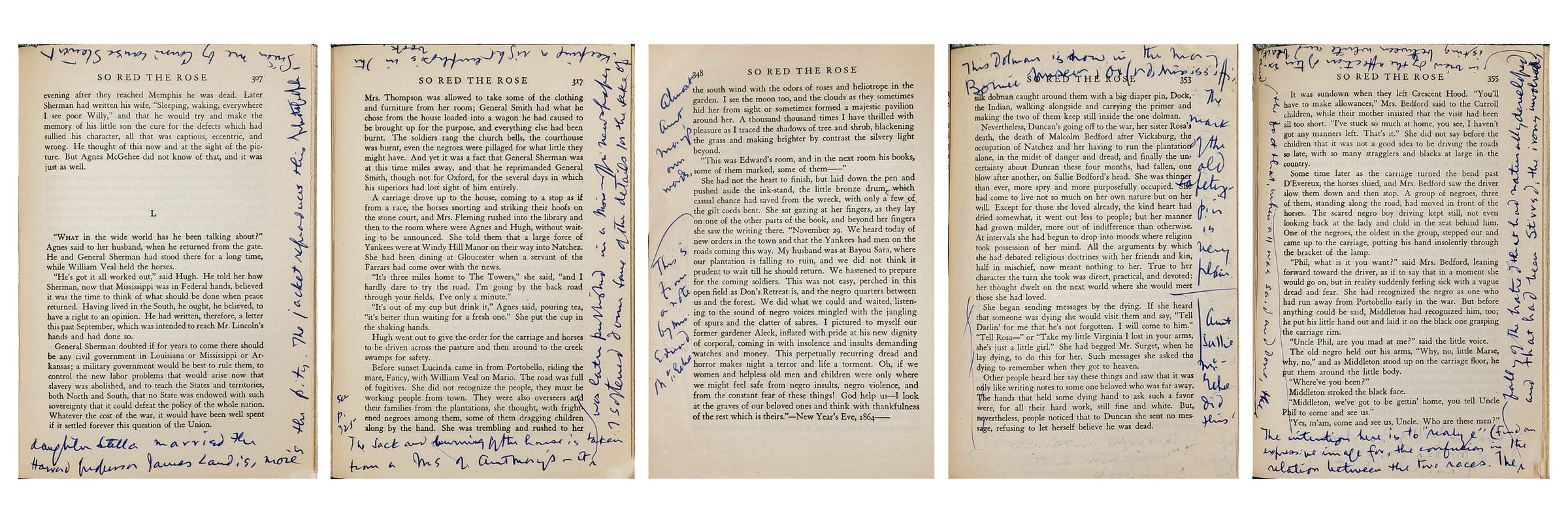
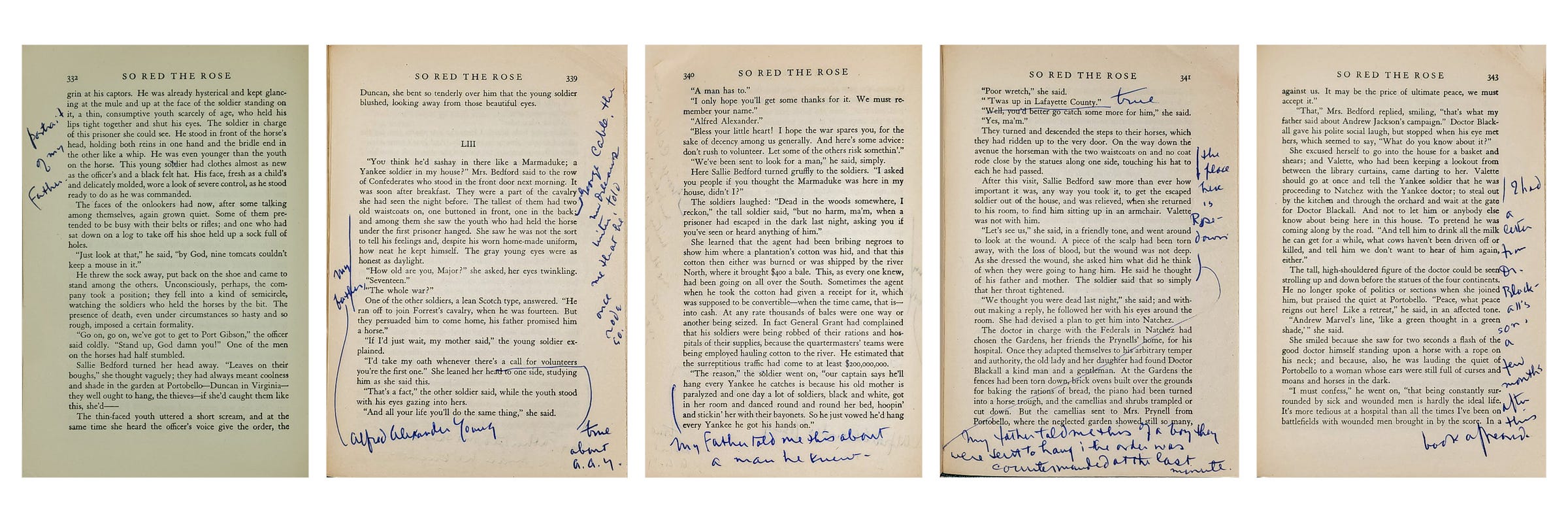
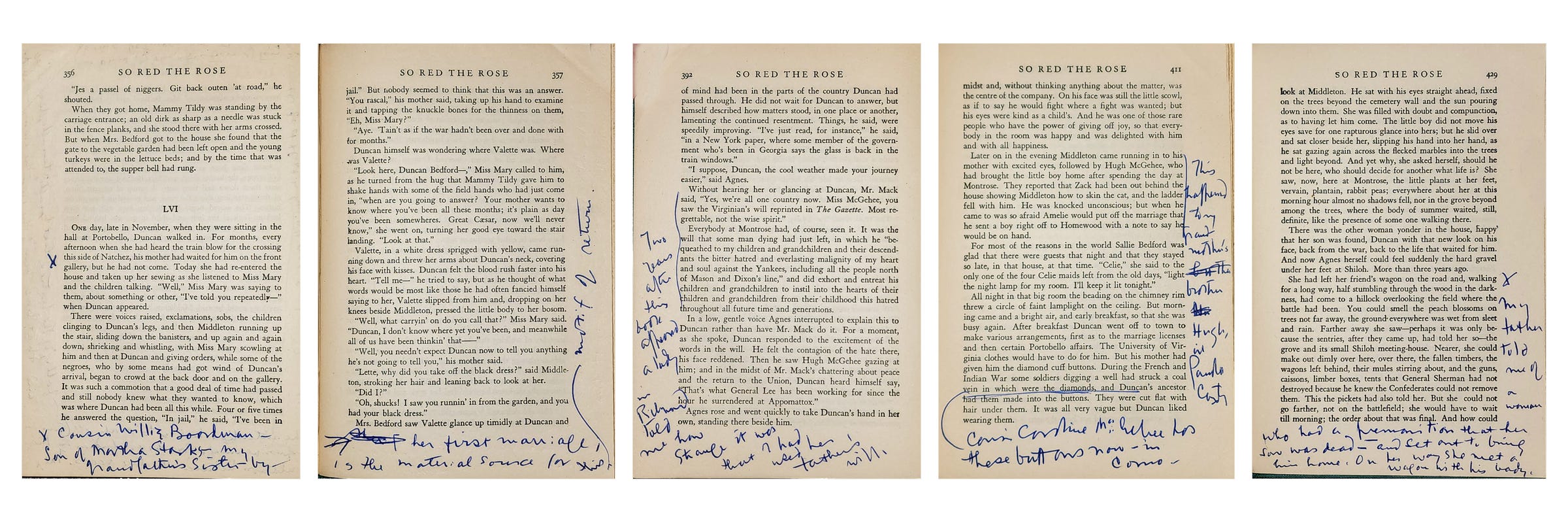
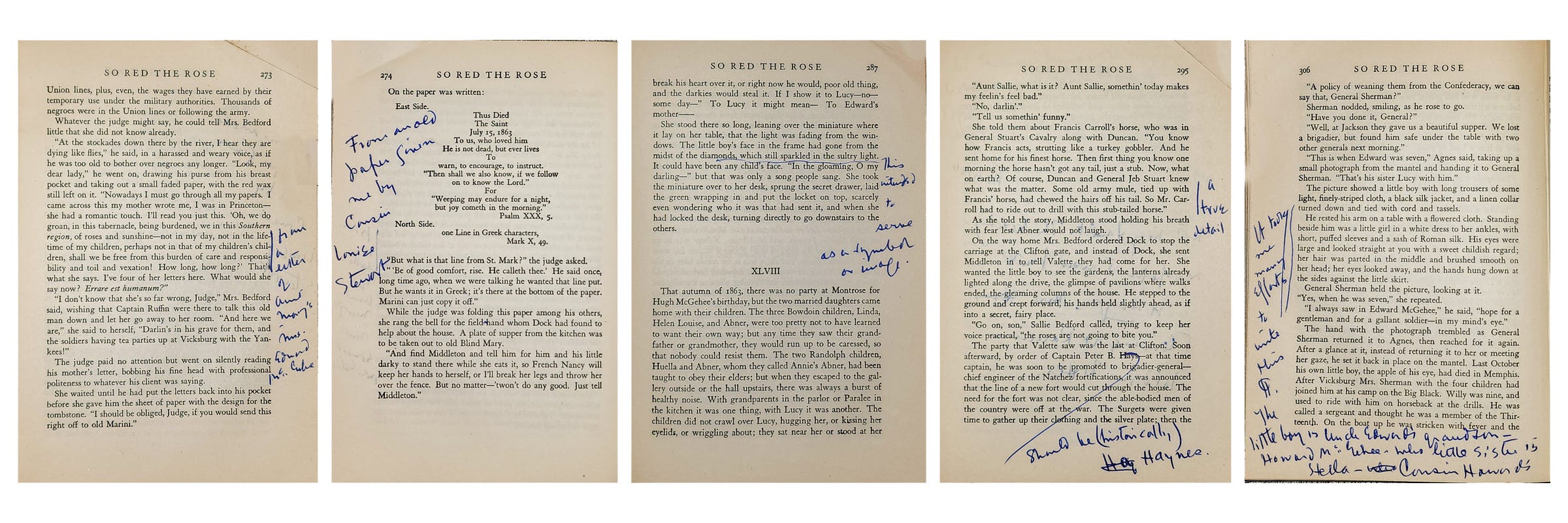
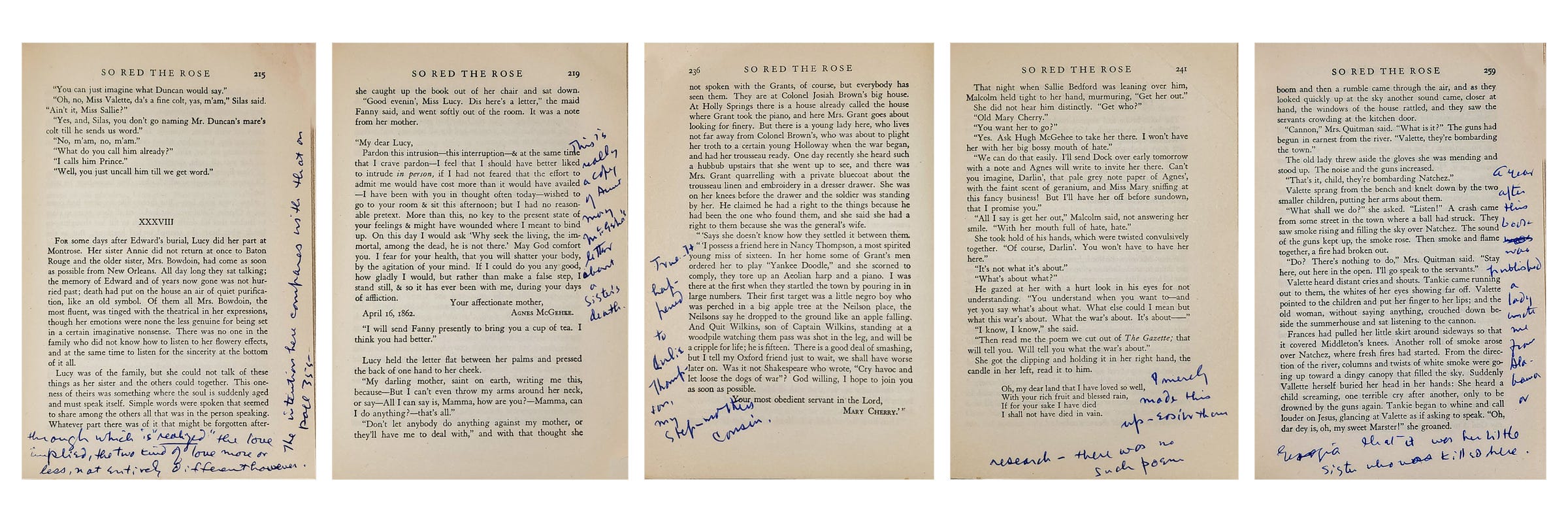
Young wrote Davidson that “almost all the characters in the novel are composites, very much so, made up of details from various actual persons or else created entire,” and that “the events in the book are either invented or are transcripts of things that actually happened, not merely history or tales or portraits, as some have thought.” Pilkington lists some of the sources: family records, journals, letters, garden books. Young had wanted them “well hidden within the book.” In the copy he sent Davidson, his annotations bring them into the light. On page 332, by the light of a pine knot, Confederate cavalry stand three Federal prisoners up in their saddles under a post oak. A soldier “even younger than the youth on the horse” holds the reins of the first man to be hanged. His face is “fresh as a child’s and delicately molded.” He waits for the order. Beside the scene Young wrote: “Portrait of my father.” Seven pages on comes a rider who “had two old waistcoats on, one buttoned in front, one in the back.” In the margin: “George Cable, the New Orleans writer, told me that he once rode so.”
Then he took up the dialogue:
The rhythm of the Southern speech cost me a lot of work. The tone of that is very elusive; I had to write it by ear, saying the things as soon as they came to me, not waiting and fooling with them. After that I did a lot of cutting or moving the position of words. Take lines 10-11-12-13 on page 199. I wanted them to break one’s heart. Or the end of Chapter XLI pages 202-203—note the Southern tone of the lines and speeches, that final sentence and its rhythm.
Young repeated the test Phelps had proposed in 1934, “the reading of it aloud is something. The effect is quite noticeable,” and answered the charge of melancholy:
But this book of mine is safe from depression first by warmth of the heart, which is all through its pages and especially in the tenderness of its concluding pages. ... The lasting optimism of So Red the Rose in so far as optimism is required is that life rests in the individual heart and soul, along with an inclusion with the social general in which this soul and heart exists and finds its human expression.
The letter closes:
Dear Donald, please remind yourself that all this is largely to be of use to you. Take what you want of it, let the rest go.
Davidson answered Young’s letter on September 29, from Ripton, before the book reached him and before he had begun writing the introduction:
I was greatly pleased to have your letter, with all the notes and pointers, and have read and re-read it several times, and checked the references to So Red the Rose in my copy. I found I had already marked a number of the passages you referred to, especially the short descriptive passage, that very fine one which comes to a focus in the phrase, “communion of saints.” But some of them I did not have marked. It will be a great help to me to have the copy of the novel from you with your notations, and I’ll look forward to receiving it.
He answered Young’s fear that he was “not any too necessary”:
Your reference, in the first paragraph of your letter, to your apprehension that your work might not be “any too necessary in this hasty world of today” represents, you must very well know, a malaise that can assail any of us, times and people being what they so obviously are. So much the worse for that world, I would say, if your feeling reflected the real state of things. But I am more inclined to think that we are on the edge of a considerable reversal of judgments and preferences that will be all to the advantage of your writings, past, present, and future, as well as to the advantage of what you believe in.
He was in a position, he wrote, to know what the rising generation accepted and what it rejected: “What they want is, in general, the very kind of assurance that you have to give them and that you do give them, one way or another, in all you write.”
Near the end Davidson wrote of his kin:
This letter has gone on to too great a length, but I must add that it has been a great experience to me to re-read all your published books. Although my personal history and background are different from yours, it was nevertheless to me an experience of being again with my own people in all their essential qualities and doings, and I could easily run off into a long chain of reminiscences that your books stirred up in me. My great-great-grandfather, Andrew Davidson, settled in Bedford Co., Tenn., shortly after 1800, coming from Virginia. My mother’s people settled near Chapel Hill, Tenn., and were friends of the Bedford Forrest family before that family moved to Mississippi. My grandmother on my mother’s side—Rebecca Patton Wells—lived with us for many years, and practically took charge of me when I was a little boy. From her I heard many terrible and also stirring tales of her experiences during the war—all she went through during the Federal occupation of Middle Tennessee.
Davidson’s father’s stories and his grandmother’s, he wrote, “would parallel many of yours.” He closed:
This long letter will serve, I hope, not only for the matter-of-fact items that needed to be mentioned between us, but as assurance of so much that I feel and cannot find time or opportunity to say; and as a kind of handclasp to wish you a most pleasant time abroad. ... Don’t bother to answer this. And good luck in everything.
That fall Young went abroad. Davidson’s letters went to him care of the American Express Company in Rome.
Davidson stayed in Vermont until November 9, through three snows, then drove south by way of New York and Baltimore to Marshallville, Georgia, where he spent the rest of his leave at John Donald Wade’s house correcting galleys of the textbook and writing the introduction. “We take one meal a day at a typical old-fashioned Southern boardinghouse at Fort Valley, 8 miles distant,” he wrote Walsh on December 14, “and do very light housekeeping for the rest.”
On December 20 he reported:
I have finished the Introduction to SO RED THE ROSE, and I hope to mail you the final typed and revised manuscript within two or three days. I think I have it about like I want it, but it was a really difficult job to get it stated just right. (Don’t tell Stark this!) I would want Stark Young to see it and check it for errors, etc. So if he has not returned from Europe I will try to send him a copy, air mail. Would it be best, in any case, to have an extra copy for him, so that he can mark it?
Back in Nashville after Christmas he came down with influenza, the worst illness he could remember in twenty years. He mailed the manuscript to Walsh on January 12, 1953: “It is exceedingly difficult to state a complex critical problem in any very pretty, easy way.” Two days later, just out of bed, he sent Young a carbon in Rome with a long letter. Students would hear of the edition only through their teachers, he explained: “So it is the teacher that the introduction must reach, or convert, first of all.” And teaching had changed:
Something like an educational revolution has occurred during the past two decades or more in the teaching of poetry and of prose fiction in American colleges. Our old friends—the Tates, Warren, Ransom, etc.—and also such younger lights as Richard Weaver of the U. of Chicago have brought this about, and maybe I have had a little share in it too. At any rate the average college student—frequently even at the freshman level—is used to a kind of stiff critical analysis that was unknown in our colleges (except at Vanderbilt, where it started!) a quarter of a century ago. ... They expect a critic to dig right into the metaphysical and technical problems if there are any to dig into. If he avoids the issue, they quickly find him out and toss him aside. By and large, they are a fairly grim lot of young folks, these days.
For that audience he had left out the praise Young had gathered from Mitchell and Glasgow, which “wouldn’t carry the slightest weight either among teachers or students of the present generation”:
I had to try to say just what, essentially, So Red the Rose is about, and why you used the methods you did use in presenting your subject. This was not easy—at least it was not easy to state—since So Red the Rose is truly so much more complex, so much more tightly and artfully wrought than at a first reading it appears to be.
The reading might surprise Young, he warned: “But what an author ‘intends’ in his deliberate act of composition is, I suspect, generally not always in exact correspondence with what actually comes out, in the end. Or, to put it another way, the mark of a really great book is that it ‘means’ more than was first ‘intended.’” Later in the letter:
I do not flatter myself that I have done more than make a meagre beginning toward the critical interpretation that your work should and I believe will receive, in increasing measure; but I do hope that my beginning, small though it is, takes hold at the right points and may prove helpful to readers and perhaps also provocative to critics more skillful than I claim to be.
He added news from Marshallville. “At [John Donald Wade’s] home for the past 20 years, off and on, I have known people so like your Heaven Trees folks that they might as well have been in your book. And John Wade is a kind of Hugh McGehee.” Wade was laying out a “Great Garden” of ten or fifteen acres behind his house, and “Under his touch, that whole little town has got itself planted with inconceivably beautiful varieties of camellias.”
Walsh read the manuscript and wrote that it seemed “contentious” in places. On January 21 Davidson answered:
I feel rather disturbed by your comment that the Stark Young piece seems “contentious” in places, and I would like to ask you to be as specific as possible about your objections in this regard. Since I don’t know just what you refer to, I don’t know exactly what to think or say. I feel the more upset because I practically got a charley horse from leaning over backward in my effort to write the most non-partisan criticism of which I am capable. I hope you will recognize that it is not possible to write an honest critical analysis and ignore the harsh issues that arise in connection with the subject matter of So Red the Rose and other works of Stark Young. After all, Sherman did exist, the Civil War was fought, the Reconstruction did take place, and we still daily feel the effects of all that, not merely in the South but everywhere.
In the same letter he recalled T. S. Stribling, the introduction’s example of the Southern writer of the 1920s who “wrote to please the Menckens, V. W. Brookses, and [Henry Seidel] Canbys of the day.” Stribling, Davidson said, had sat in the Davidsons’ apartment at Wesley Hall and told him he wrote the South down because that was what sold. “Stark Young, on the contrary, with marvelous integrity and courage, took a course opposite to Stribling (and to others of the Stribling type). From beginning to end, he never wavered, he never pulled any punches.” Davidson was “anxious to have the introduction appear in a form that will please Stark and Scribner’s and you,” and he said what it had cost him: “I have sweated blood over the piece, worked harder on it than almost anything of the sort I ever tried to do.” Of the inscribed and annotated copy on my shelf he wrote:
As I wrote you earlier, I am afraid (judging from Stark’s letters to me) that he has been visualizing some entirely different kind of introduction. He was apparently most concerned with the historical “authenticity” of his material, and marked a copy of the book to annotate some of his sources. He was also concerned that I should emphasize the “dramatic” technique—which of course I have done. ... A writer, no matter how great, will not necessarily realize all the aspects of the “meaning” of the work he has executed; the performance may exceed his “intention.”
Davidson’s introduction opens on the narrator of Young’s story “Cousin Micajah”:
“By the time I was seven,” says the narrator of Stark Young’s story, “Cousin Micajah,” “I felt myself one of a large clan who loved me. Growing up poor—we had all land and no money—I should have been surprised to hear anything but that we are born and die in some beloved air, and that the life of the affections is what we mean by life.”
So Red the Rose, Davidson went on, was no more “a mere ‘Civil War novel’ than the Antigone of Sophocles is to be catalogued as a drama of the Theban Civil War”:
It is the tragedy of a people, closely bound by ties of kinship and common feeling, who refuse to dissociate “the life of the affections” from “what we mean by life,” in desperate conflict with other people who insist that such a dissociation is not only proper but necessary to human progress.
Toward the end of the introduction he wrote:
But with every year that passes So Red the Rose renews its claim upon us, for it has in it the almost infinite capacity of new revelation that belongs only to master works. ... For it is perfectly clear that if Faulkner and Warren and various others are entitled to be placed in the highest rank of literary distinction, so, too, is Stark Young.
Young came back to Rome from Morocco late in January and found the carbon waiting. He answered on January 31:
I have most carefully read the introduction, a great deal of it amounts to brilliance, I think, (I rarely use that word) and some of it is very beautiful in feeling and very moving. ... I do thank you, Donald, I don’t know anybody who could have done this difficult task better or rather as well. ... Excuse this seemingly flattering letter. I do very profoundly appreciate your real interest in your subject.
On February 4 he sent the manuscript back with his notes on the sheets:
I wrote you how much I was made happy by your Introduction and promised to send any suggestions I could conjure up. I have put about two days’ work on it—for it seemed to me that if you could do all that work you did, I at least might do what I could. ... To me, for example, and the average reader—not specialist—the Sherman passages could be shortened in the light of the article’s general emphases. ... But one thing, please feel entirely free to accept or dismiss any or all my suggestions—I’m merely trying to be useful. There is nothing in your whole article that per se I don’t find of marked interest, often wonderfully penetrative, and often in itself creative. I’d like to keep the MS. if you’ll let me.
“I sail March 9th on the Doria,” he told Davidson. That March he wrote once more, from his apartment on East 57th Street:
I spent some hours studying the introduction only to find it more and more worth the trouble all around, to find it richer and richer in content, statement and implication. My book is indeed fortunate, and I am very very appreciative. These things are hard to say, but my heart is in the right place, and you will understand.
He enclosed one long sentence from the manuscript, on the burning of Montrose, that he found “rich in significant meaning but not easy to follow in the reading,” and in print Davidson divided it in two. And he sent a book:
I am mailing you a little Renaissance volume I picked up at a Rome dealers. It will at least serve to remind you of my grateful thoughts, dear Donald.
The Modern Standard Authors edition came out later in 1953 at $1.75. In the Saturday Review for October 10, Ben Ray Redman headed his notice “A Neglected Classic,” quoted Davidson’s “excellent introduction,” and wrote:
It has scope and depth, beauty and power, wisdom and humor. It is tragic without bitterness; indeed, in true tragedy there is no place for bitterness. It is rich in sentiments that never sink into sentimentality. It is alive with love, in all its manifestations.
Young sent the new edition to Paul Green, who thanked him in September for “your wonderful token of thoughtfulness—the new edition of So Red the Rose,” and promised, “I will read your fluent words and experience your colorful images again on this a second reading of the story.”
Davidson reworked part of the introduction as “Theme and Method in So Red the Rose” for Louis Rubin’s symposium, which became the book Southern Renascence. It calls Young’s fiction “an unexplored realm, to which hardly even a reportorial Marco Polo has journeyed,” and sums up the novel’s history in one sentence: “In this instance the judgment of readers has run ahead of the judgment of critics.” When Scribner’s permissions department asked Rubin to pay $50 for the reprinted portion, a quarter of the $200 Davidson had been paid for the whole, Davidson objected to Walsh. He had written the introduction, he said, “principally as a matter of good will toward Stark Young and you,” and “largely as a matter of devotion!”
Walter Sullivan, in “Southern Novelists and the Civil War,” found the center of the novel in four words: “The family is the image.” Randall Stewart called Davidson the novel’s best interpreter. Garrett, introducing the 1992 reissue, wrote that the book’s “considerable literary and artistic virtues, splendidly delineated by Donald Davidson in his ‘Introduction’ ... are solid and significant,” and he quoted Young’s September 9 letter on images and “a body for the soul of his matter.”
A stroke in 1959 weakened Young. He died on January 6, 1963. Young’s people bury in Friendship Cemetery in Como, Mississippi. You will find Mr. Young between his aunts Frances and Sarah Starks and near his mother and father. At the memorial in the Morosco Theatre that February, John Hall Wheelock, his editor at Scribner’s, read from the novel.
On page 348 of my copy, beside Agnes McGehee’s journal, Young wrote “Almost Aunt Mary’s own words.” Agnes’s New Year’s Eve entry breaks off at her dead son’s room: “This was Edward’s room, and in the next room his books, some of them marked, some of them——.” She “had not the heart to finish.” On page 349 the chapter ends:
She closed the book, already praying, her eyes fixed on the last embers of the fire, her whole body quiet with some strong force that made life dear to her—and believed that God saw in every heart its own sorrows.
In blue ink, Young wrote:
How strange it is, a voice coming through the years like this.
A Note on Sources
The annotated copy. So Red the Rose (Charles Scribner’s Sons, 1951 printing), inscribed by Stark Young to Donald Davidson, September 22, 1952, in the author’s collection. Quotations from the margins follow my transcription, checked against photographs of the pages. Page numbers and quotations from the novel follow the 1951 printing; a later Scribner printing with the same pagination alters some passages. See downloadable PDF below.
Davidson’s letters. Davidson to Young: August 4, September 2, and September 29, 1952; January 14, 1953. Davidson to Tom Walsh: December 14 and 20, 1952; January 12, January 21, and August 29, 1953. Box 2, Correspondence, Outgoing, Donald Davidson Papers, Special Collections and University Archives, Vanderbilt University. My transcriptions. Davidson’s letters of January 9 and June 3, 1952, are known from Pilkington’s notes.
Young’s letters. John Pilkington, ed., Stark Young: A Life in the Arts, Letters, 1900–1962, 2 vols. (Louisiana State University Press, 1975). To Davidson: May 7, 1929 (letter 201); October 15 and 16, 1929 (211, 212); March 26, 1930 (217); April 23, 1930 (221); June 4, 18, and 25, 1930 (226, 228, 229); July 1, 1930 (230, 231); July 16, 25, and 30, 1930 (232, 233, 235); July 19, 1931 (251); July 4, 1952; September 9, 1952 (791, vol. 2, p. 1213); January 31, February 4, and March 1953. To Leonidas Payne: October 3, 1929 (208); February 10, 1933 (vol. 1, p. 449); May 13, 1934 (352). To Ellen Glasgow: March 10, 1936 (451). Letters between Young and Maxwell Perkins from Dictionary of Literary Biography, The House of Scribner, 1905–1930; Perkins to Elizabeth Lemmon from As Ever Yours; Perkins to Hemingway, October 1, 1934, for the sales figure; Tate’s letters to Lytle and Ransom from the Lytle–Tate correspondence; Tate’s 1929 letters to Davidson and Ransom’s of February 22, 1930, as quoted by James H. Justus, “Enduring Modernism: Stark Young and the Nashville Agrarians,” and by Rock; Young to Hudson Strode, February 4, 1934, as quoted by Garrett; Perkins to Hemingway, June 11, 1943, from Dictionary of Literary Biography; Paul Green to Young, September 3, 1953, in A Southern Life: Letters of Paul Green, 1916–1981 (1994), 533.
Biography. John Pilkington, “Stark Young: The Southern Roots,” Southern Quarterly 24.4 (1986), for the family, the father’s service, and the 1949 letter; John Pilkington, Stark Young, Twayne’s United States Authors Series 463 (Twayne, 1985), for the bank note, Young’s sources, the burial at Friendship Cemetery, and the Morosco memorial, as well as for Young’s remarks on keeping his sources “well hidden,” and for Tate’s response to the manuscript; Pilkington’s introduction to the Letters; Mark Royden Winchell, Where No Flag Flies: Donald Davidson and the Southern Resistance (2000), for Davidson’s diary of August 18, 1952; Stark Young, The Pavilion (1951); Pilkington’s entry on Young in the Handbook of Texas and Rock’s profile of Young, for the Chekhov translations and the paintings; Garrett and M. Thomas Inge, Faulkner, Sut, and Other Southerners (1992), for Faulkner in New York; KPFA program listing for March 31, 1963, for the recording of the Morosco memorial and Wheelock’s reading.
The symposium and after. Stark Young, “Not in Memoriam, But in Defense,” I’ll Take My Stand (1930); Davidson to Tate, October 26, 1929, as quoted by Rock; Virginia J. Rock, The Making and Meaning of I’ll Take My Stand (dissertation, 1961); Donald Davidson, American Composition and Rhetoric, 3rd ed. (Charles Scribner’s Sons, 1953).
The novel’s reception. J. Donald Adams, New York Times Book Review, 1934; John Donald Wade, “Two Souths,” Virginia Quarterly Review 10.4 (October 1934); Ellen Glasgow and William Lyon Phelps as given in Book Review Digest; Raptis Rare Books listing of P. T. Sherman’s copy, with the Eddy inscription (captured January 1, 2025); Donald Davidson, “The 43 Best Southern Novels for Readers and Collectors,” Publishers Weekly 127 (April 27, 1935).
The film and Gone with the Wind. Garrett for the sale of the film rights; Young to Leah Salisbury, July 30, 1934 (Pilkington, letter 361); “‘So Red the Rose’: Stark Young’s Story Filmed as Stark Young Liked It,” Newsweek, November 30, 1935; Margaret Mitchell to Young, September 1 and 29, 1936, and to Herschel Brickell, April 8, 1937, in Richard Harwell, ed., Margaret Mitchell’s Gone With the Wind Letters, 1936–1949 (Macmillan, 1976), 59–60, 65–66, 137, with Harwell’s note on Tara’s columns; Gordon L. Jones, “So Red the Rose: The ‘Gone With the Wind’ That Never Was,” Atlanta History Center (2024), abridged from “So Red the Rose: Atlanta’s Gone with the Wind that Wasn’t,” Atlanta History 43.2 (Summer 1999), 45–67; Peter A. Soderbergh, “Hollywood and the South, 1930–1960,” Mississippi Quarterly 19.1 (Winter 1965–66), for the premieres.
The introduction and its reception. Donald Davidson, introduction to So Red the Rose, Modern Standard Authors (Charles Scribner’s Sons, 1953), and “Theme and Method in So Red the Rose,” in Southern Renascence (1953); Walter Sullivan, “Southern Novelists and the Civil War”; Randall Stewart, “Tidewater and Frontier,” Georgia Review 13.3 (Fall 1959); Ben Ray Redman, “A Neglected Classic,” Saturday Review, October 10, 1953; George Garrett, preface to So Red the Rose, Southern Classics Series (J. S. Sanders, 1992). See downloadable PDF below.
