


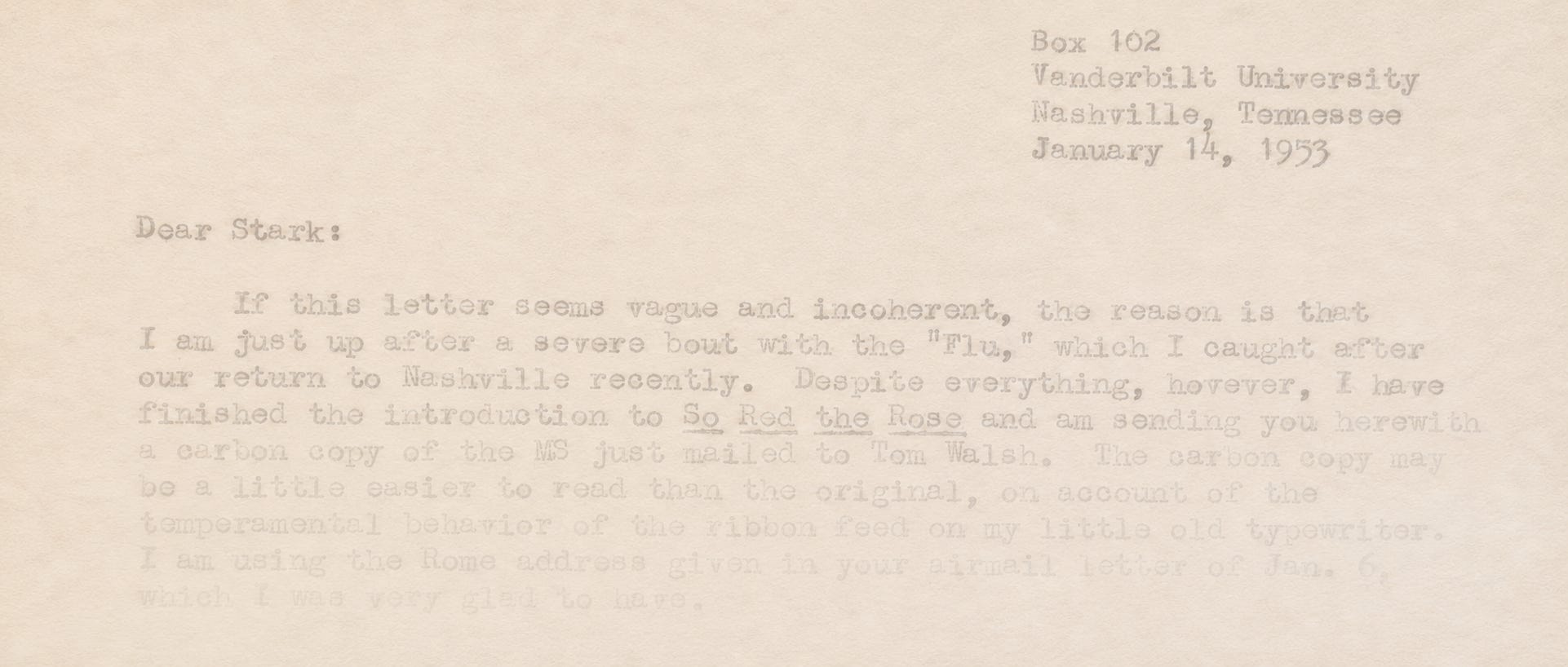
Vanderbilt University
Nashville, Tennessee
January 14, 1953
Dear Stark:
If this letter seems vague and incoherent, the reason is that I am just up after a severe bout with the “flu,” which I caught after our return to Nashville recently. Despite everything, however, I have finished the introduction to So Red the Rose and am sending you herewith a carbon copy of the MS just mailed to Tom Walsh. The carbon copy may be a little easier to read than the original, on account of the temperamental behavior of the ribbon feed on my little old typewriter. I am using the Rome address given in your airmail letter of Jan. 6, which I was very glad to have.
I feel sure that some parts of the introduction should be revised, or even rewritten. The opening pages—perhaps six or eight of them—and the last two or three are not as well written as I should like to have them, and there are probably weak passages elsewhere too. The difficulty, for me, in writing an introduction like this, is that it is so hard to find a clear and direct form of prose statement for matters that one ought to be able to “assume” but nevertheless has to “explain”, somehow or other, the state of the world being what it is. I was distressed, on my last re-reading of the MS, to discover here and there some very involved and academic-looking sentences and passages. Maybe I can improve all such when I come back to the task later.
One point I do feel it’s necessary to make in writing this letter to you. In your long and valuable letter to me, before you left, you spoke of the “educational” use of this edition—having in mind the students who would have access to it or might in some way be attracted to it. I share that concern with you. But I know from experience with textbooks and so on that it is next to impossible to reach students except through teachers.
Normally, the students will hardly know of the existence of such an edition as this unless some teacher mentions it, recommends it, or designates it for use; nor will many college bookstores stock it without such sponsorship. I feel sure that Tom will agree with my analysis of this situation. There are always a few free-ranging students, of course, but they are the minority. So it is the teacher that the introduction must reach, or convert, first of all. The sale of the book in the general trade is of course an entirely different matter. God knows what determines that—I certainly don’t.
Next, when the book does reach the student, by whatever means, it is important to understand that that student is hardly the kind of person that, I imagine, you were visualizing. Something like an educational revolution has occurred during the past two decades or more in the teaching of poetry and of prose fiction in American colleges.
Our old friends—the Tates, Warren, Ransom, etc.—and also such younger lights as Richard Weaver of the U. of Chicago have brought this about , and maybe I have had a little share in it too. At any rate the average college student—frequently even at the freshman level—is used to a kind of stiff critical analysis that was unknown in our colleges (except at Vanderbilt, where it started!) a quarter of a century ago. The emphasis has shifted, pretty much, from the lecture system, the historical-scholarly approach, etc., to something quite different.
The students who take up the new edition of So Red the Rose will very likely be persons who have been dosed with Faulkner, Warren, and so on and have gotten into modern criticism one way or another. They expect a critic to dig right into the metaphysical and technical problems if there are any to dig into. If he avoids the issue, they quickly find him out and toss him aside. By and large, they are a fairly grim lot of young folks, these days.
The educational revolution that I mentioned represents a field in which the so-called Agrarians have triumphed rather sweepingly. We lost on the political-economic front, but won very decidedly on the literary-intellectual front and, to the extent indicated, on the educational front. This is admitted—ruefully and painfully acknowledged—by even the powerful and well-intrenched Marxist opposition; and they have counterattacked in all sorts of ways, some of which you no doubt know about.
Without laboring the point any further, I will simply say that I had to take all such matters into account in composing the introduction and do as serious a job of critical analysis as I could contrive within the limits allowed. For the same general reason I thought it would be very inadvisable for me to quote the commendations of Margaret Mitchell, Ellen Glasgow, etc., as you urged, for they wouldn’t carry the slightest weight either among teachers or students of the present generation. And furthermore, I had to go beyond such obvious and perhaps superficial kinds of discussion as I might have indulged in and had to try to place the novel as justly and exactly as possible in a critical context that would bring its most serious aspects into clear relief.
I had to try to say just what, essentially, So Red the Rose is about, and why you used the methods you did use in presenting your subject. This was not easy—at least it was not easy to state—since So Red the Rose is truly so much more complex, so much more tightly and artfully wrought than at a first reading it appears to be. I had to deal somewhat selectively with the significant features of the narrative—this was unavoidable, of course; but I hope you will be disposed to concede that I concentrated on the most significant.
I did not have any room to discuss the quality of the prose itself; I could hardly get into that, with any adequacy, without adding some pages to the introduction. You may be surprised at the shape and emphasis of my critical analysis. I was a little surprised myself at what I finally on. You may not be able to recall that you “intended” just this or that. But what an author “intends” in his deliberate act of composition is, I suspect, generally not always in exact correspondence with what actually comes out, in the end. Or, to put it another way, the mark of a really great book is that it “means” more than was first “intended.”
This is enough for me to write here. I should now like to have your views—your corrections as to fact (if I have erred anywhere); your suggestions as to changes if I have blundered or written ineptly, as to emphasis or interpretation. I do not flatter myself that I have done more than make a meagre beginning toward the critical interpretation that your work should and I believe will receive, in increasing measure; but I do hope that my beginning, small though it is, takes hold at the right points and may prove helpful to readers and perhaps also provocative to critics more skillful than I claim to be.
Strange though you may think it, I would expect the best initial reception of the new edition in the East and Mid-west rather than in the South. English departments in the South, to an extent you would not believe, are either under leftist domination or still think it “backward” or “not liberal” to show an interest in “Southern” items—unless they defame the South. It is quite otherwise in places like, for example, the University of Minnesota or Notre Dame (which just recently adopted my two freshmen textbooks). And I would expect the numerous Catholic colleges to take an interest. But at such places as Duke, Univ. of North Carolina, etc.—no soap. They HATE anything “Southern”, and they hate it ten times more if it has any tinge of “agrarianism.”
If you approve the introduction, I hope you will write Tom Walsh a line, when you write me, since I know he will be wanting to make plans for printing. I think he wants to catch the fall trade and so would have to have the book out in time.
I am delighted that you have had such a fine visit abroad and hope some time to hear more about it from you. We stayed in Vermont until Nov. 9. By that time we had already had three snows, and were delayed by snow on the road when we started to drive South. Mrs. Davidson and I visited New York for two days, just before going South.
On the drive South we had a good visit at Princeton; visited also, at Baltimore, the two able young editors of the Hopkins Review; then had a fine evening in Richmond with Martha Byrd Porter and her husband, Dr. Porter, good friends of ours (and enroute to Richmond visited Stratford Hall); drove through the Carolinas and visited King’s Mountain battlefield; had a long evening of historical converse at Greenville, S. C., with Mary Chevillette Simms Oliphant (granddaughter of Wm. Gilmore Simms); and then went on to spend the remainder of my leave at Marshallville, Georgia, with my friend John D. Wade.
At his home for the past 20 years, off and on, I have known people so like your Heaven Trees folks that they might as well have been in your book. And John Wade is a kind of Hugh McGehee. He is now, by the way, laying out and planting, back of his beautiful old house, a historical “Great Garden”, 10 or 15 acres in extent, worked out in a symbolical design that only John Wade could conceive and execute. Under his touch, that whole little town has got itself planted with inconceivably beautiful varieties of camellias. With him and with my other friend, Richard E. Dodd, we enjoy such converse as can be had only in the South that you know.
We worked hard, came back to Nashville, got the house opened and half cleaned, and then I got sick, but am better now. Nashville is boiling with furious political activity in which my young married daughter, Mary, is deeply involved. The first sight that met our eyes as we drove in was the wreck of Hillsboro High School—a large, fashionable county school favored by well-to-do suburbans. It was burned, mysteriously, two days before the election last November, and sixteen voting machines were burned with it. So that district, which was known to be pro-Eisenhower, had to stand in line interminably to vote by printed ballot! That’s how things go in Tennessee now. Regards and best wishes.
Faithfully yours,
Donald Davidson
From the Shelves: So Red the Rose

An escutcheon is the shield upon which a family bears its arms and guards its good name. Stark Young’s So Red the Rose, published in 1934, follows two Mississippi families through the Confederacy’s rise and fall. His inscription runs across the front free endpaper of my 1951 copy, the lines fattening and thinning as a fountain pen’s will. It reads:
As always, a fascinating gift to the world. Thank you.
This is superb.