


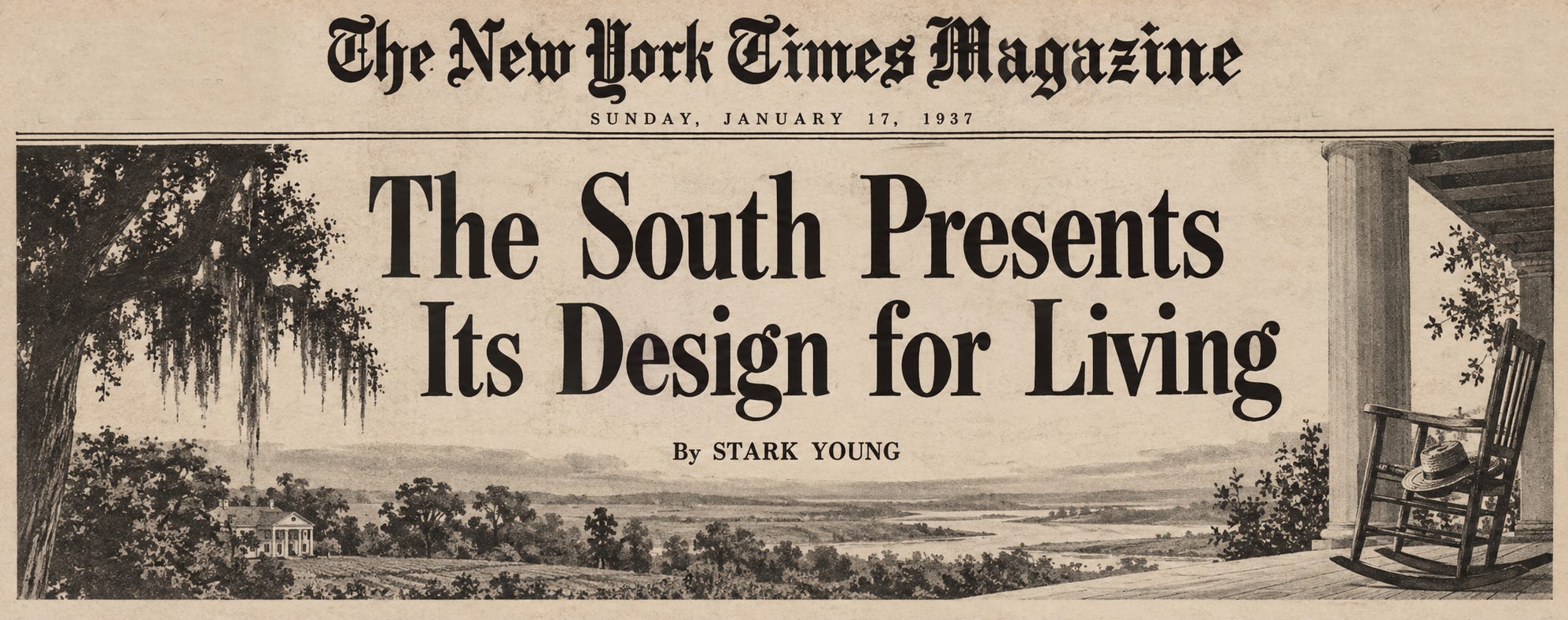
My research and reading for an essay on Stark Young’s So Red the Rose is ongoing. I’ve uncovered the provenance of my copy and it looks like I need to make a quick visit to Vanderbilt’s Special Collections library. I followed a citation to Young’s article “The South Presents Its Design for Living,” in the New York Times Magazine of January 17, 1937. Here it is.
There must be few people who have not been struck these last several years with the widespread interest in the South and Southern matters. For two generations now a great number of books by Southern writers have been appearing; the present decade has seen the number grow to more and more.
Some of these books have won prizes; a remarkable number of them have turned out to be bestsellers. They have included novels, poetry, plays, histories, social studies and economics, all dealing alike with Southern subjects. There have also been plenty of books and articles written about the South by outsiders. How shall we account for this great interest in the South; what is the Southern appeal? To answer that is a large order, but we can at least consider it.
To begin with, there are many Souths; in a sense there is no one South and never was. There is the plantation South, now moving fast toward extinction; there are the towns with industries; towns that are the centers of farming regions; cities with all the mixture of classes and living that the city implies. Of the divers sorts of people there are, for instance, the descendants of the old planter class, with its tradition; the poor whites; the factory people; the many types of Negroes; the floating population made up of all these and more.
If you examine the Tidewater in Virginia, you will find how much, as everybody in the South knows, it differs from the Virginia further west. Regions in North Carolina and Tennessee are anything but like the Deep South. And even in a single State—Mississippi, for example—you can go a mere mile or so very often and run into another sort of people and a different living.
In Texas, especially, you will find side by side families from the planter class and the what we might call yeoman class, descended all from colonists and refugees out of the various regions in the older South. Indeed, not seldom in the same house you will find two members of the family speaking two sorts of English, one a speech derived from our mountain folk, one a speech from the planters.
And yet the fact remains that though there are many Souths, it can be said truly that there are certain general qualities to be taken as characteristic of the whole region. “The South,” then, in a way you can speak of.
Of these various Souths it is the plantation South that has come first in the literary eye. A few years and it was becoming a legend, heavily sweetened, partly false, partly true. But long before the plantation vogue there flourished the writers of the tall tale and character yarn. It was original and genuine, straight out of the frontier, and the tang or go of it hung on after the first burst and gusto of it had written itself out.
For example, in Lincoln, born in the South of Southern parents, the tall tale can be seen as a part of his popular gift. It reached its full culmination and possibility in Mark Twain, born of Southern parents, in a border State, and soaked with its tradition. And in many a Southern writer today, often more than he himself realizes, this natural spirit and yarn spinning works for him. Nevertheless, the plantation and not the frontier became the leading material for literature.
There was competition all along for this planter Old South legend, but a few years ago the rivals took over the field. Various forms of what was loosely called realism threatened to blot the other off the map.
It must, however, be said in passing that this mass of material for what is called Southern realism is made up of poor whites, dirt eaters, factory workers, piney-woods people, Negroes and many other types and localities all lumped together. One of the chief requirements for this realism in Southern writing appears to be, first, an avoidance of sentiment and, second, an intention of “telling the truth.”
This “realism” is even carried to yet another South, one that is not to be despised as literary material, but that never existed outside the imagination. It is Gothic, monstrous, tragic, drab, semi-insane or incestuous, as the case may be, just as it is sometimes remarkable and sometimes trash. It makes, at any rate, one more South to be interested in.
Very recently, however, the plantation and the Old South have come back, and the range of Southern writing now includes, comfortably enough, all sorts and conditions.
Not long ago, in an article on certain novels by Southern authors, I read that the interest so manifest just now was due to the economic situation and problems that the South presents. That would be indeed an easy explanation. A great variety of economic problems, panoramas and conditions exist in the South, of course, and they duly appear in print. They are, of course, a source of interest to students of social problems and to reformers.
We must note that reforming appeal. For almost a century the South has set out morsels of the first quality for people who cannot think (or cannot enjoy themselves) except in terms of causes and crusades. The mere mention of the South and the wrongs there has always been able to warm the cockles of certain indignant hearts. While certain people may—through our Southern moral inferiority or indifference—only delight or bore us, we scandalize them or elicit their noblest objections. We might almost claim it as a Southern charm that we have enabled so many people to find themselves right merely by finding us wrong.
If you inquired of the average person as to the interest just now in things Southern and the causes of that interest, he would be most apt, I am sure, to suggest the romantic. Most people, if they said that, would mean a vague combinations of juleps, moonlight, majors and colonels and suitors, Negroes singing, fox hunts, dolce far niente, jasmine and magnolias.
Some of them, a bit more precisely, will mean a sense of possibility, of gentle glamour, of pleasure in living, perhaps even of the gallantry of tradition, time’s sweetness and old grace. The romantic impulse is as old as human societies; every one knows that we move naturally toward it, even if it be only the romantically anti-romantic. That we move happily toward it is a horse of another color, a matter that for some people is seen as a snare and a delusion. When those who think thus call the appeal of the Southern material romantic they mean it is no better than it should be.
Especially for those who have been suckled on the modern theses of the self, the romantic appeal will be rated as the escape motive. They mean escape from the present, from life as we have it. But it is highly obvious that to employ material far away or special in time or place may not necessarily imply trying to run from life as we have it, but rather using the other as a test or quality with which to confront our own life and times. It is possible, also, to speak of escape as a process of being stampeded and betrayed out of one’s character by the noise, force and crackling narrowness of the industrialism and spreading progress: one flees, in sum, to romance. In that case the South, as a fleeing point, merely turns into a prescription against one of the diseases of modern civilization.
The flight is the cure. All Northern folk make much of the Spring; put into their fables a mythical land where Spring reigns, flowers are eternal, life is easy and morals are either relaxed, stingless and without consequences, or swept away by reckless, picturesque and passionate forces. Well, in this sense certainly the South suggests an escape, a fulfillment, a joyous abomination, a warming of the heart, a casting off of garments, according to the individual. So that the idea of going South is as useful nowadays to the railroads and steamship companies as to the publisher.
The romantic appeal of the South is all the same undeniable. We Southerners ourselves feel it, some unwillingly. Our mere liking for the vivid, if nothing else, makes us touch up our account of it; our loyalty, or antagonism, makes us polish off the account as best we can for the sake of the greater attention we may get for the subject.
There is, of course, the familiar argument that the memory of the War Between the States, the defeat, the humiliations and horrors of reconstruction for those twelve years after put us on the defensive. In so far as this is true it was only to be expected.
Meanwhile, Southern writers are often put to it. Those who wish to write down the life they know, simply and without any distortion of the actual, find themselves confronted with the fact that things taken for granted by a man native to a place may be romantic for an outsider, especially when the life around that outsider tends to be stripped, increasingly solidified, stultified, calculated and dull. And so this writer, confronted with the romantic accusation, does not quite know where to turn.
If the poor author mentions roses, jasmines, Summer nights, forefathers, magnolias or gardenias, he will be exposed to accusations of romantic sentiment. His writing will be called lush; it will be said, for instance, to reek of the perfume of camellias (though that flower has no odor). But since these are the things around him in the world, what is he to do?
Nevertheless, the fact remains that our Southern drift and tint is toward the romantic. A society founded on the English county-family system, squirarchy and blood clan and domestic sentiment, early got the start on us. It was stiffened and formalized with the classical influences in education and manners. There was thus added to us the romantic appeal of the mother country, of old lands, old battles, old causes, forms and beauty.
To push the romantic still further on us in the South minstrels have sung of it—the most poignant American ballads have a Southern setting; orators find it soft and sweet under their tongues; foreign visitors, especially those not in love with the American idea, use us to hit the rest of the country over the head with. But, for all this romantic investment, either actual or conferred by fable on the South, it would be as well to remember also that the Southerner is capable of great warmth and natural coldness. His glowing vein is often accompanied by the most daylight common sense, disillusion, impatience and fatalism.
I have been watching this question, however, for some time now, during these past seven or eight years since that crash, known as the depression, of so many pet Americana. I have decided that behind these effects of romance, of the bright sun, of flowers and lassitude and vistas and, if you like, emotional escapes, there is something much more fundamental about this turning of people’s interest toward the South.
Here, there and everywhere these last few years people have seen the world about them going to pieces. Enough has been happening in these parts to make them wonder if the end of a man’s life is really success, money, publicity, competition, speed and speedways and progress.
Big initiative and laissez faire, princedom in finance, sheer social betterment have failed us or seem threatening to fail us. Life, however full of motion and possession, can prove hollow. Ten miles of concrete paving—where does it lead to? Richest man in a hemisphere—what can he find to converse about? Are his children, even, sitting around him talking: what ideas have they in common with him, what ideals to live by or depart from, or use to bridge the gaps between generations?
And then with the depression the paving fails into disrepair; the rich man is less rich perhaps; it may even seem foolish to be so busy. If you are rich and busy, will that help you to know where you stand with people reassorting their values, governments reconsidering the relation of the individual to society and the functions the State may assume in private affairs?
Can you keep life in your heart and pleasure in your human adjustments, or are you to be only a crass individual without any interesting individuality? Even the headlines in the newspapers seem no longer enough to go on with; you cannot go on forever being fed headlines as seals are fed tallow balls, to keep up the performance.
And so among divers turnings you turn your interest to the South, which is a part of our common American experiment. The South by repute has a definite point of view. Perhaps hearing everlastingly the phrase “Solid South” has led you to think so. Perhaps hearing the South lectured, blamed for ignorance, evil, prejudice and backwardness, you conclude that, however incorrigible, it must be a place at least deadset and distinct. At any rate, the fact must have been borne in upon you that the South had a civilization once, the only clearly defined and frankly admitted system that we ever had in this country of ours.
You say to yourself that perhaps after all there was something in this civilization that you did your best to destroy before, during and after the War Between the States, joining your strength to the curve of history, with the Industrial Revolution and all that, striving to break the agrarian as against the industrial society.
Whether in the other there was anything or not, the order you have followed has turned into pretty much a mess. You tell yourself that in case there was something in that Southern civilization perhaps some of it still remains; for you know that in an agrarian society the same land, even the same tools, more or less, and the same habits remain, change slowly. The society is more static. Ideas are more static.
Everybody knows that to some extent the South has gone industrial, but that at the same time Southern people have not been disposed to bolt the whole mass as it stands. If the South has remained static, even if in your opinion it has been backward, objectionable, and so on, it has at least held out pretty well against what you now see was but half-unconscious rot, evolved from a dissatisfied, pressing and shortsighted state of society. And it has done a good deal of mild gazing at this overactive front of confidence and optimism, this raw and solitary and baffled egotism, these bedazzling fortunes, and has asked, volubly or tacitly. what the result would be.
Well, whether or not the South represents any single, definite thing is not the point. The point is whether the South does not present an effect of having a point of view that we can turn to and consider, admiring or condoning or hating, as the case may be.
Some of this engagement in Southern interests would naturally turn to the Old South. There, whatever else, the tradition and the picture are by now distinct. For better or for worse, the Old South had a social system, definitely maintained in the interests of a recognized class.
For instance, its representatives in the government were not employed as, shall we say, Webster was, to go to Washington and promote the cause of particular interests. A man like Calhoun stood with his own kind; their interests were wholly his. The rest of the South could follow the leadership of (one-fifth of its total) the ruling planters; and everybody knew that. With the world of today crumbling and slushing about you, it might be easily possible that you gave this Old South, about which a good many writers seem these days to be bothered, a glance at least, for better or for worse.
Or in this search for a laboratory for your social thinking you may turn to that other South, those other Souths, presented in many recent books: the South of the share-croppers, the poor whites, the race question, factory conditions, et cetera, et cetera. One thing at least you can say for it: the people or conditions portrayed seem to turn into lively illustrations. In some way or other you seem to get them where you can look at them. Things seem to come to a head down there in the sun.
But what counts more than any of this is, I think, the suspicion in many people’s minds—I am speaking now of the people who are most likely to buy or read books—that somehow the Southerners get more out of the world we live in. Anybody can tell you they have not got much money down there. But they seem to live agreeably somehow (or are bored at the thought of not doing so). They even play games or join clubs without the theory that you make good contacts thereby.
For all his hot violence and biases, the Southerner, on the whole, likes the moment to be affable; he has a certain easy at-homeness among others. In many cases he even likes to stay at home with his family. The fact is the idea of disliking your parents is as yet slow to seep in for one thing, because it would not become your amour propre, that personal pride that is so strong and uncertain a quantity in so many Southerners.
Life down there appears to breed clear types, tangible characters, admirable or not. Southerners themselves complicate matters by seeming to have such warm, definite recollections, even when they are Southerners harsh and critical toward their own section, whom wild horses could not drag to return to it. What, you ask yourself, lonesomely, is this state of affairs in which, love it or (in a manner) hate it, a man goes on talking about a region as definitely as if it were a person?
And then there is the critical-thinker type of Southerner who with his mind sees the South’s faults, sins, black stains, but somehow betrays the fact that in his heart he loves it. His ravings sound only like some more or less inexplicable performance of the brain: but—note this—the love seems to be for something that is as final in itself and real as a person. About this South he tries, as a critic recently said of a novelist, to be an honest man; but his honesty is less convincing than his adoration.
With so many people from the South it is a case not of presence but of root— their roots are there. And to those who love a place it is their country. No matter where they are, on sea or land or in any city, some old song. suddenly heard again, or a childhood dish tasted, or a fragrance remembered from the garden, or a field, or a voice or a word, brings tears to their eyes because of its memory of some place, that place is their country. To such as they the love of their country is one of the great, as it were, natural beauties of the heart.
It is not, then, surprising, is it, that seeing people going on, or feeling, like that about their section of the country; and all these various authors writing about it, you should find yourself turning a little to an interest in the Southern?
Perhaps you may conceive that in the South if they do hurry, they do it in their own way. And even though the Southerner may not always exhibit anything very notable in that line, at least the image of manners hangs applauded in his view; manners, he knows, are the mask of decency that we employ at need, the currency of fair and restful communication; their flower is a common grace, and their fruit not seldom friendship.
You think of the Southerners and by chance half of what you think may be quite wrong, but it engages your attention nevertheless. You may conceive that since they are used to lean purses they have fallen back on other things for happiness. Capacity for life is thus developed; and capacity attracts. Or at the very least you may conceive that they are not whining like some of your friends in this town who are down to their last yacht. And momentarily at least you may have a faint suspicion—say to yourself—those people down there, that’s the way we ought to be living.
beautiful ! thank you Chase.
Excellent as always. Thank you for your labors!