


A History of North Carolina in the Proprietary Era, 1629–1729. By Lindley S. Butler. University of North Carolina Press, 2022. 470 pages.
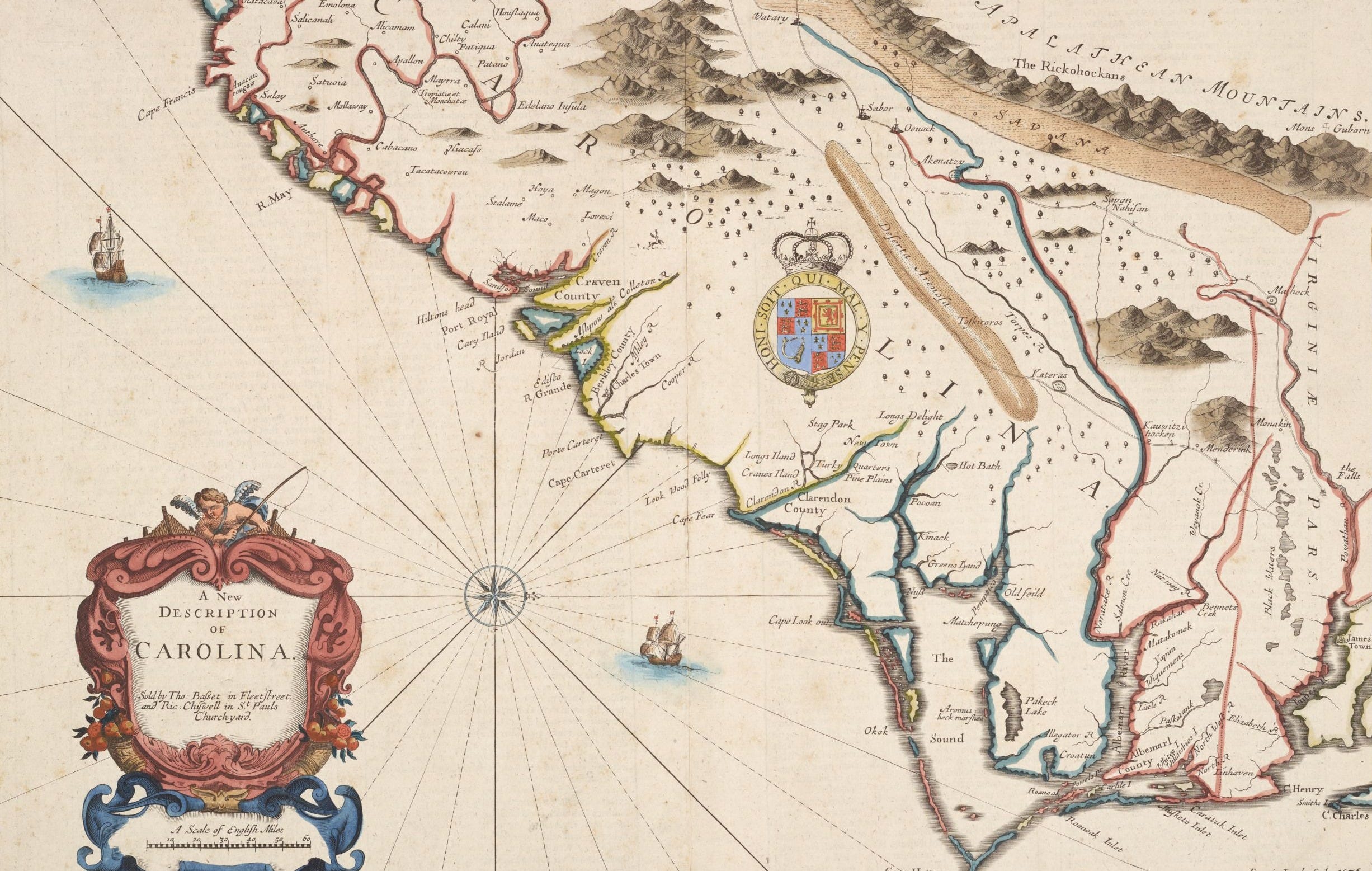
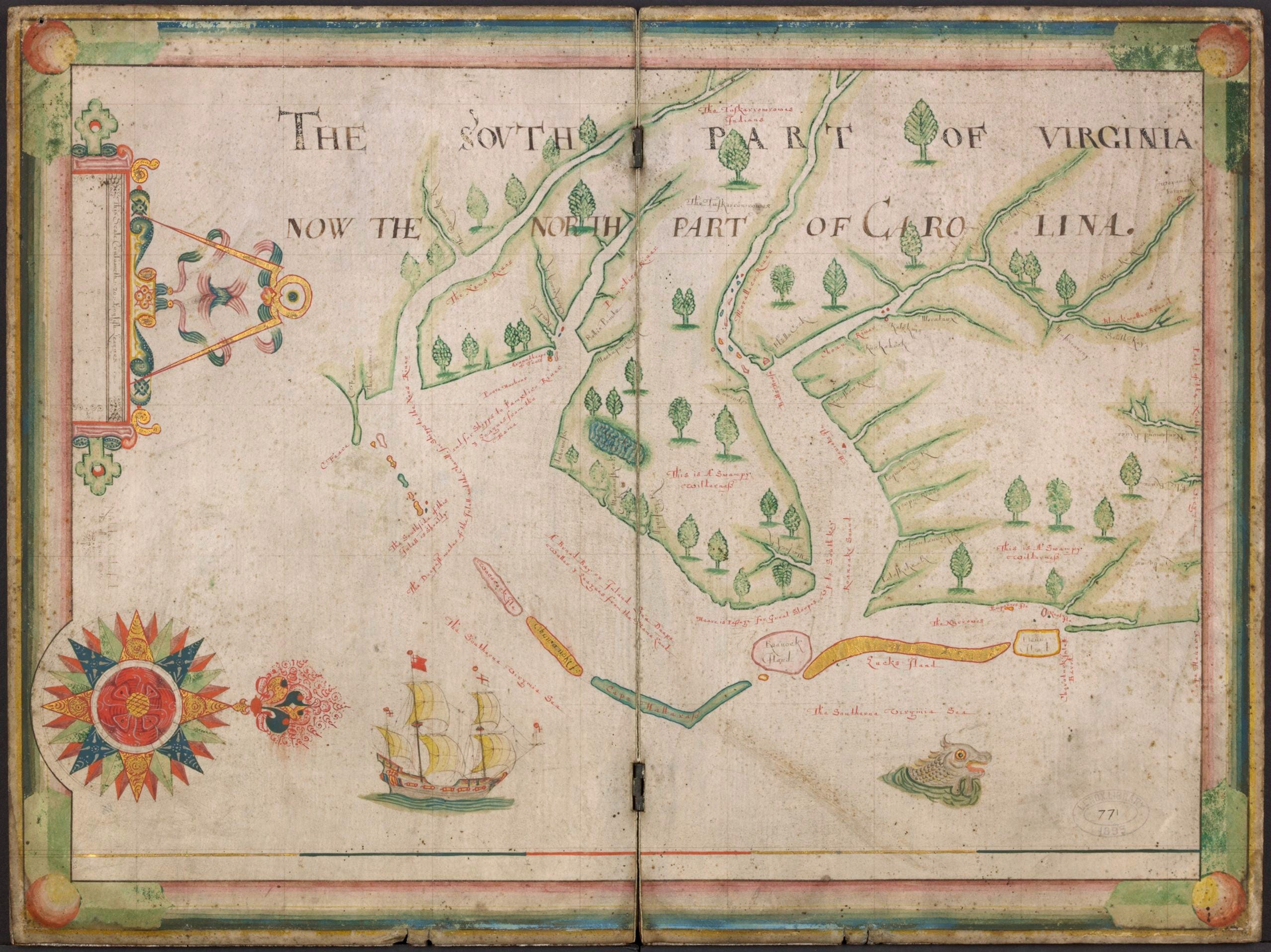
The Outer Banks stand off the Carolina coast like Hadrian’s Wall left to the sea. Behind the breached barrier the water turns shallow and brown, the marsh grass bends. Out of the Great Dismal Swamp the streams come down black into the sounds. An Atlantic ship had nothing in Albemarle to steer for. So the first permanent English settlers came the back way, out of Virginia, carrying livestock and household goods along the Nottoway, Blackwater, and Chowan Rivers. They took up land on the Pasquotank and Perquimans and began the ordinary work of keeping house.
Charles I had granted everything south of Virginia to his attorney general, Sir Robert Heath, in 1629. Heath never did much with it. In 1663 Charles II regranted the country to eight courtiers who had helped him recover his throne, among them George Monck (Duke of Albemarle), whose title still lies across the sound, and Anthony Ashley Cooper (Earl of Shaftesbury). Their charter carried the medieval powers of the Bishop of Durham and made the Lords Proprietors owners of Carolina much as a man owned an estate. Nothing in American government now resembles it. They could appoint governors, grant land, collect quitrents, and govern a province none of them ever saw. Seven of the eight shares returned to the Crown by purchase in 1729. Lord Carteret kept his eighth. The century between grant and sale gives Lindley S. Butler his era.
Butler writes about a world that has nearly disappeared. Few houses and marked graves remain from North Carolina’s first century, and the colony has to be recovered from deeds, court minutes, letters, inventories, maps, and the objects dug from the ground or raised from the sea. Butler spent sixty years in those sources. A native of Rockingham County who studied at Chapel Hill, he became professor emeritus of history at Rockingham Community College and historian for the state’s Queen Anne’s Revenge shipwreck project, and he wrote or edited a shelf of North Carolina books. He died in April 2022, just as this one appeared. It was his last.
My interest in the book’s subject is personal. I am no historian, but research on my surname hits a seemingly unbreachable brick wall in Proprietary North Carolina. In 1706 my kin “Tho. Steely” turns up on an “Account of ye males yt is to work on ye three miles District in South Lancaster,” a road district in early Albemarle. Two men listed beside him, “Tho. Hakings” and “Jon. Worley, Jr.,” surface again in what the Steelys left behind. Eleven years later the Chowan tax collector recorded Thomas and William Steely. Thomas died in 1719, leaving his plantation on the south side of Albemarle Sound to William Steely and Thomas Hawkins. A 1720 deed places William’s land exchange with John Worley near Middle Neck Bridge. Then comes William’s name on a 1723 jury list. The entries put a Steely household on a particular piece of the Albemarle shore.
Such scraps explain both the fascination of Butler’s period and the thinness of its historiography. “For many historians,” he writes, “the colony’s distant era has appeared to be of little consequence, and in the past it was difficult to research.” Only one previous book covered the whole proprietary period, the second volume of Francis L. Hawks’s History of North Carolina (two volumes, 1857–58). Hawks credited the government established in the 1660s with two principles that entered “the political creed of our whole country,” elected representatives and taxation by consent.
William L. Saunders put the sources into print in the Colonial Records of North Carolina during the 1880s and called the Virginians on the sound the “parent settlement of North Carolina.” R. D. W. Connor later named Albemarle the state’s “Genesis,” and Hugh T. Lefler called it the “Cradle.” Lefler and William S. Powell‘s Colonial North Carolina remained the standard modern account, and the editors of its series introduced the colony as the “proverbial exception” among the thirteen. A. Roger Ekirch’s “Poor Carolina“ found poverty, faction, and weak institutions continuing through the royal decades. Virginia governor Thomas Culpeper called Albemarle the “sinke of America.”
A few historians outside the state saw another North Carolina. Herbert L. Osgood held that “the foundations of American liberty were laid” during the first colonial century. Wesley Frank Craven wrote that Albemarle posed “a more perplexing problem of identification than any other along the Southeastern coast” because it “was American.” Butler’s own 1989 monograph, North Carolina Genesis, found an “emerging democracy” in the colony’s political unruliness and pronounced Albemarle “unlike any other English colony.”
The Marxist social historians arrived last. Butler politely dismisses Noeleen McIlvenna’s A Very Mutinous People, which sees early Albemarle as a diverse class struggle. Her Culpeper rebels were grassroots democrats building “a society of equals” until Thomas Pollock‘s Chowan planter capitalist faction crushed them. The men who led the rebellion were landowners, merchants, militia officers, councilmen, judges, and former governors.
North Carolina, Butler argues, began unlike its neighbors. It had no plantation class to match Virginia’s or South Carolina’s and no New England town. Farms stood apart along the waterways. Fortunes stayed moderate, offices circulated through a small governing set of planters, traders, mariners, and artisans, and religious dissenters were numerous. Across the Atlantic the proprietors soon judged the Ashley River settlement more promising than Albemarle and shifted their money and attention south. Left to themselves under a charter that promised an assembly and liberty of conscience, the settlers grew touchy toward any governor who came expecting obedience.
The long narrative: North Carolina began by accident, took up self-government early, tolerated religious dissent better than most of the colonies, and built a modest but workable Atlantic economy behind a ship-swallowing coast. He breaks from the consensus in two ways. He restores the Lords Proprietors, remembered as greedy and neglectful landlords, by showing that their governing papers—read closely—supplied real political and religious freedoms. He redeems Albemarle from its name as a poor and isolated nest of rebels. Its people produced, traded, sued, voted, married, worshiped, accumulated property, and built institutions fit for them.
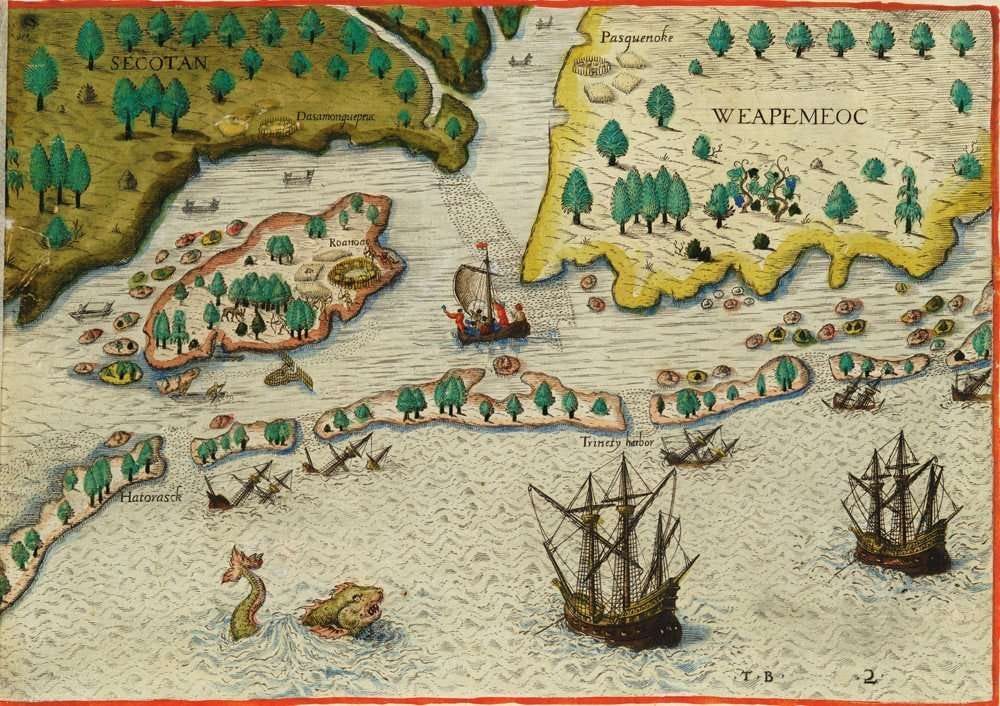
The first chapter warns against reading English possession as inevitable. Verrazzano reconned the Carolina coast in 1524 and sailed on. De Soto’s expedition crossed the western country. Juan Pardo‘s soldiers built Fort San Juan, where archaeologists have uncovered a palisade and burned buildings littered with Spanish artifacts. The Joarans destroyed the fort in 1568. Raleigh’s Settlers vanished from Roanoke Island. For more than a century, Indians remained strong enough to absorb, contain, expel, or kill the Europeans who entered.
The failed ventures continued under the 1629 Carolana grant, which produced no colonists. Permanent settlement came when Virginia fur traders moved south, and Nathaniel Batts set up a trading post near the meeting of the Chowan and Roanoke Rivers. His 1660 purchase from Kiscutanewh, king of the Yeopim, is the earliest surviving deed for North Carolina land.
Butler’s rehabilitation of the proprietors begins with the English Civil War. They inherited this scattered settlement in 1663, and most of them had lost property or known prison and exile. Whatever their appetite for profit, these men had learned something about arbitrary power and religious persecution. Their Concessions and Agreement and the Fundamental Constitutions gave freeholders an assembly, and the protection they extended to religious practice was wider than most of the English world then allowed. Of course, religious toleration did not make a seventeenth-century aristocrat an egalitarian.
The proprietors’ own venture fared worse. In 1664 New England Puritans and Barbadian planters established Charles Towne on the Cape Fear, the first English town in the propriety. Excavations of its fortified compound have turned up tobacco pipes, Delftware, Chinese porcelain, and Spanish ceramics. It failed by 1667. The corn was standing when the inhabitants left.
Albemarle survived because it had preceded the proprietors and could resist them. In 1668 the settlers pressed the proprietors into the Great Deed of Grant, which conceded land on Virginia’s terms, a fifty-acre headright and a farthing quitrent an acre. They recorded it in the precinct court minutes and held it unalterable ever after. They deposed governors, disputed elections, resisted the customs collectors, and now and then jailed the men who carried royal or proprietary commissions. When acting governor Thomas Miller set about collecting the penny-a-pound tobacco duty of the 1673 Plantation Duty Act while running the government, the insurgents of Culpeper’s Rebellion jailed him, called an assembly of their own, ruled for nearly two years, and then escaped the usual penalties for treason.
A decade later the colonists removed a Lord Proprietor. Seth Sothel had bought the Clarendon share and reached Carolina only after pirates captured him on the way. His alleged takings in office included an enslaved man, seven pewter dishes, a herd of cattle, and imported lace. In 1689 Thomas Pollock led the armed band that arrested him at his plantation. At Sothel’s own request the assembly tried him, banished him for twelve months, and barred him from office.
Again and again the coast interferes. Older historians held that the shoals isolated North Carolina and retarded its development. Butler rejects the old “poor White Carolina Trash” argument without pretending that the inlets were an advantage. The rivers emptied into broad sounds behind shifting bars where an ocean ship risked grounding, so cargo went north overland or crossed the sounds in smaller vessels for transfer at another port. Local sloops carried pork, tobacco, hides, shingles, barrel staves, and naval stores to Virginia, New England, Bermuda, and the West Indies. New England merchants kept correspondents among Albemarle Quakers, and smuggling filled the gaps in the official customs records.
Boatwrights built for the shallow water. Indian, African, and European watermen ran dugout canoes and broad periaugers on the rivers and sounds, while sloops and shallops worked the inlets. Probate inventories turn up adzes, broadaxes, cooper’s tools, and whipsaws. Carpenters framed houses, and coopers made the hogsheads in which tobacco traveled. Albemarle occupied a secondary market, but it was not a subsistence wilderness cut off from the Atlantic.
Religion gave the scattered colony its nearest thing to an institution. William Edmundson crossed the Dismal Swamp in 1672, wet and exhausted, and found the one Quaker family he knew in the colony. Settlers at his meeting sat smoking their pipes while he preached. George Fox came later that year, and meetings multiplied. For nearly thirty years the Friends were North Carolina’s only organized church. Then the founders died off and the council turned Anglican. Religious grievance joined an older quarrel. Albemarle’s families had governed since the 1660s, Bath‘s planters wanted their share, and the colony soon had rival presidents and disputed assemblies. Thomas Cary‘s return restored Quaker affirmation for a time, but Edward Hyde‘s arrival brought the contest to arms. A royal warship ended the Cary Rebellion in 1711. Two months later the Tuscarora attacked.
John Lawson had walked some five hundred miles through the Carolina backcountry and turned the journey into the colony’s great early natural history. He packed insects into vials and pressed plants into paper, and he asked how natural knowledge might “Inrich the country.” In September 1711 the Tuscarora captured him, and after he argued with a Core chief they killed him.
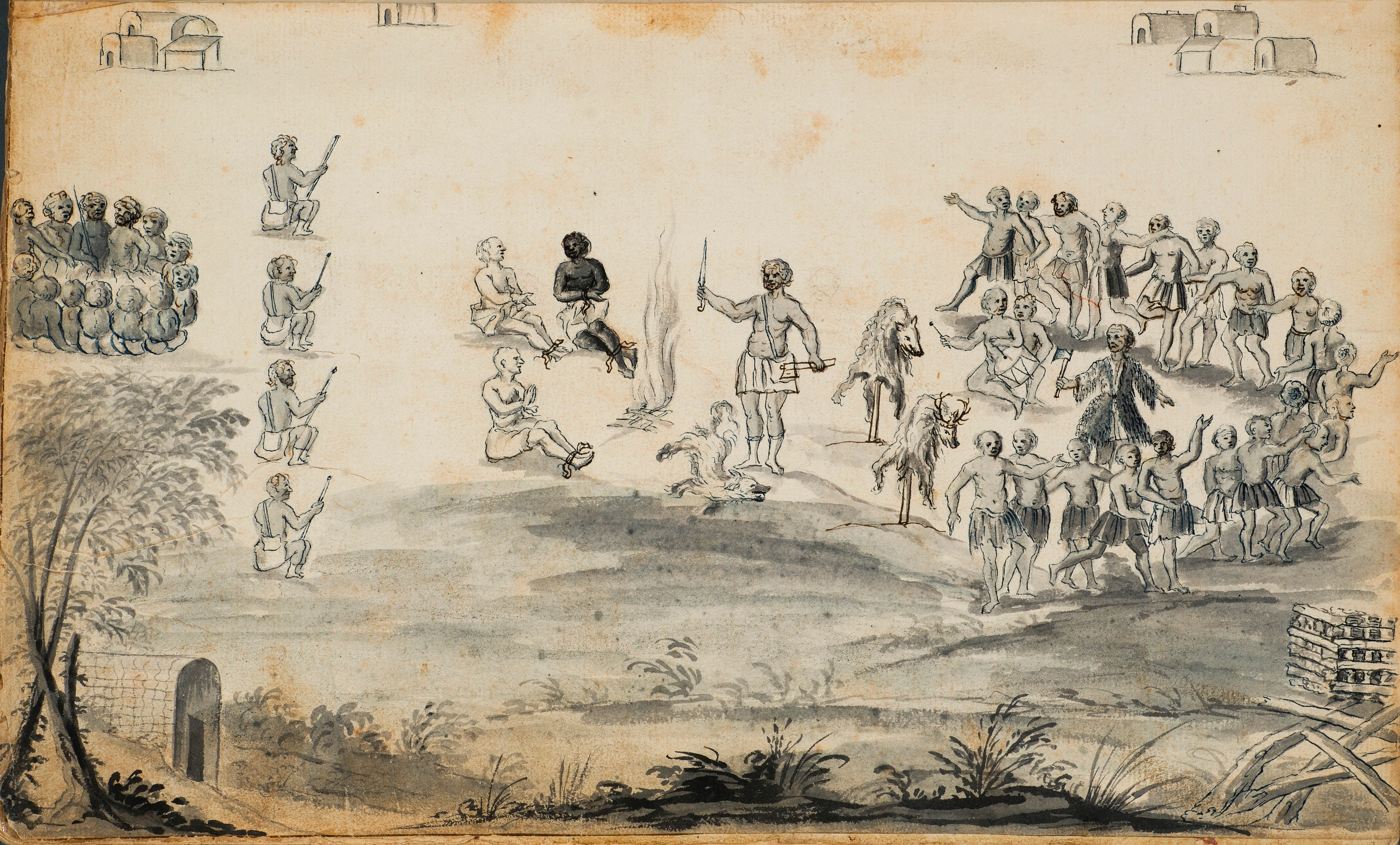
The war had been building. New Bern sat on Tuscarora land taken without payment or treaty, and on 22 September 1711 Indians from the lower towns fell on the Pamlico and Neuse settlements in what the historian William Powell records as “three days of slaughter.” Two hundred settlers dead, eighty of them children. Virginia priced its help at a cession of land, so North Carolina turned to South Carolina, whose expeditions of allied Indians broke the Tuscarora in stages and in March 1713 destroyed Fort Neoheroka. Hundreds died there, and the victors marched 392 prisoners, mostly women and children, south for sale. The war subdued some political grudges and deepened others. Quakers who refused to serve lost property for the refusal, and the assembly paid for the fighting with North Carolina’s first paper currency.
Butler’s years with the Queen Anne’s Revenge project pays off in the Piracy chapter. Blackbeard’s flagship, a captured French slave ship, grounded at Topsail Inlet near Beaufort in June 1718. Its remains have yielded cannon, anchors, medical instruments, grains of gold, and objects made across Europe, Africa, and Asia. Butler knows the vessel from the bottom upward.
Blackbeard shed part of his crew and accepted the king’s pardon. He settled briefly at Bath, then made Ocracoke his base. Virginia governor Alexander Spotswood, acting without North Carolina’s invitation, sent Lieutenant Robert Maynard into the sound, and Blackbeard’s head returned on the bowsprit. The raid reopened the colony’s politics. Edward Moseley and Maurice Moore used suspicions of official collusion to attack Governor Charles Eden and Chief Justice Tobias Knight. Other pardoned pirates entered the precinct books, married and acquired land, and became difficult to distinguish from their neighbors.
During the final proprietary decade, Albemarle ceased to contain North Carolina. Bath recovered, and New Bern and Beaufort survived the war and began again. Queen Anne’s Town acquired a courthouse, a prison, warehouses, and inns. After Governor Eden’s death in 1722 it became Edenton, the capital and, by legislative declaration, the colony’s “Metropolis.” William Byrd II arrived in 1728 and found forty or fifty modest houses, mosquitoes, and a courthouse with “the Air of a common Tobacco House.” He also noticed that the metropolis lacked a church building, an omission he could hardly be expected to pass in silence. Byrd hung the name “Lubberland” on the whole colony, a slander the state’s historians have been answering since Hawks.
Farther south, George Burrington and Maurice Moore reopened the Cape Fear. Moore and his connections took up large tracts and planted Brunswick. From the longleaf pine forests, lumber, tar, pitch, and turpentine moved through the colony’s one dependable deepwater outlet. Mark Catesby collected and drew the natural world Lawson had hoped to catalogue. Byrd set the Dividing Line betwixt Virginia and North Carolina.
By 1729 the province had an established church, several towns, a capital, a growing planter class, and an expanding enslaved labor force. The old order of household government and courts held in plantation halls was giving way to public buildings and settled offices. North Carolina was beginning to resemble its neighbors.
My Take
My presentism detector got to oscillating a page or two in, then simmered down for a few hundred pages. The trouble is loudest at the two ends of the book. It opens with “the migrations out of Africa that populated the planet,” a long way to go back for Albemarle and eerily close to the opening of a book on Scotland I read recently. The overture almost reads as a requirement now for any book about White men. The Natives who arrive in it get a reverent lineage, “first folk” who “coalesced from families into tribes” and “created cultures and civilizations.” The Europeans are “interlopers,” “intruders,” and “invaders,” bringing “enslavement, epidemic disease, and murderous warfare,” a “holocaust.” Mr. Butler’s adjectives revealed his hand before a single settler was turned to man on the cob. I do not doubt the diseases or the warfare, but the blade was two-edged.
The conclusion is similar. Butler admits in his introduction that his conclusions are colored by our polarized moment, an honest confession that a stricter editor would have flagged as a symptom rather than printed as a credential, and the epilogue’s last paragraph assures the reader that the nation still strives toward its ideals and remains on the right course. Herbert Butterfield gave this habit its name nearly a century ago.
Several of the chapters become catalogs or lists in sections. Butler spent a lifetime accumulating evidence and is reluctant to omit any useful jot or tittle (which I appreciate). Most of the book is better than its fashionable bookends. If the subject interests you at all, I recommend it, even if just for the sources cited.
Butler’s Bibliography

The intros and conclusions really give the historian a sense when the book was written-almost its own historiography. I remember Larson's economic history of America had this insane anti-Bush tirade post 08 crash that is meaningless now, other than identifying him as a true Earlham College alumnus (read nutcase). Reading the conclusion with a serious historian in 2020 made the woman (a leftist, but very fine historian) actually laugh at his breathless flourishes.
Butler's finishing research before his death firmly in the George Floyd era will be a good identifier on how history really went off the rails. Hopefully, we are moving in a better direction for that.
Great review. Thanks for writing.
Fascinating. Thank you.