


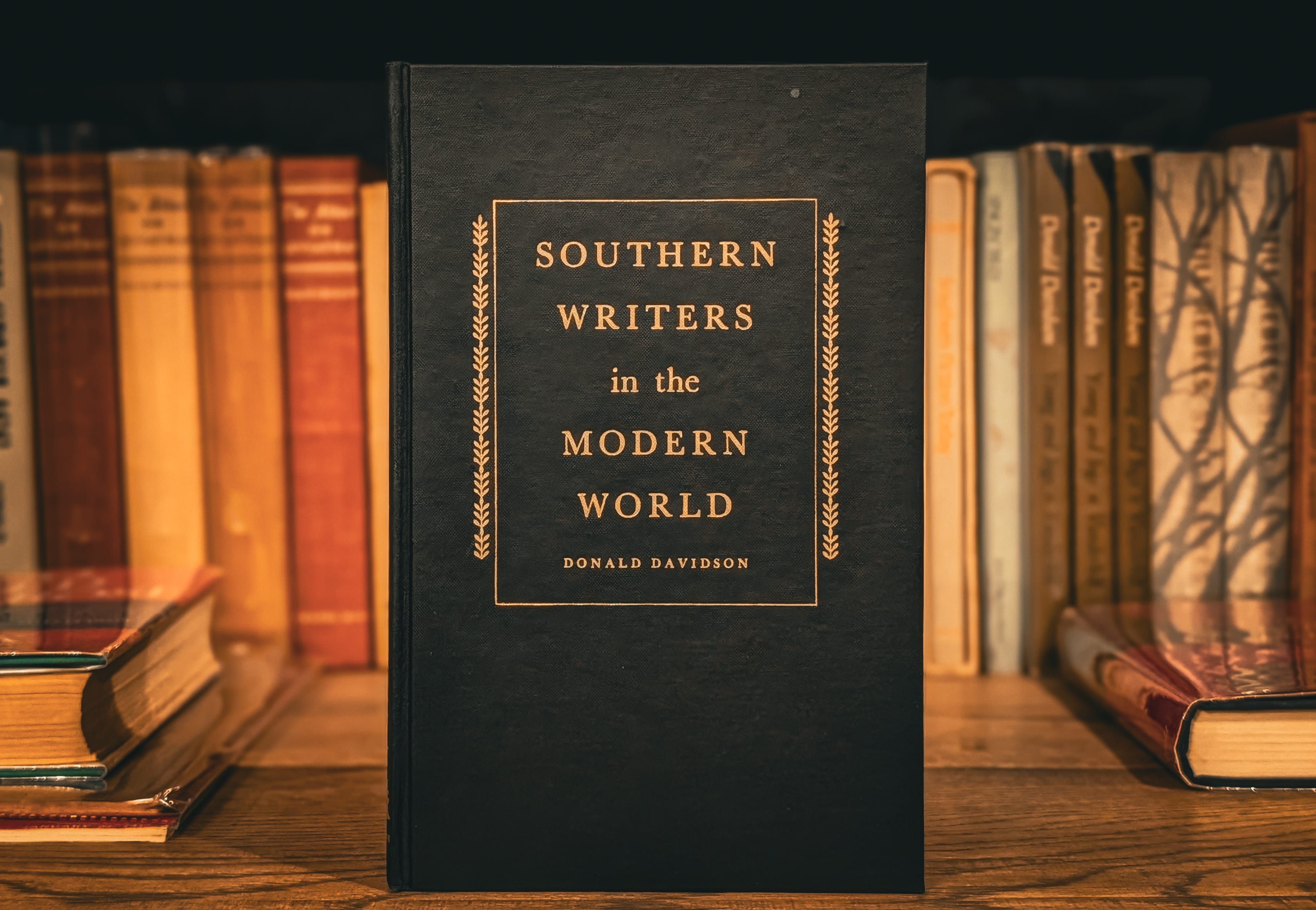
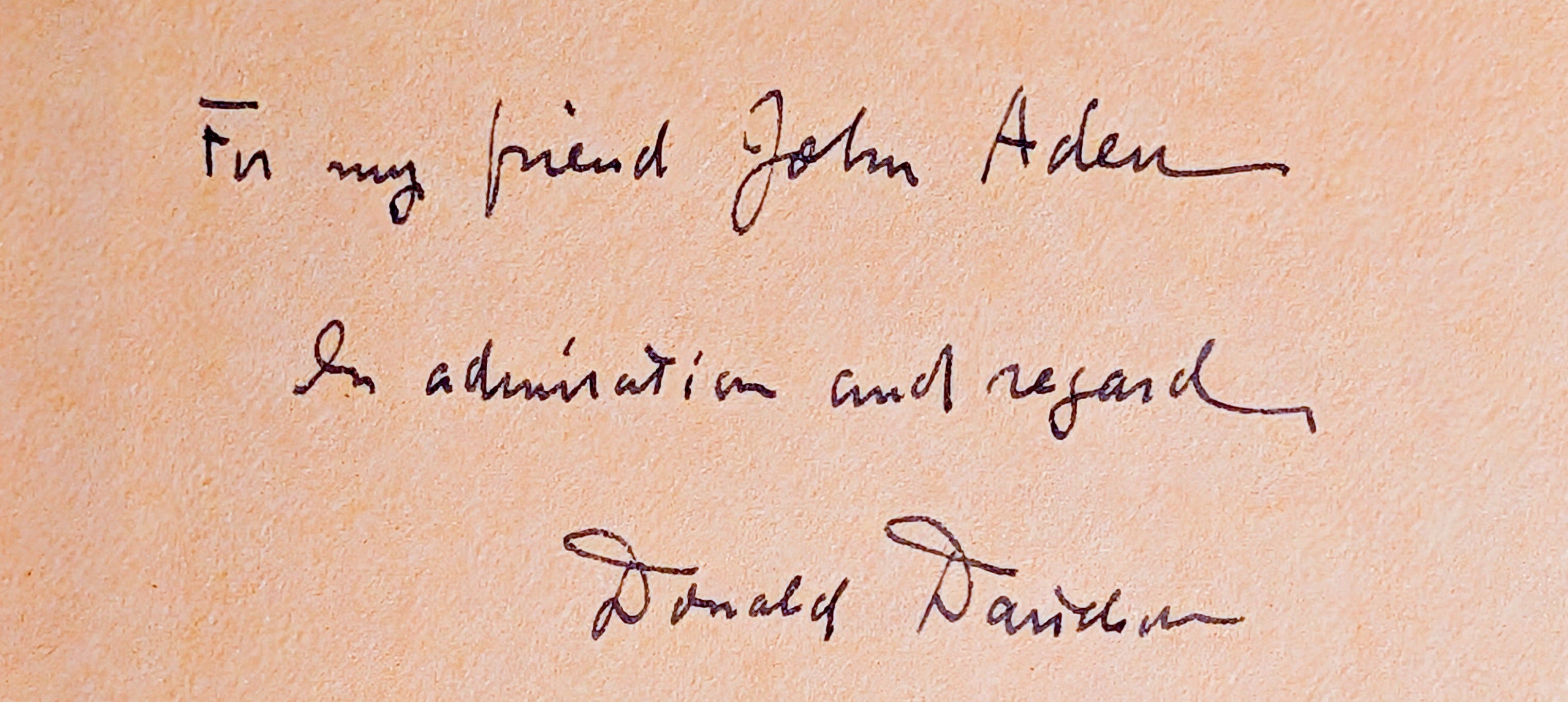
Eugenia Dorothy “Dolly” Blount Lamar was born in Jones County, Georgia in 1867 and spent most of her life in Macon, where Mercer’s spires stood across Tattnall Square from her childhood home. She was Historian-General and President-General of the United Daughters of the Confederacy, helped get Sidney Lanier into the Hall of Fame, worked for the preservation of Stratford, and opposed woman suffrage before the Georgia legislature. Her money followed her loyalties. It funded the Eugenia Dorothy Blount Lamar Memorial Lectures, founded for “the permanent preservation of the values of Southern culture, history, and literature.” Donald Davidson opened the series in 1957, delivering three lectures at Mercer on November 20 and 21. The University of Georgia Press published them in 1958 as Southern Writers in the Modern World. My copy carries an inscription in Davidson’s hand on the front endpaper: “For my friend John Aden / In admiration and regard / Donald Davidson.”
Thomas H. Landess, in an essay collected in A Defender of Southern Conservatism: M. E. Bradford and His Achievements (University of Missouri Press, 1999), describes Mr. Aden as tall and lanky, sunken-cheeked, Southern by birth, speaking with an elegant accent. His wit was “urbane,” “both entertaining and dangerous,” and “perfectly suited to the teaching of eighteenth-century literature.” His lectures were “brilliant, laced with humor and fine irony.” Of all the professors in the Vanderbilt graduate school, Jack Aden was the most feared. He demanded near perfection. He “piled assignments on their heads like a grave digger shoveling dirt.” His students complained they had no time for basic necessities, much less the work required in their other courses. He expected them to master the major scholarship in the field and to know everything written in the eighteenth century besides. Even the diligent scholar entered his exam in high anxiety, knowing it would demand the most arcane knowledge and the most agile and disciplined mind. He did not grade on the curve. He would have flunked an entire class with a wry smile if the students had not measured up.
M. E. Bradford came to Vanderbilt a few years after Aden arrived. From Aden he learned what he learned from the other professors: a respect for the text and the body of criticism, the necessity of knowing history, a submission to his masters. From Aden alone he learned the work ethic of the genuine scholar. Bradford would shake his head in wonder that he had ever survived Jack Aden’s class.
Aden wrote with the same rigor he demanded of his students. The Critical Opinions of John Dryden: A Dictionary came out in 1963, followed by Something Like Horace: Studies in the Art and Allusion of Pope’s Horatian Satires in 1969 and Pope’s Once and Future Kings: Satire and Politics in the Early Career in 1978. He was among the first scholars to treat Swift’s poetry as serious work. He died in Nashville on April 26, 1993, after a long illness.
By the summer of 1957 Davidson was thirty years into his Vanderbilt tenure, unrepentant about I’ll Take My Stand and about his writings against Leviathan. The Lamar invitation reached him at the Bread Loaf School in Vermont, where his summer neighbor was Robert Frost. After a reading that July, Frost put a question to him: “Do you suppose they’ll send troops into the South?” Davidson took the question home, worked on the lectures through the fall, and read them at Mercer on November 20 and 21. The 101st Airborne was already in Little Rock.
“The Thankless Muse and Her Fugitive Poets” is the title of the first lecture. It reaches back to the Nashville circle that gathered on Whitland Avenue and on Sidney Hirsch’s Twentieth Avenue balcony. Three decades after the little magazine folded in 1925, John Crowe Ransom, Allen Tate, and Robert Penn Warren had been assigned as anthology reading and dissertation subjects. Davidson, for his un-Reconstructed ways, had been pushed to the margin of his profession. The lecture is a quiet polemic on literary fellowship that refuses to hand that history over to the usual flattening machine.
Davidson begins where the modern public mind has always begun, at the bottom line. In the 1920s, he writes, the last thing expected of an ambitious young Southerner was that he would devote himself to poetry. Poetry did not affect the price of cotton or the value of real estate in Atlanta or Miami. Progress and standard of living were the languages the New South had agreed to speak. Both put the same question to every human activity: what does it produce, and at what return.
Out of this indifference came what Davidson calls the privilege of being let alone. Chancellor Kirkland of Vanderbilt could not have guessed whether the obscure verse-making of a few instructors and their students was an asset or a liability to the school. The Fugitive meeting survived as an accident of that indifference, and produced what the bureaucracy could not have produced on purpose.
What the bureaucracy let alone became a household of poets. The Fugitive meeting had front-porch familiarity. A streetcar line ran to a stop called Vanderbilt Stile, and Davidson takes the trouble to record the name because men with names stood around at a particular hour at a particular corner. Ransom drew a sheet of paper from his pocket at that corner one evening and read his first poem to Davidson. That sheet of paper is the cornerstone Davidson lays under everything the Fugitives went on to build.
The Fugitives shared the same assumptions about society and about man, nature, and God. Many questions never had to be asked, including some of the metaphysical ones. A working tradition leaves its deepest assumptions unspoken, and the men inside it write out of them rather than about them.
Suppose, Davidson says, that Ransom had come from California and Tate from Iowa, the group assembled at Vanderbilt by scholarship aid or the pull of Dan McGugin’s football teams rather than by birth and neighborhood. The poems might still exist. The Fugitive would not.
In the second lecture, “Counterattack, 1930-1940: The South Against Leviathan,” Davidson names the long enemy. Leviathan was his word for it: industrialism, collectivism, centralized power, social science, bureaucratic schooling, foundation money, national journalism, and economic reduction. Its modern phase begins with the bargain of 1876 and what he calls the Peace of Henry Grady. The South gave Hayes the White House, let the tariff stand, and left Northern money-making alone. The North let Southerners be Southern. Wall Street money came down for cotton mills and schools to sell the deal at home. The peace held partly by literary magic. Joel Chandler Harris, Thomas Nelson Page, and George W. Cable had drawn the heat out of the old Abolitionists.
The magic wore off at Versailles. The agreement broke without notice before the doughboys were home, and what Davidson calls a Cold Civil War opened on the South. The bombardment was long and sustained. The terms now used for such campaigns, words like propaganda and psyop, were not yet in circulation. The work was being done in the language of the smooth-handed nineteenth-century liberals—amended by Wilson, with later contributions from Hoover, Walter Lippmann, and the credentialed think-piecers of the New Republic, the Nation, and the New School of Social Research.
In their telling, Davidson reminds his audience, Southerners were all a bunch of Ku Kluxers, lynchers, religious bigots, a people of hookworm and pellagra, sharecroppers and poll taxes, poor whites and fundamentalists. The roads were unpaved and the plumbing antique. We had failed to provide ourselves with a sufficient number of Deans of Education. The symphony orchestra was scandalously underrepresented per capita. We labored under a surplus of U.D.C.s, D.A.R.s, and W.C.T.U.s, of Methodists and Baptists, of one-horse farms and Old Colonels. Our women had developed unwholesome opinions about their ancestors. Our men chewed tobacco, or drank mint juleps, or did both at once. Instruction from Northern sources was the only known cure.
Environmental factors determined a society, the economic factor chief among them, and the good life of a region could be inferred from its standard of living ranking. The Trojan Horse of liberalism, Davidson writes, had vomited a horde of social scientists, funded by Northern foundations and entering the South through the colleges and the churches and the charities, with a Fifth Column of Southern journalists. Davidson once asked a Southern sociologist whether a country housewife became a better woman by trading her old icebox for an electric refrigerator. The sociologist said yes, without hesitation.
Newspapers cast the Scopes trial as religious bigotry against enlightened science, and Davidson rejected the cartoon. The modernists meant to define God as science and evolution as quasi-religious dogma. The real issue, Davidson insisted, was a state’s authority over instruction in its own schools. Chancellor James H. Kirkland answered that “Vanderbilt’s answer to the Scopes case is to build more laboratories,” a thing a Southern college president could say while courting Rockefeller money. A dispute over truth, religion, and the authority of the state had been answered with a building program. Modern institutions hide their metaphysics in their floor plans.
The Agrarians answered in 1930 with a book, I’ll Take My Stand, but by 1957 Davidson could admit the South was more heavily industrialized than ever, even on its farms.
“The Southern Writer and the Modern University,” the third of the Lamar Lectures, was delivered as an informal talk to the Mercer faculty on November 21, 1957. Davidson asks first whether the writer needs the university, then whether the university needs the writer. The modern university wants the Ph.D., the laboratory specialist, the administrator, and, with what Davidson calls an almost pathological concern—the football coach. The writer it tolerates as an irregularity, when his work fits an accredited course. A university cannot manufacture writers.
The new apparatus drew his scorn: fiction seminars, drama laboratories, story clinics, writers’ conferences. Laboratory borrows the coat of science. Clinic turns the story into a patient. Conference reduces the work of formation to supervised talk. Davidson attacks the belief that literary life can be reproduced by arranging the furniture of literary life.
He refuses the easy sneer at education. Faulkner had no B.A. Thomas Wolfe trained under Frederick Koch at North Carolina and George Pierce Baker’s 47 Workshop at Harvard and came out “torrential and formless”; the form he wanted he got from his editor Maxwell Perkins. Jesse Stuart hitchhiked to Vanderbilt in 1932 to study under the Fugitives. The credit hours were never the decisive thing. What counted was that some teachers were themselves writers, and that a boy from Kentucky was not asked for receipts on his right to high literary art.
Davidson compared the university to a medieval castle, a shelter from the rapacity outside. The universities, he writes, were not yet “reconditioned for the mass-production of brainwashees.” Inside the walls the credit hour was already at work. Creative writing earned the same hours as marriage counseling, the management of filling stations, or client-centered psychotherapy. A school that levels the dialogues of Plato to parity with Margaret Mead on Samoan marriage customs has conceded the argument for the high arts.
Young writers formed by industrial life had little to write about but their frustration. Their language, infected by what Weaver, in The Ethics of Rhetoric, called the rhetoric of social science, could no longer describe a room.
Other institutions saw the fruit Vanderbilt had grown and tried to buy a tradition with conferences and writer-in-residence lines. Vanderbilt held no writers’ conference, not one.
The writer must be a somebody, Davidson says, not the nobody that science in its strict impersonality requires. A somebody has an origin, a speech, a memory, and someone to answer to. Almost seventy years on, the diagnosis has held. The writers’ conference he could call a novelty is now an industry. Every campus keeps a writer-in-residence, and the MFA has become the union card for literary work. Weaver’s rhetoric of social science got into the hiring committees and the magazine prose, and into ordinary educated speech.
A literary tradition needs people in one place long enough to be corrected by their dead and known by their neighbors. Davidson had known such a place.
This post is fascinating, quite funny and terribly true for today. Thank you.
I received an undergraduate degree from Vanderbilt in 1965. I can only remember one professor. Dr. John Aden. Surely he is the Jack of your post. We called him Dr. He fits the physical description. He must have been kinder and gentler to us undergrads as I remember him as being hard but not as excessively demanding as described by your graduate students. I do think from time to time of how much I enjoyed his classes and how fortunate I was to have had him. Good memories.
Hits modernity right between the eyes.