


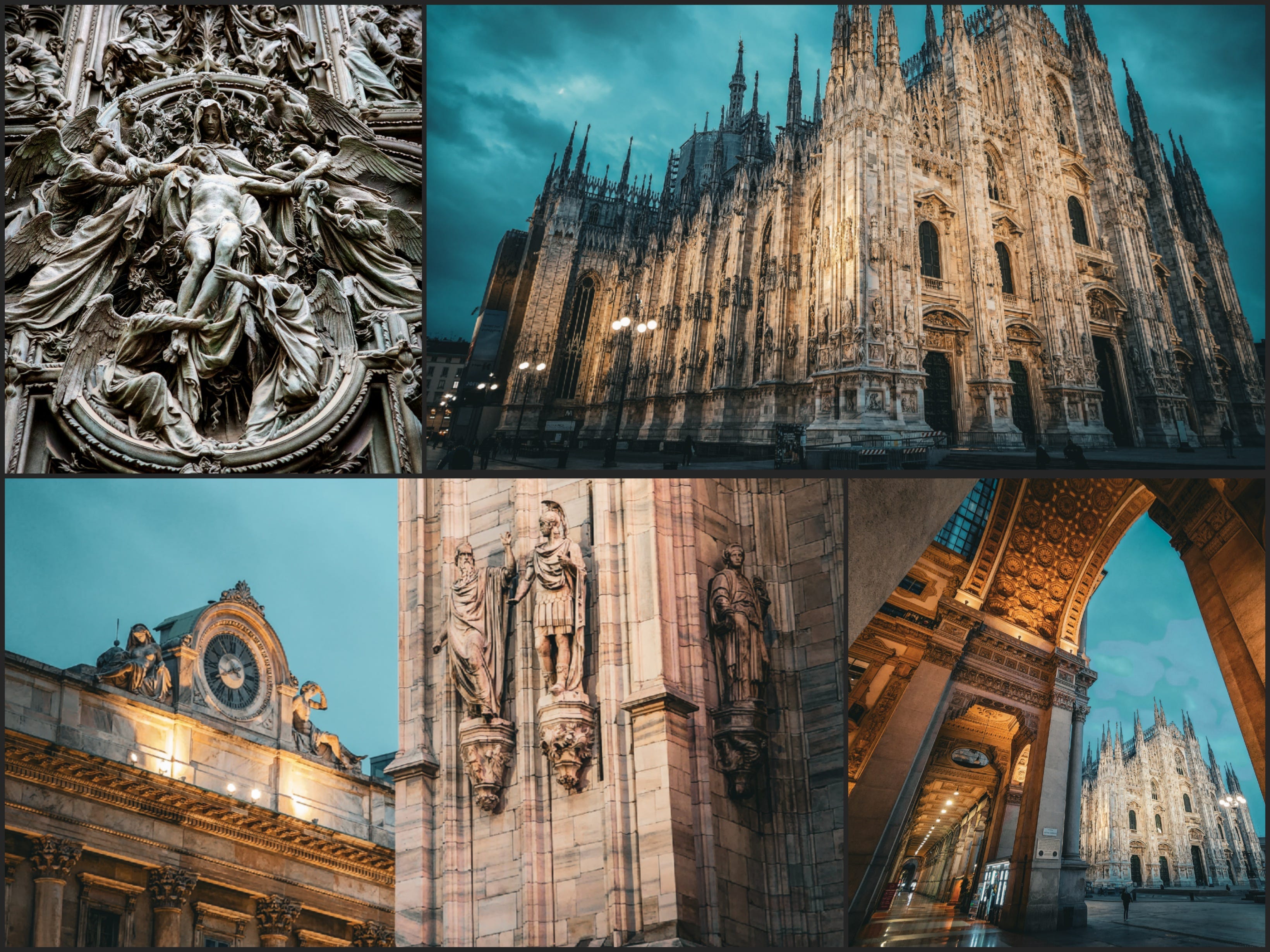
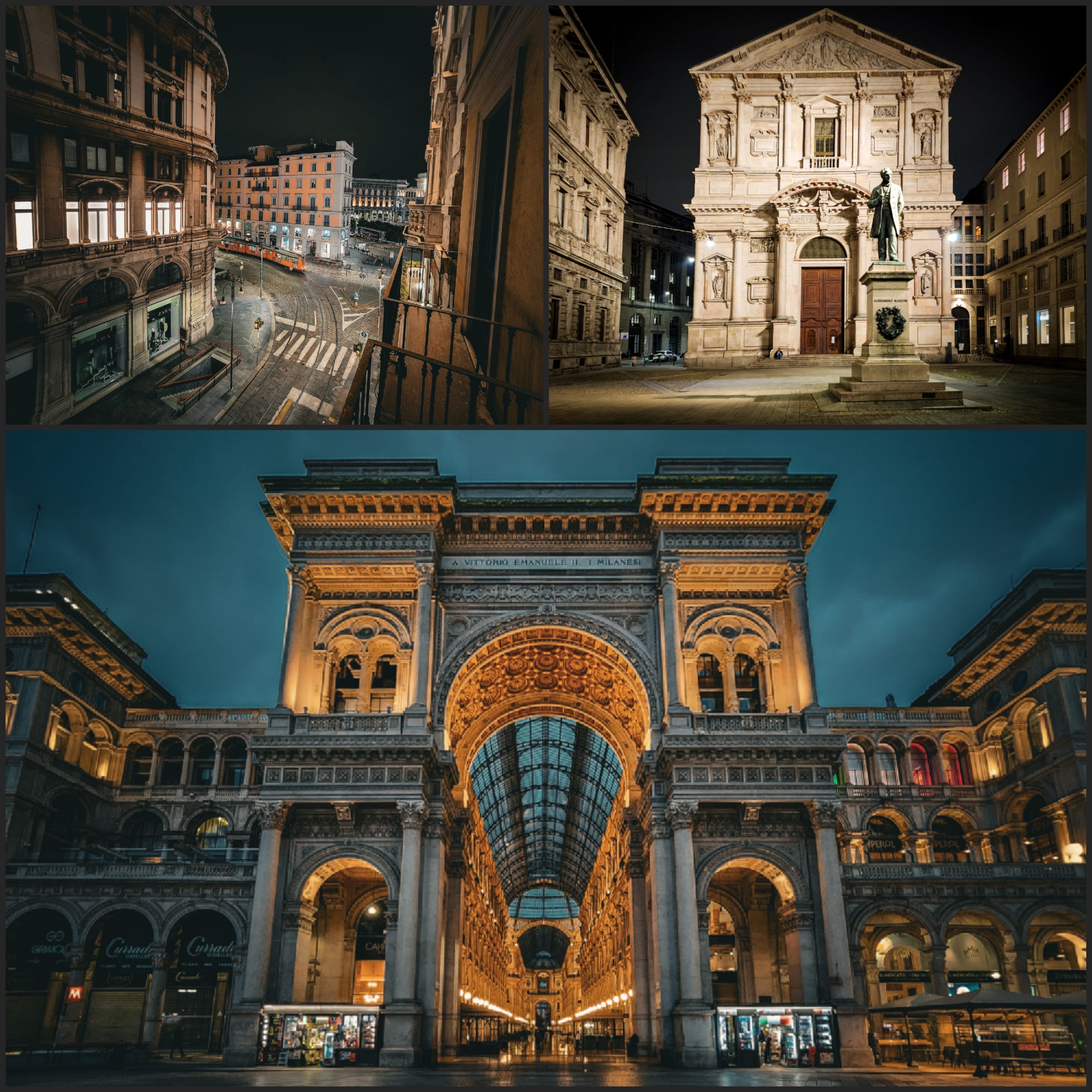
The vagrants and tourists don’t arrive until eight. I went out at six-thirty. The Piazza del Duomo was empty. The Duomo faced the square from the east, flood-lit from below, white marble against a sky still closer to night than morning. The five great doors were shut. They laid the first stone of this Cathedral in 1386. Six centuries. You stand there doing the arithmetic and it does not resolve. 1386. Before the printing press, before Columbus.
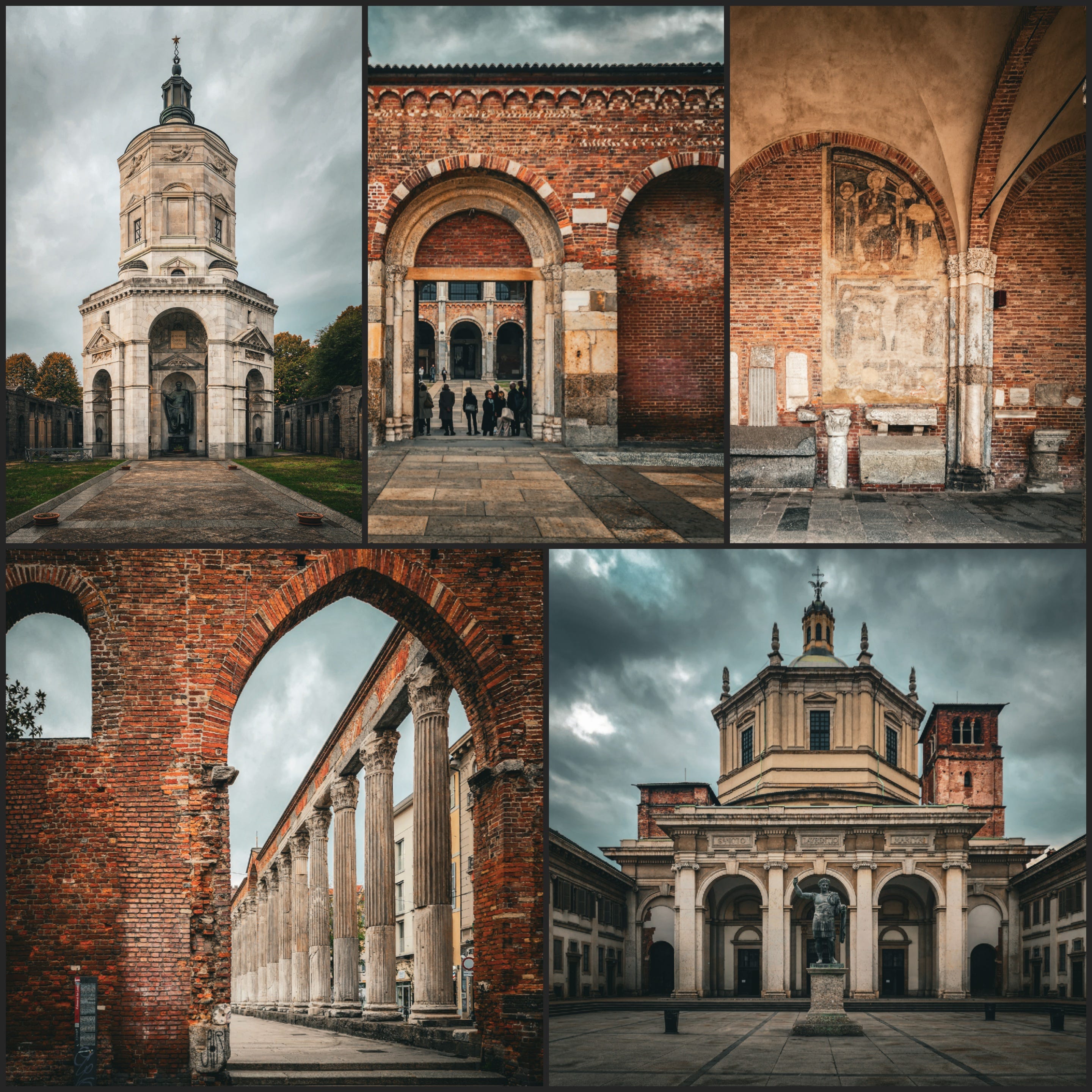
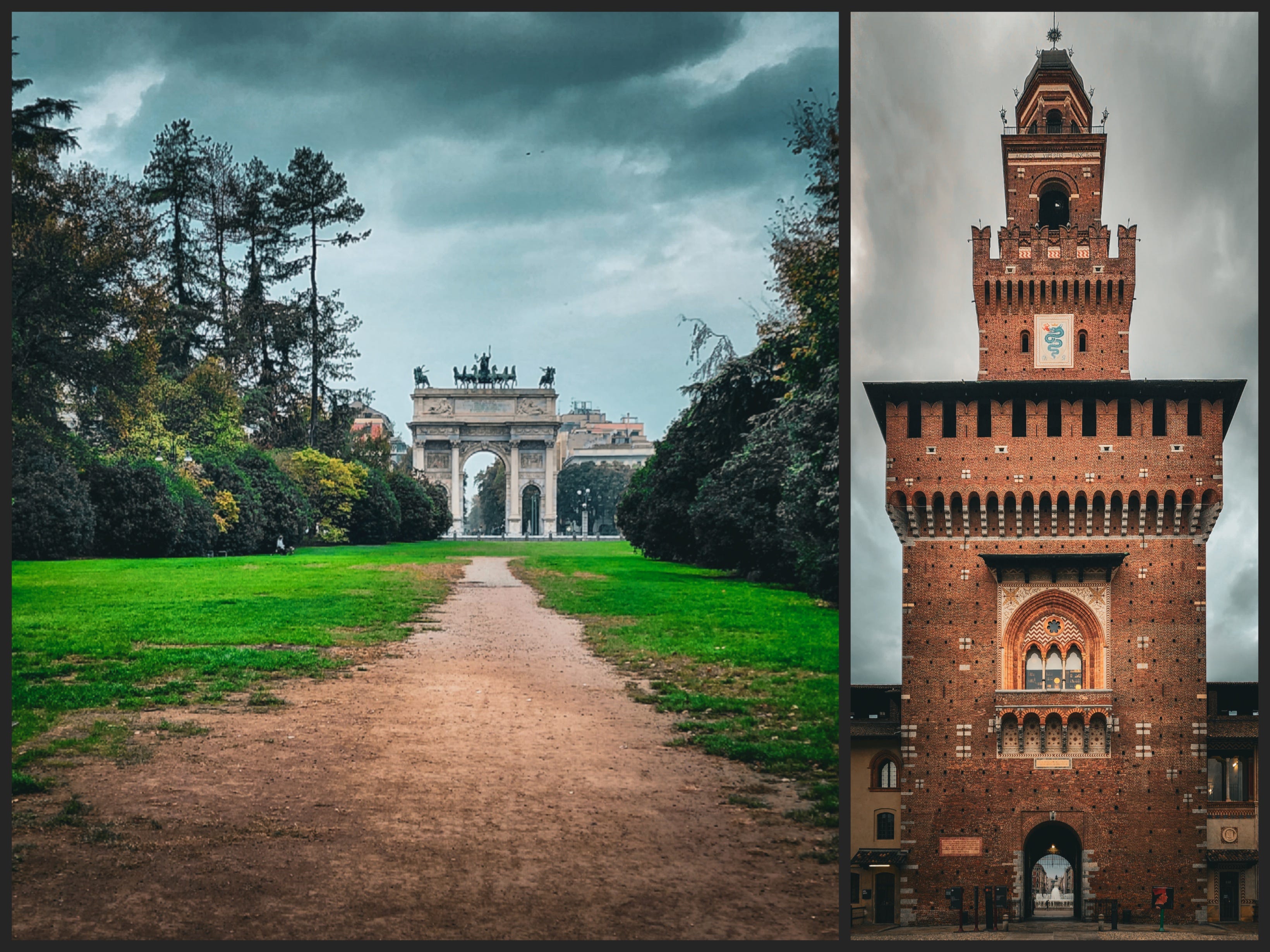
A train to Genoa left in the afternoon. The morning belonged to whatever we could cover on foot. Camera in hand, turning where the street turned, stopping when something stopped me. At the Colonne di San Lorenzo, sixteen Roman columns stood in their original alignment on a city street, a parking sign and graffiti visible through the colonnade. The columns date to the second or third century AD. Milan built around them the way a river builds around a rock.
At Sant’Ambrogio, founded by the bishop who baptized Augustine, Roman sarcophagi lined the arcade walls. Inside the Basilica of San Lorenzo Maggiore, wooden chairs sat in rows on a floor where congregations have gathered since the reign of the emperor Constantius II. Light came through high windows in long pale shafts. I sat down. We had a train to catch.
The train left Milano Centrale, Mussolini’s station, moving south for ninety minutes. I had never ridden a train, never been to Europe. I ain’t even made it to Missouri. The luggage rack didn’t like my luggage, American suitcases in a country where people travel with one small bag. An hour out, the Apennines rose from the plain — green, rounded, nothing like the Alps’ vertical wall. An October cloud settled into them. Farmhouses slid past at train speed, ochre and yellow, red tile roofs, satellite dishes bolted to their sides, garden walls going brown at the edges. Rain hit the window in small drops that bent the view without killing it. The ordinary country between one ancient city and another.
In 2022 I asked my wife to fly to a foreign country with people I knew from Twitter. I told her we would eat well and walk a beautiful city. She said yes.
Alan Cornett had put the week together with Tom Ruby through their venture, Cultural Debris Excursions1, named for Russell Kirk’s essay about collecting the flotsam of a sunken civilization. Alan is a friend of mine, a Southern gentleman who studied under Dr. Clyde Wilson and was one of Kirk’s assistants. The man knows books. Tom Ruby I had not met before Genoa. I count him now as a friend and a mentor.
Discussion topics ran down the itinerary: urbanism, local knowledge, fealty to the past, Christopher Columbus. They had arranged fixed menus with local chefs, private access to places you could not walk into off the street, and cocktail hours featured Alan-batched Boulevardiers and Limoncello Spritzes and Tom’s heirloom liqueurs. Kirk’s daughter Cecilia was in the group, and a gentleman whose family name sits on a college football stadium and who is working to bring back the American Chestnut.
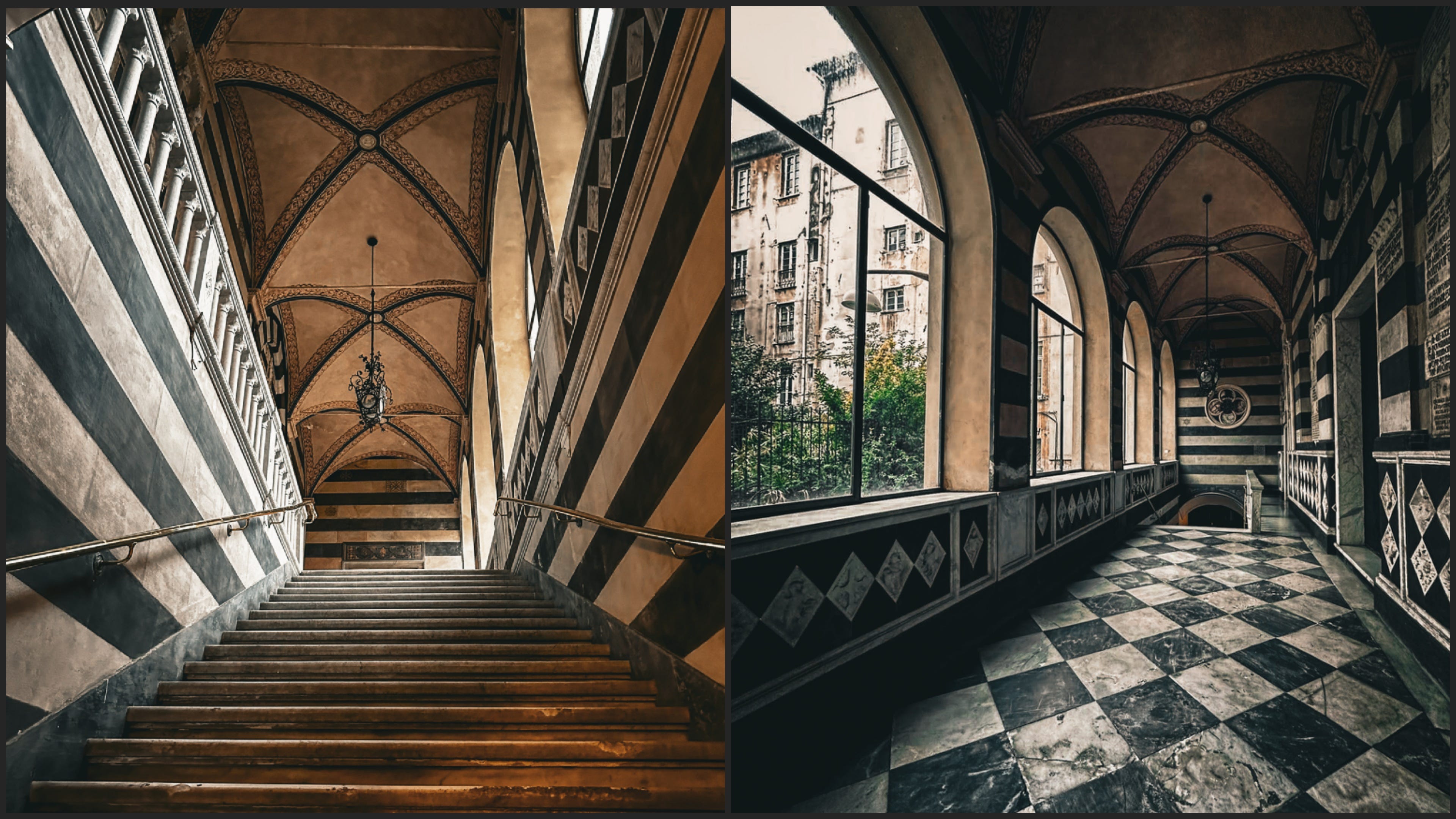
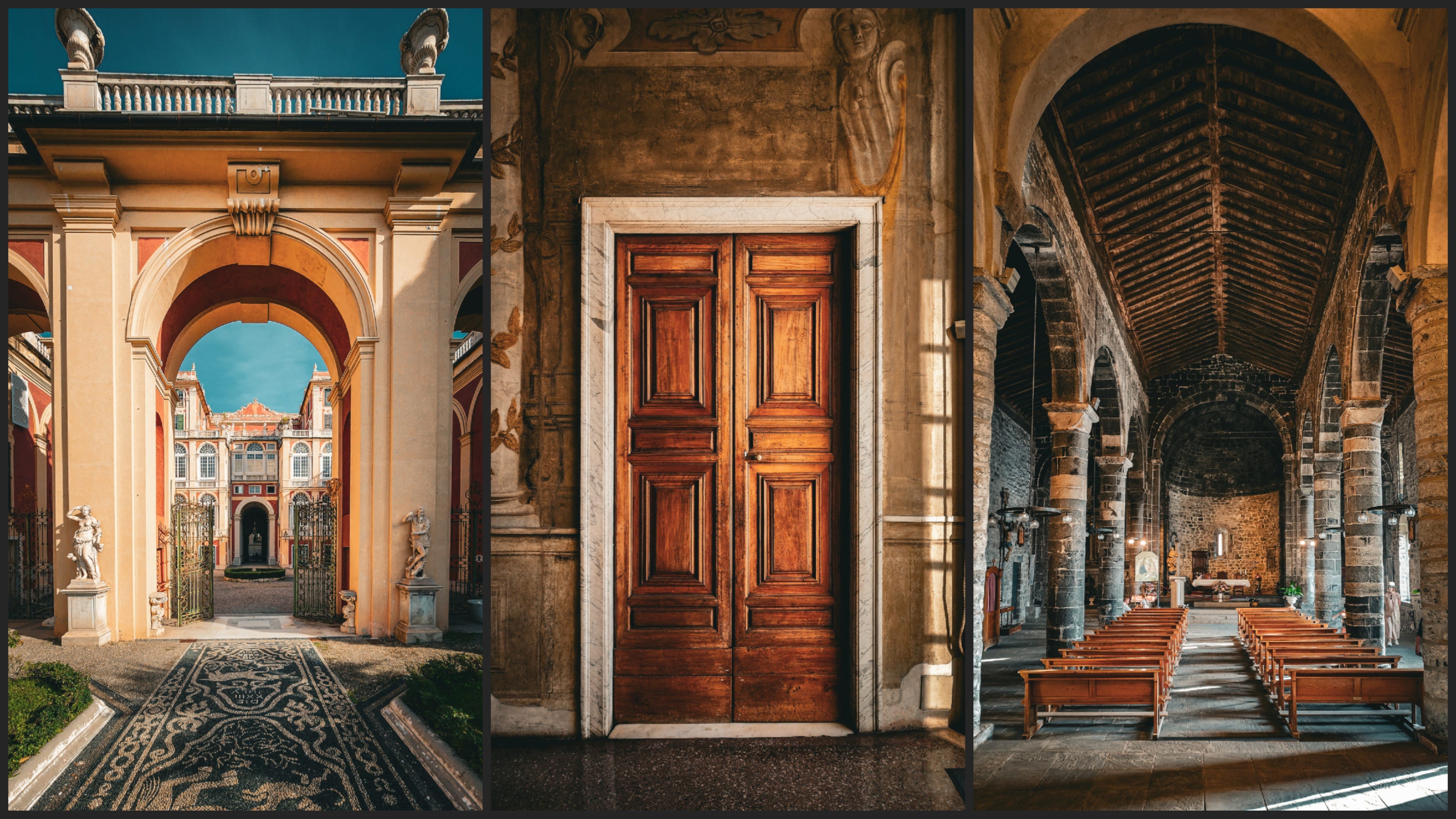
We arrived at Genova Piazza Principe on Saturday. Our hosts brought us to our Bed & Breakfast, the Valéry Guest House. The stairs rose between the Palazzo Grimaldi della Meridiana and the Musei di Strada Nuova. We climbed to a modest door, then a few steps more, and the space opened into an atrium, Latin inscriptions cut into black-and-white marble walls and columns that marked every building of consequence in medieval Genoa.
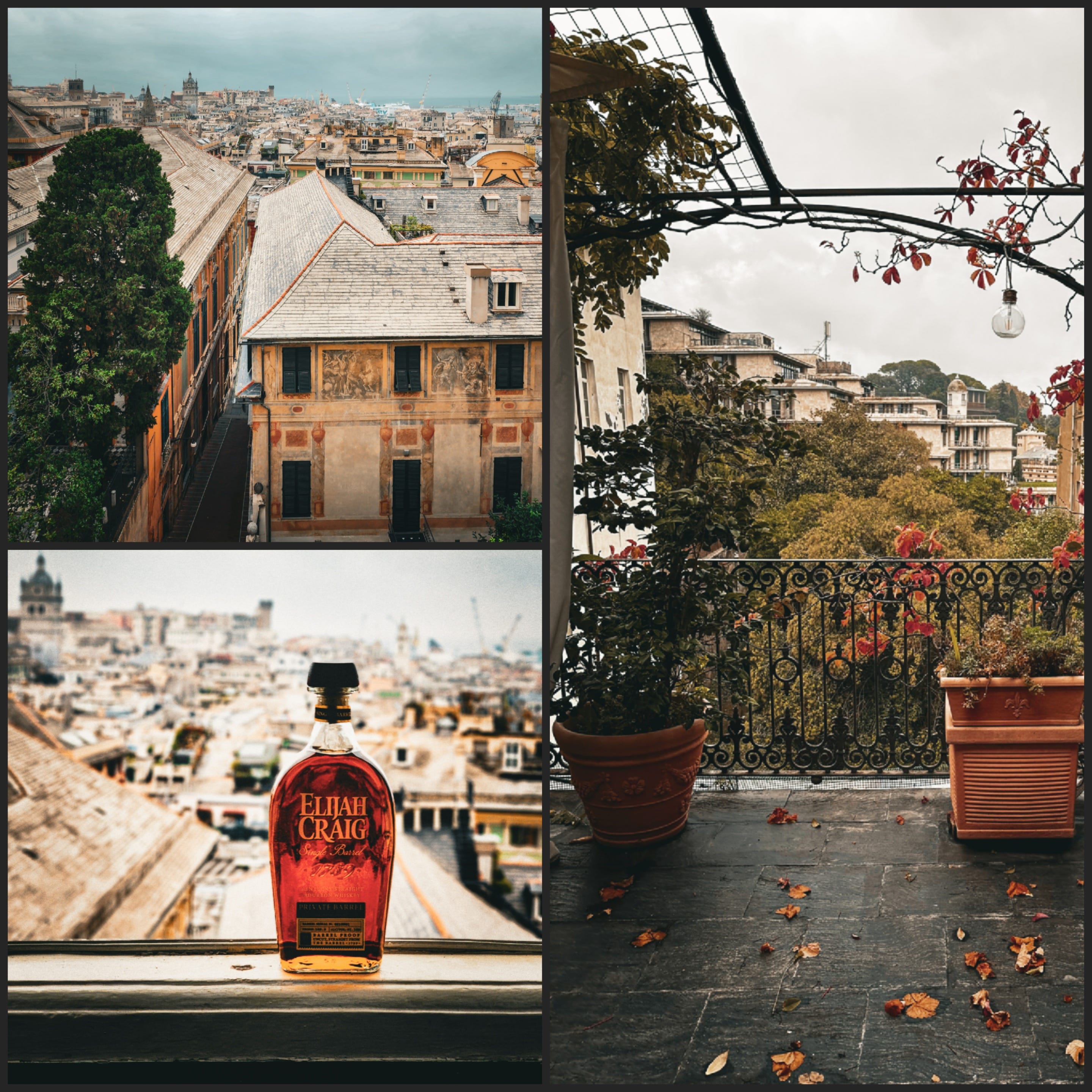
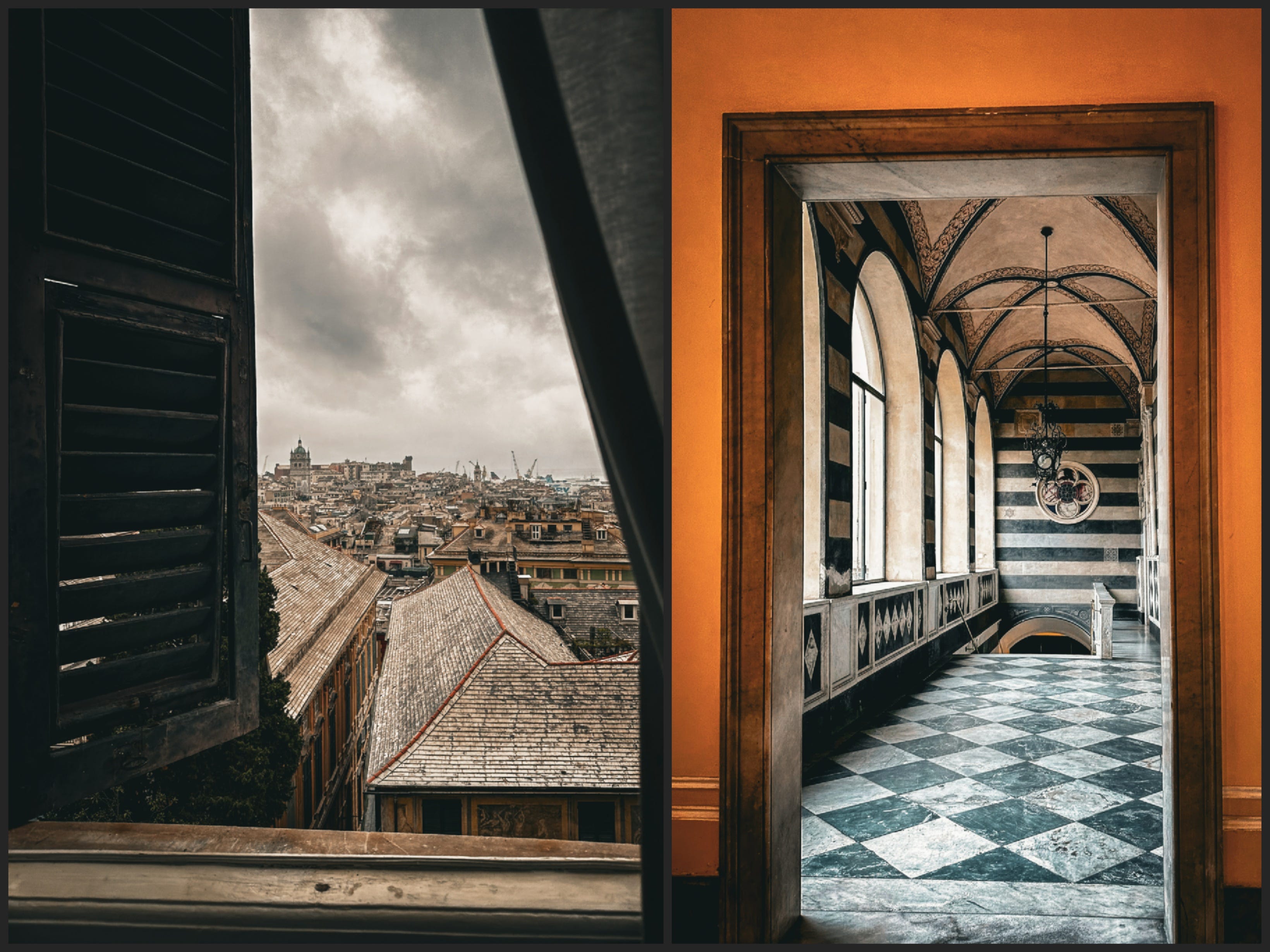
Genoa drops from the Apennines to the Ligurian Sea in a crescent of stone. The mountains crowd the harbor, the city built upward. Narrow alleys called caruggi run between the waterfront warehouses and the churches and palaces above, six feet wide in places, vaulted in stone, the upper floors close enough to block the sky. The Romans knew it as Genua. During the Second Punic War, Scipio landed here. Mago Barca ravaged the city. Rome rebuilt it as a military base for campaigns against the Ligurian tribes. Genoese fleets sailed east in the age of the Crusades. Columbus was born here.
The Genoese drew portolan maps, financed ships, kept accounts. When the Ottomans took Constantinople in 1453, Genoese bankers turned west and underwrote Spain’s American empire. By the 1550s they held half the loans to the Spanish Crown. American silver moved through Genoa to Flanders. The families who controlled that trade built their palaces on a single street of marble and fresco, the Strada Nuova.
In 1784 the Genoese minister in Paris wrote to Benjamin Franklin about sending a consul to Boston. Franklin, Jefferson, and Adams replied that they were ready for a treaty of friendship and commerce with the Most Serene Government of Genoa. Nothing came of it.
Three years later Jefferson arrived. He spent three and a half months on the road through southern France and northern Italy and studied Genoa with an architect’s eye. In Piedmont he smuggled rice seed, whose export was punishable by death, and sent it to South Carolina.
In 1791 George Washington received Giuseppe Ravara, a Genoese merchant, as consul general of the Republic of Genoa in the United States. Ravara became entangled in an early scandal. He was accused of sending anonymous threatening letters to the British minister in an attempt to extort money. The case raised a constitutional question: could a consul be tried outside the Supreme Court under Article III?
Washington pardoned him, citing “sentiments of respect for the said Republic of Genoa.” Six years later the United States named Francis Childs, printer of the Federalist Papers, its first consul to Genoa. He never arrived. The republic fell that same year.
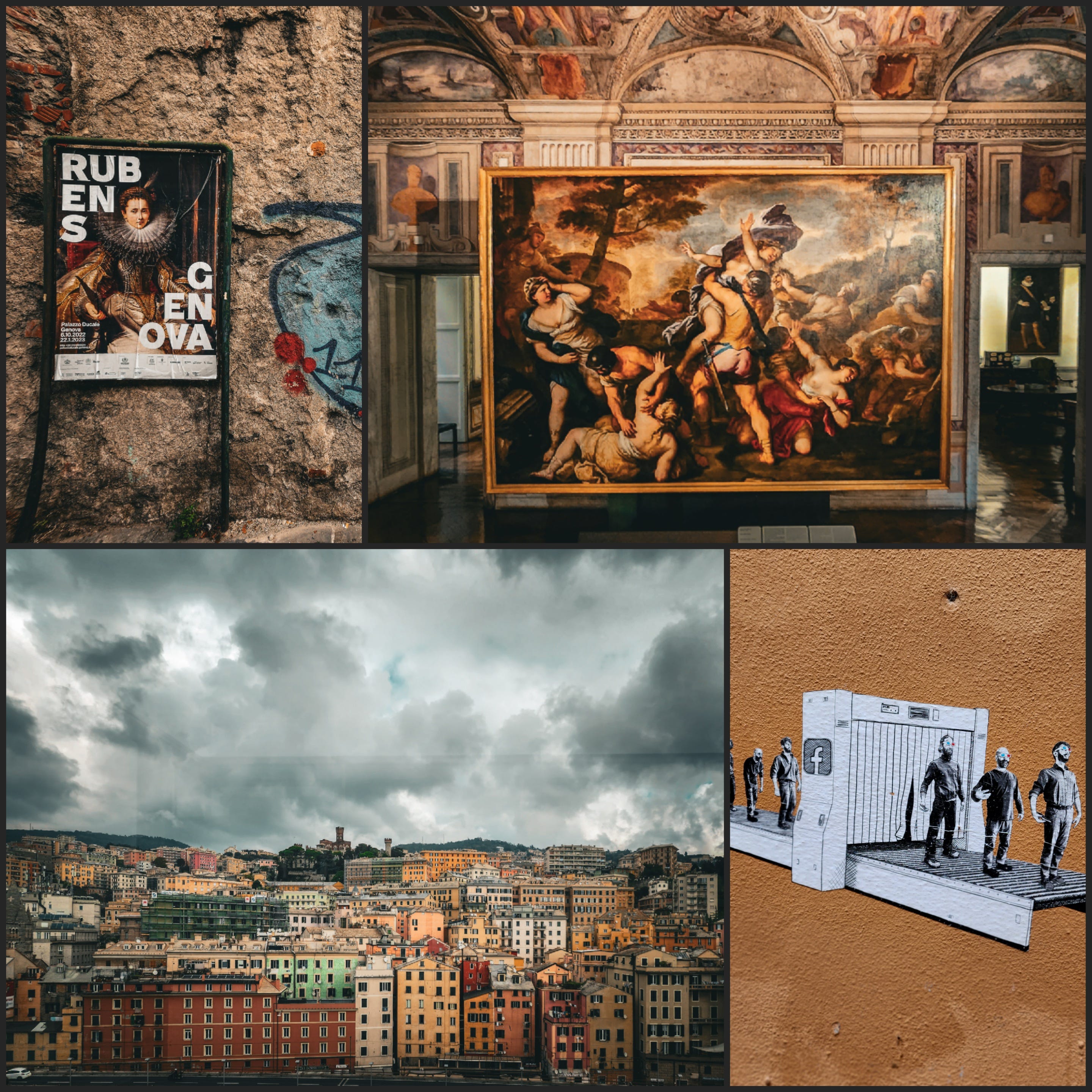
San Francesco di Castelletto once stood on the hill above the Strada Nuova. Franciscan monks broke ground in the mid-thirteenth century. Consecrated in 1302, it stood striped in black-and-white marble, the kind the Genoese took pride in the way Southerners do a porch. Margaret of Brabant, Queen of the Romans, was buried there in 1311. The republic’s first elected ruler was buried there, and an admiral who rescued a pope from a Neapolitan siege with ten Genoese galleys. Then Napoleon killed it. The French seized the property and demolished San Francesco lot by lot over three decades, filling the crypts with rubble.
Parts of the church survived inside a residential building. A passageway connecting Palazzo Bianco and Palazzo Tursi crosses the site where the monastery stood. I walked it. The shapes of arches still showed in the exterior walls. My guest house atrium was part of San Francesco di Castelletto. I did not know this at the time.
On the night of October 4, 1892, Paul Valéry, twenty-one, sat in a room in the Palazzo Montanaro while a storm battered the Ligurian coast. He had come to Genoa sick over a Spanish woman and sick of his own poems. A sleep-deprived Valéry swore he would free himself from “those falsehoods: literature and sentiment.” He turned to mathematics, philosophy, and language. Twenty years passed before André Gide drew him back to poetry. A plaque on the exterior wall marks the night. The guest house bears his name.2
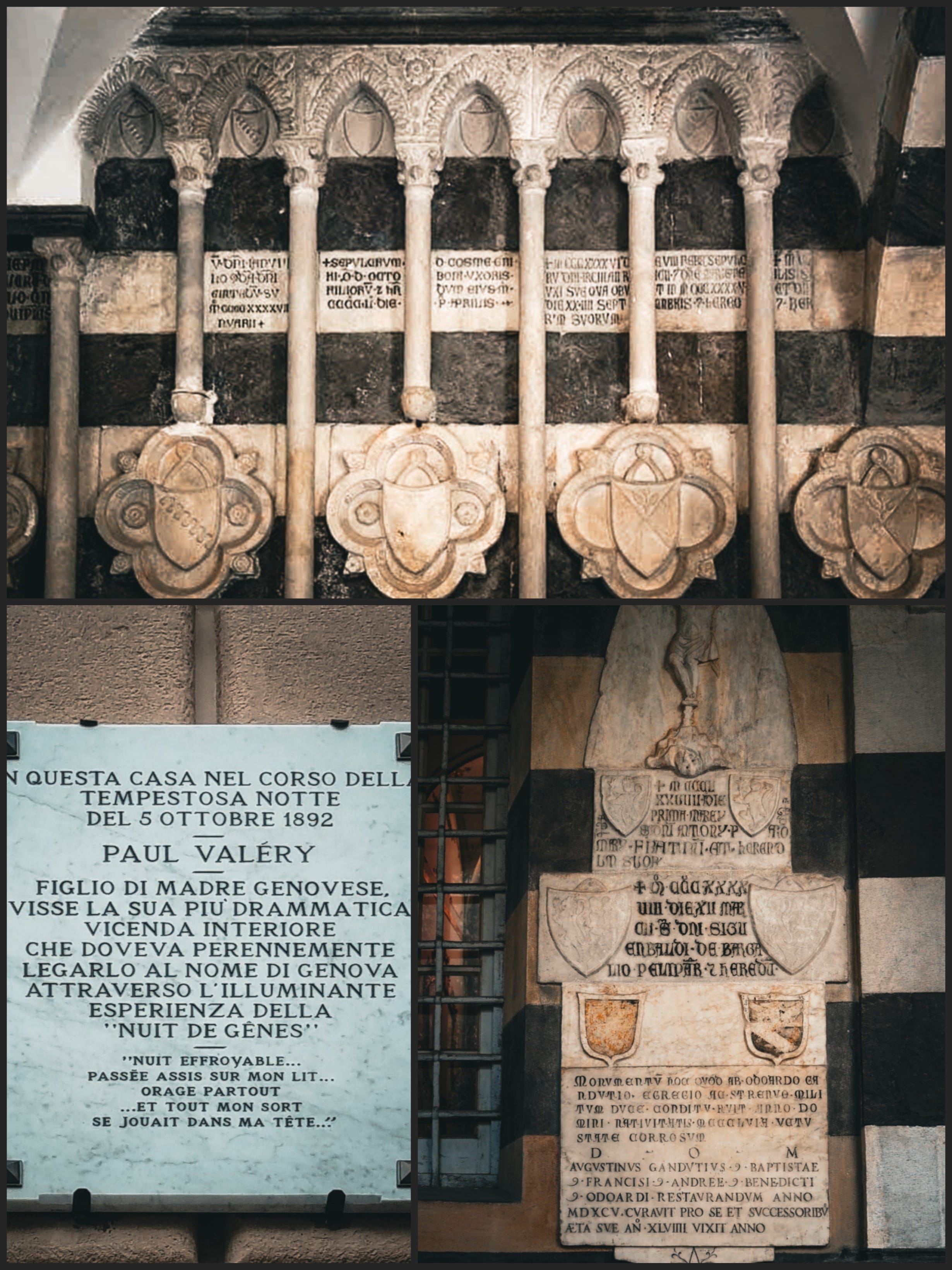
The days in Genoa followed a pattern: breakfast, walk, stop, look, eat, walk, stop, eat, drink. We walked through Porta Soprana, the twelfth-century gate where the old city walls begin, and passed the house where Columbus is said to have grown up — an eighteenth-century reconstruction of a building the French navy shelled to rubble in 1684 — and turned into the alley maze. The Chiostro di Sant’Andrea sits in an open lot between apartment buildings. The cloister belonged to a Benedictine monastery demolished in the nineteenth century.
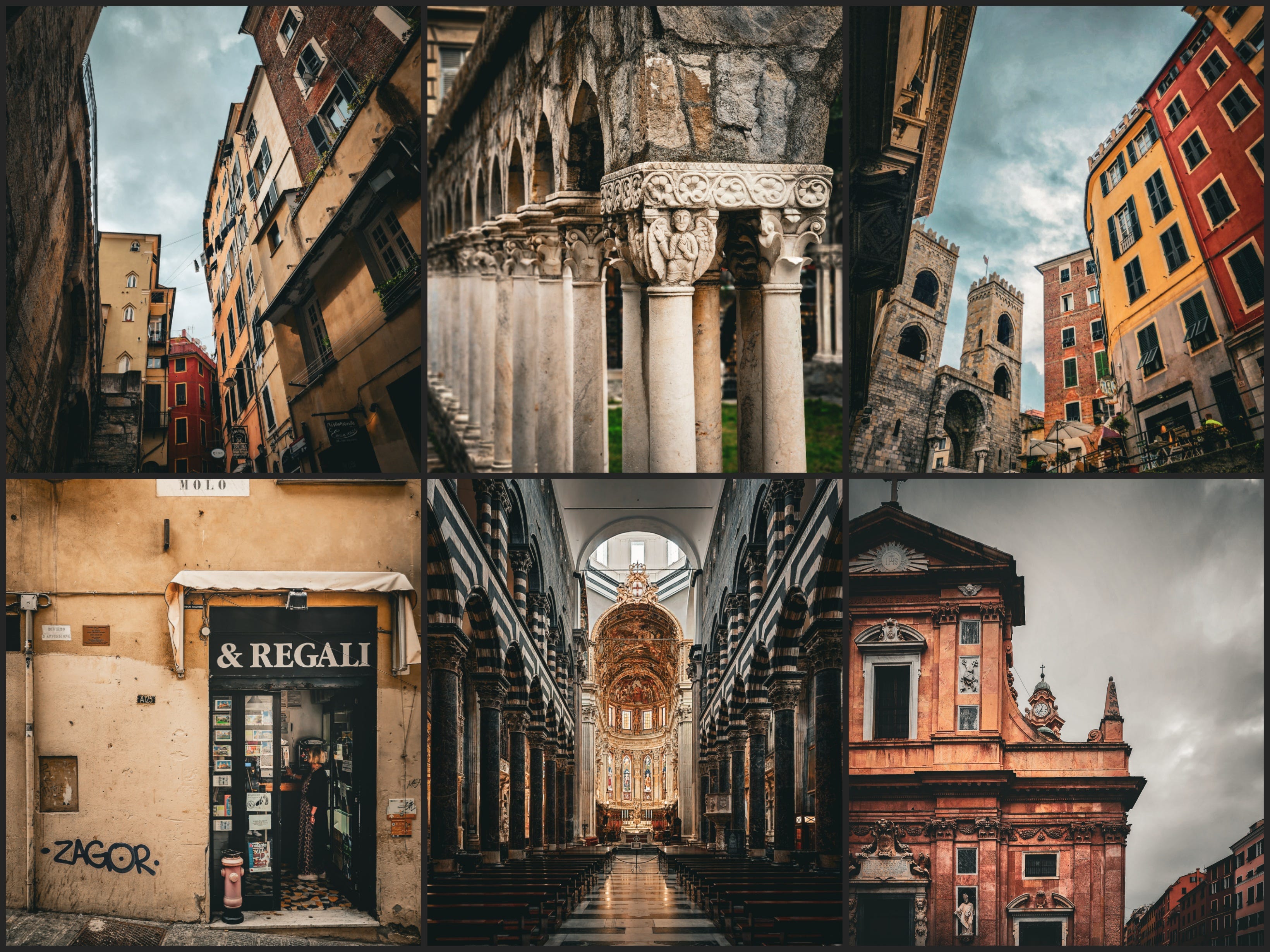
From the Columbus monument near the train station — A Cristoforo Colombo / La Patria, cut in marble, bronze wreaths gone green at the base — we took the Zecca-Righi funicular up to the old defensive walls above the city. Genoa spread below in haze, the port cranes and the Ligurian Sea dissolving into a single gray wash. The walls ran through fog and cedar trees. A medieval gate appeared along the path with Osteria da Richetto built into it. We ate and drank.
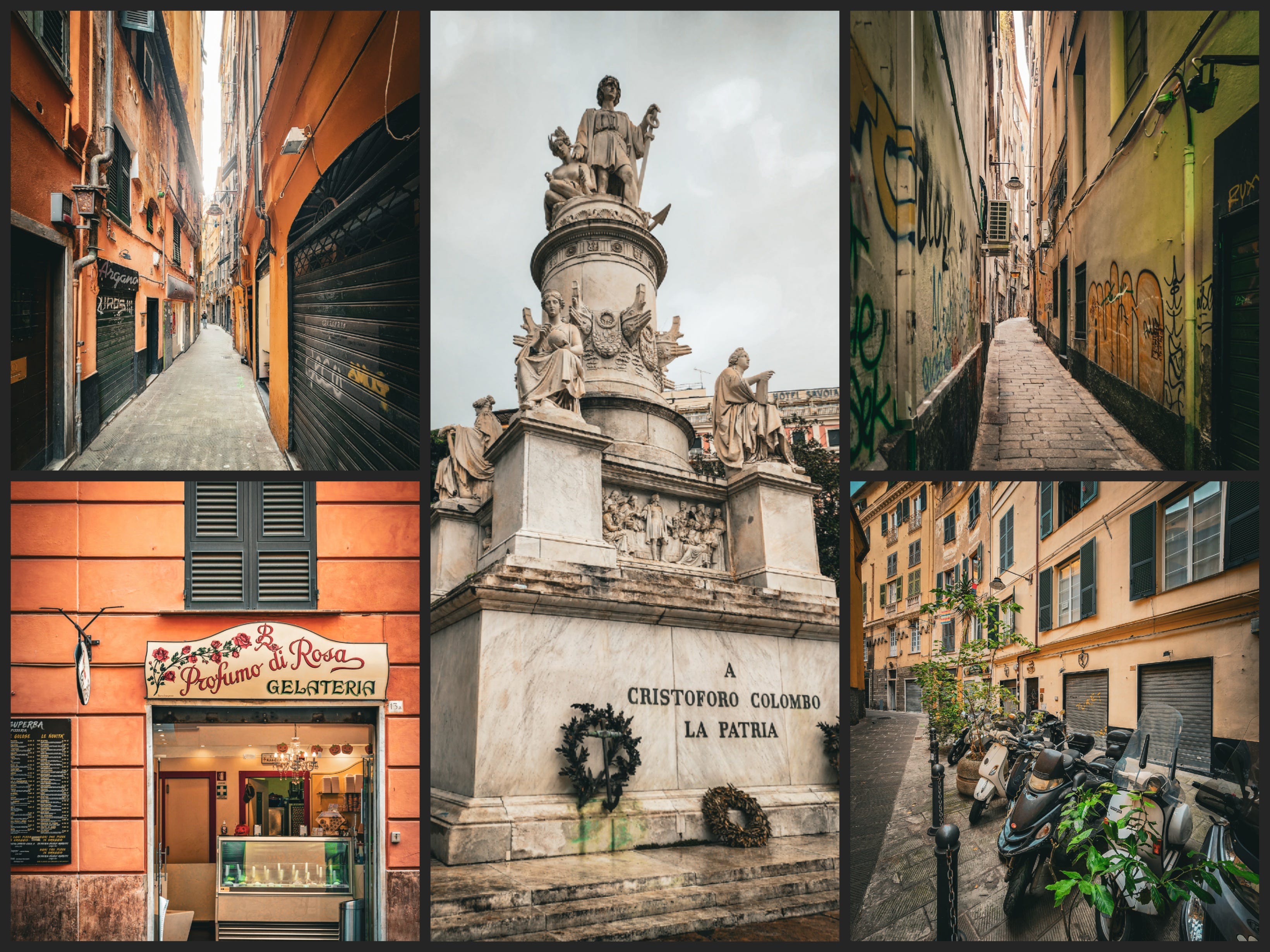
On the descent we stopped at the Sanctuary of the Madonnetta, built in 1696. The courtyard floor is a risseu — a traditional Ligurian pebble mosaic, black and white river stones laid by hand into scrollwork and heraldic patterns. In the crypt the sanctuary keeps a permanent nativity scene: a hundred carved wooden figures from the seventeenth and eighteenth centuries, set in a miniature reconstruction of old Genoa.
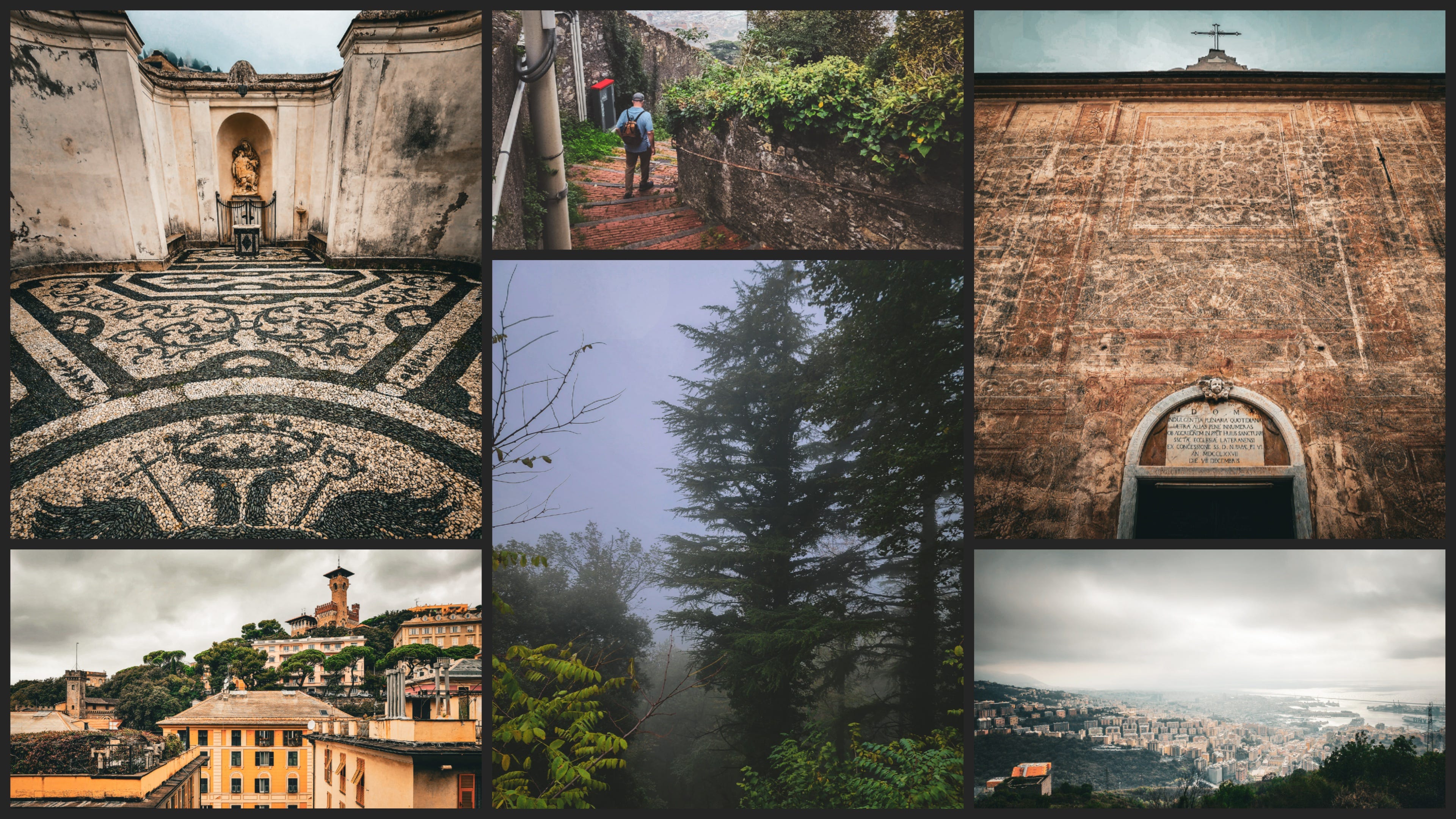
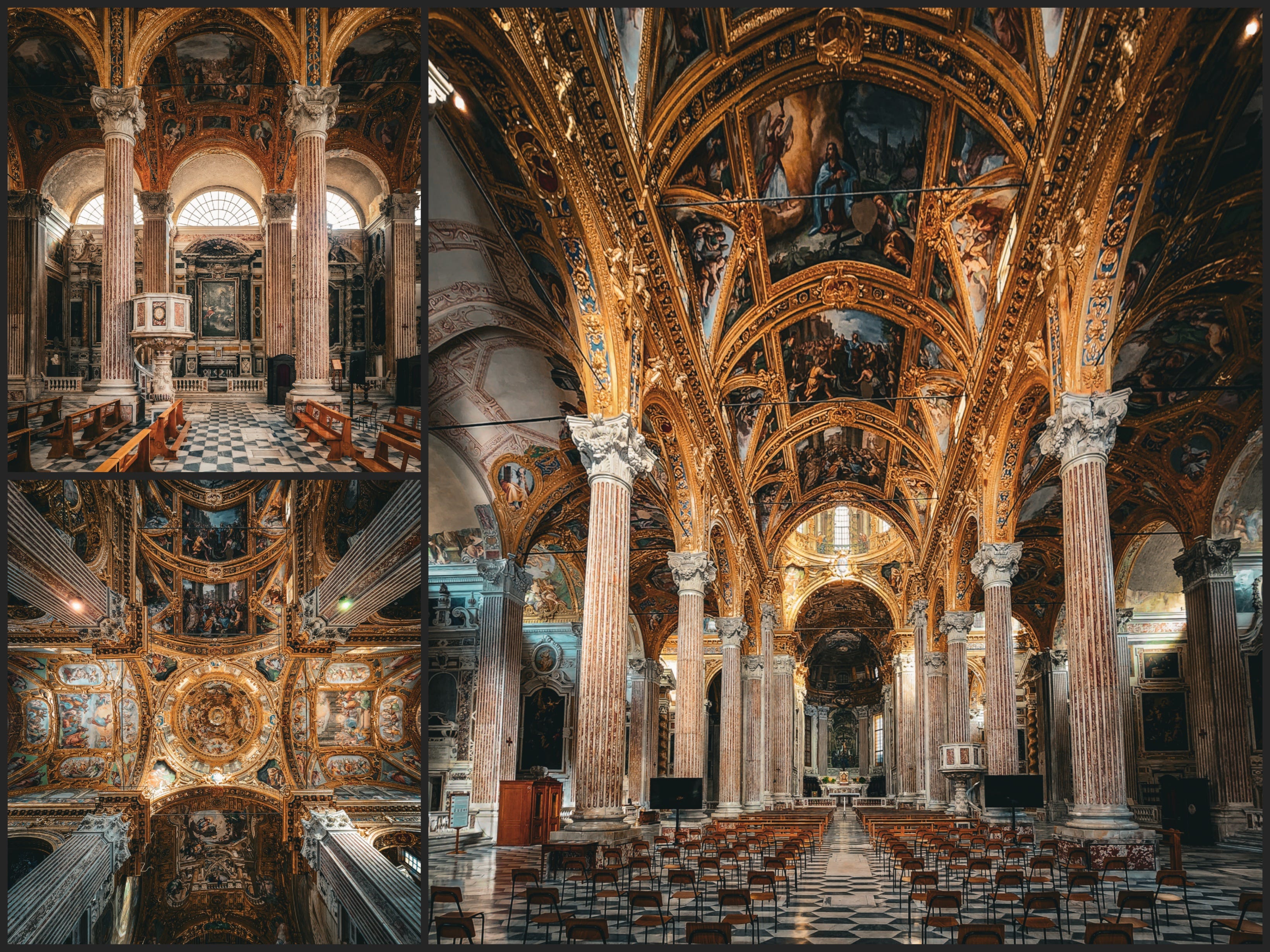
Lower in the city we found the Church of Our Lady of Mount Carmel and Saint Agnes, founded in 1262 by Carmelite friars who had arrived in Genoa with the retinue of Louis IX of France after his failed crusade. The Carmelites built their church on the site of an older chapel; the parish of Sant’Agnese, founded in 1192, was merged into it in 1799 after the Napoleonic suppressions wiped out both congregations.
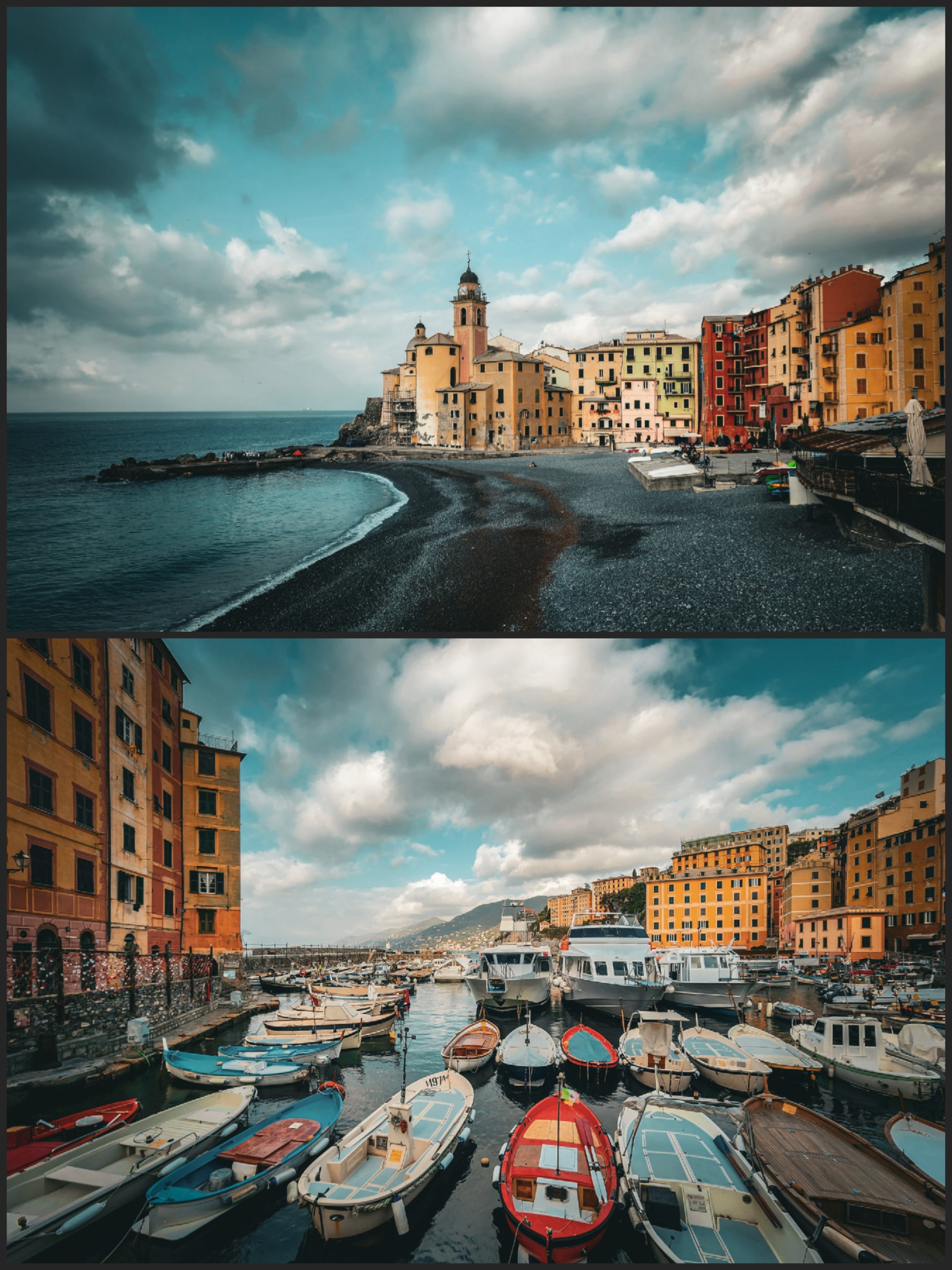
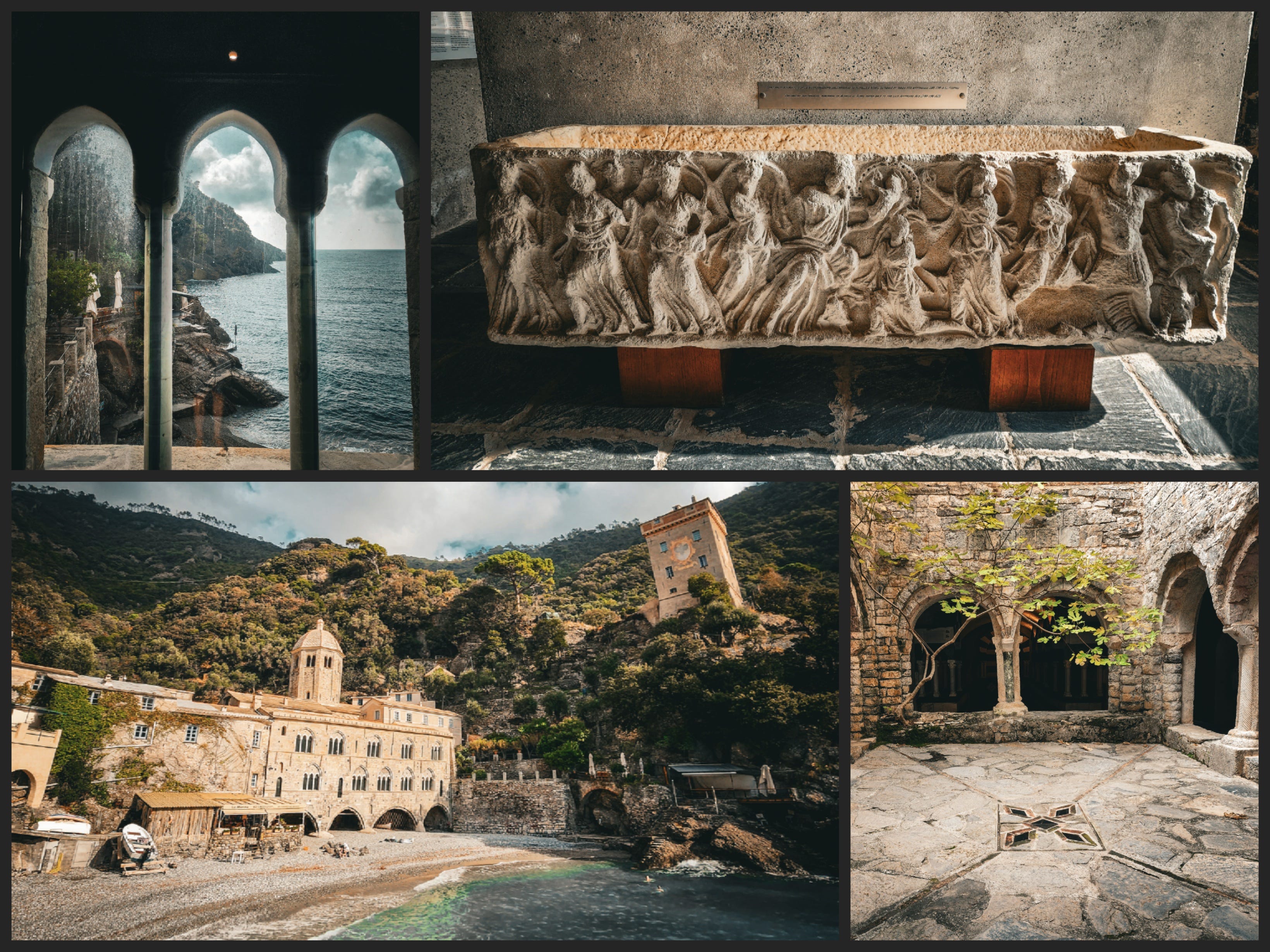
We took the train to Camogli and the ferry from there to San Fruttuoso. The abbey appeared around the headland — Gothic arches opening onto the water, a Doria watchtower above in the trees. No road reached this place. The mountain closed around the cove on three sides, the sea on the fourth. Off the cloister, a Roman sarcophagus sat on wooden blocks.
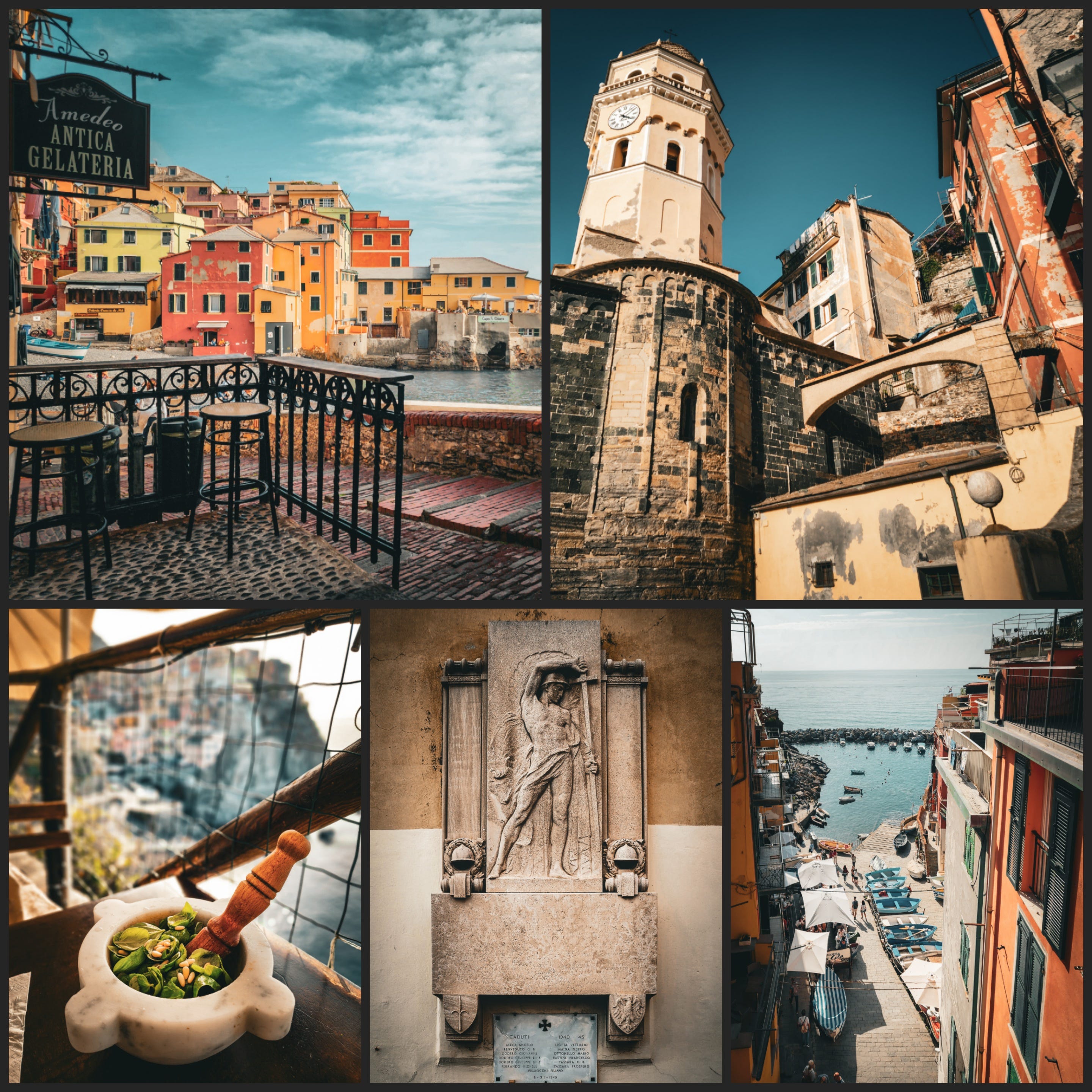
The fishing village Boccadasse sat on a cove at the eastern edge of Genoa. The boats still came in. The nets hung out to dry. People still lived above the sea in rooms with salt on the windowpanes. Back in the city that evening, at Savô Pizzeria, they kept bringing pizzas and pouring Ligurian wine and nobody told them to stop. Best pizza I have had anywhere.
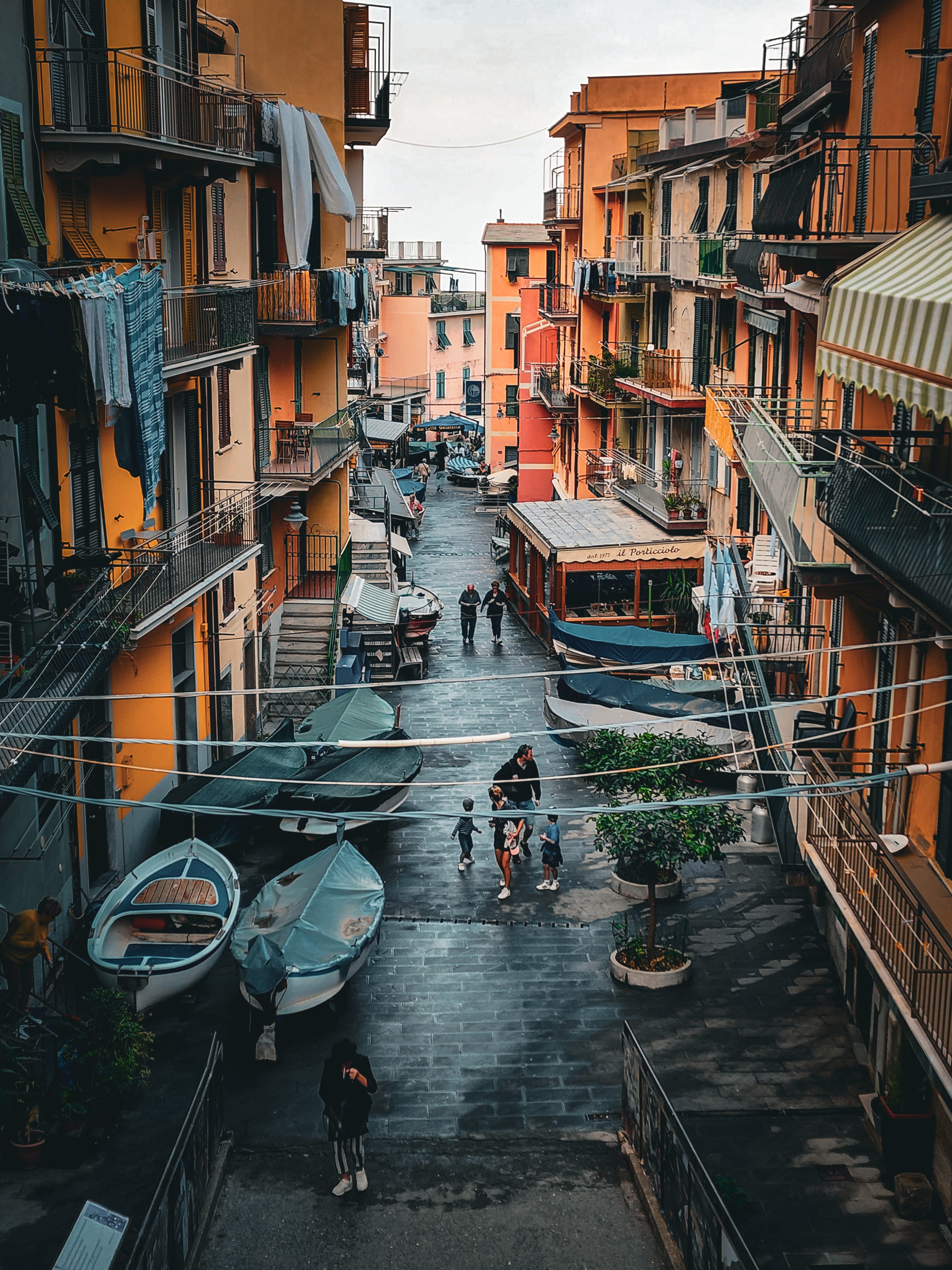
My wife and I took the train south to the Cinque Terre. At Manarola the main street ran downhill from the station to the harbor like a long boat ramp. At Nessun Dorma, on a cliff above the village, we made pesto. At Vernazza a church rose straight from the waterline, built from the same stone as the seawall. Above Riomaggiore, terraced vineyards climbed toward the ridge. We came back to Camogli for dinner. I had caviar pasta and a Negroni. The pasta lives rent free.
I had the University of Genoa on my list. In 1964, a historian named Raimondo Luraghi established Italy’s first American history program there, and he built it around the study of the South. Luraghi had been born in Milan in 1921, drafted into the Italian army in 1941, and turned against the Fascists to join the partisan resistance — first Giustizia e Libertà in Torino, then the 4th Garibaldi Brigade, where he rose to command a ranger battalion in the mountains. Wounded in action on July 29, 1944, he earned a silver medal for gallantry.
After the war he joined the Communist party and worked as a journalist, quit journalism and Communism, but not Marxism, so naturally he moved into teaching. He first crossed the Atlantic in 1963 for a Harvard International Seminar directed by Henry Kissinger. Fulbright grants sent him into the archives of the American South, and in 1966 he published Storia della Guerra Civile Americana — 1,395 pages, awarded the Prize of the American Universities in Europe for the best book in American history by a non-American. David Donald called it the best single-volume history of the war. Luraghi lectured at Harvard, the University of Richmond, the University of Georgia, Notre Dame, and Indiana. Mr. Luraghi died on December 28, 2012, at ninety-one. Historian Emory M. Thomas called him “a modern Thucydides.”3
Dr. Clyde Wilson, in his Southern Reader’s Guide, recommending Luraghi’s The Rise and Fall of the Plantation South, wrote: “Raimondo Luraghi of the University of Genoa was one of the twentieth century’s most important European students of the American era of the War Between the States. He wrote, among other works, a superb history of the Confederate Navy and a general work on the War that has not been translated into English. In the work in hand, he writes a graceful appreciation of the society of the Old South. To state a sophisticated case briefly, he finds antebellum Southerners to be, as is claimed by their defenders, admirably honourable and non-materialistic.”
Professor Luraghi compared the plantation South to the Mezzogiorno, 1861 in Richmond to 1861 in Turin: agrarian peripheries governed by landed elites, divided from their industrialized counterparts, dragged into crises of unification on someone else’s terms. Luraghi read the antebellum South through the classical ideals of the Italian Renaissance, the planter modeled on the integral man, or what the Southern Agrarians and Richard Weaver called the whole man. He saw the war as the first modern industrial conflict: the agrarian Confederacy, forced to fight a technological war it had no infrastructure to wage, bypassed capitalism and built a war industry from the top down. Emory M. Thomas puts Luraghi’s point bluntly: Confederate industry, driven under Jefferson Davis, expanded at a pace and scale rivaled only by Mao’s China.
I first encountered his successor, Valeria Gennaro Lerda, in Dr. James Everett Kibler’s lectures and in his book The Classical Origins of Southern Literature. She chose her subject from a need to understand what follows a civil war. She knew that question from inside her own country. Italy’s questione meridionale, the “Southern Question,” took shape after unification in 1860, when the industrial North absorbed the agrarian Kingdom of the Two Sicilies.4
Lerda taught the American South at Genoa for more than thirty years. She co-founded the Southern Studies Forum, which met first at the university in January 1990, and she ran the Fulbright Senior Lecturer program that brought a Southern historian to Genoa each year. Pierangelo Castagneto, another scholar from Luraghi’s program, wrote on John Taylor of Virginia and Andrew Nelson Lytle.
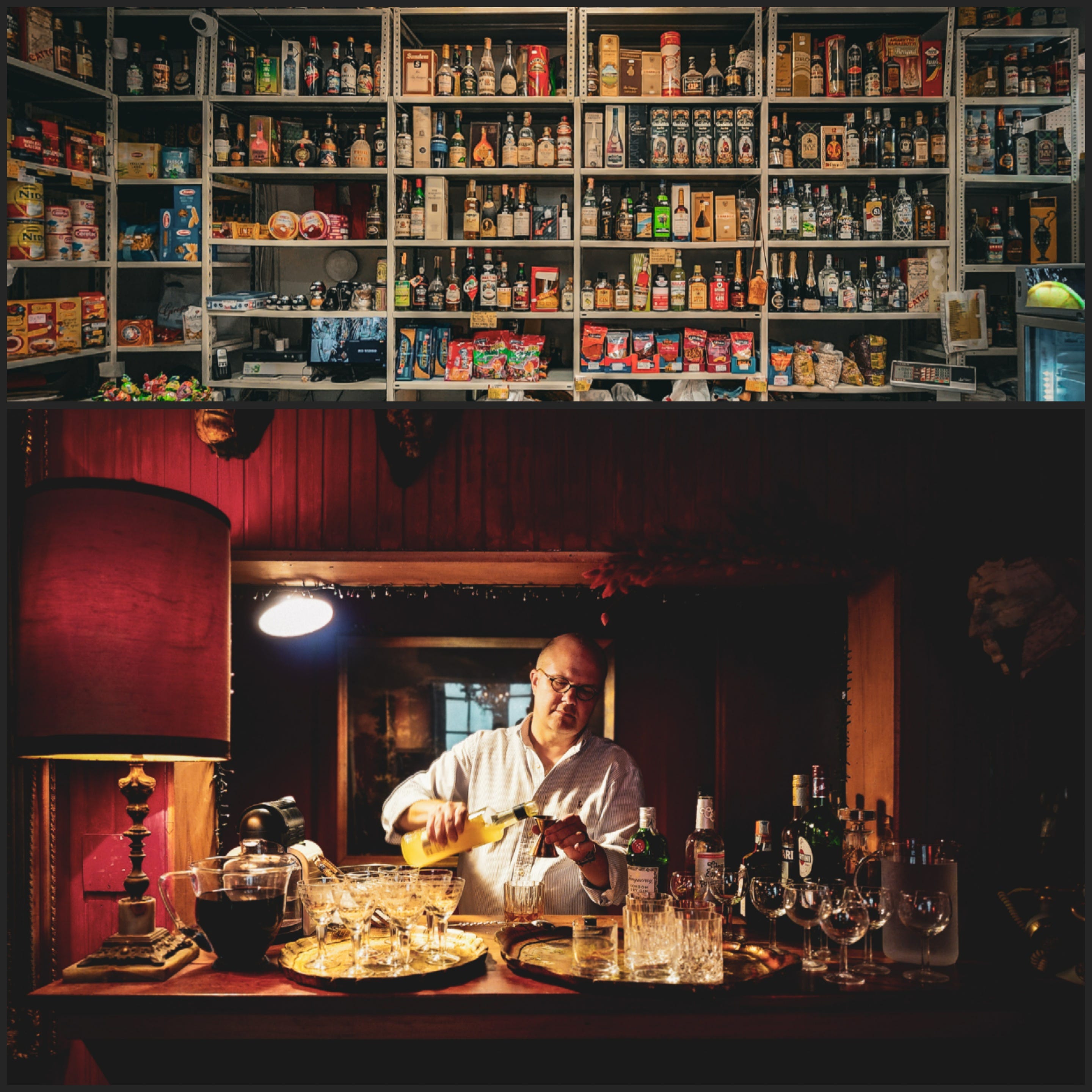
On the last night in Genoa, Alan and I went to Neat Whiskey Bar, a place I found in the alleys. I set a bottle on the counter. Leiper’s Fork Distillery, Williamson County, Tennessee. Single Barrel, Cask Strength, 109.7 Proof. Barrel No. 52, New American Oak, Charred, Selected for the Southern Whiskey Society. I carried the bottle from Nashville to Genoa, rolled in a shirt, bagged in plastic.
The bartender picked it up, turned it in his hands, read the label. ROME ran across his knuckles. He poured three glasses. We drank. No one had carried a bottle across the ocean and set it on his bar. After that he kept pouring. The Michter’s came out. Then something else. The tab stopped mattering. We drank bourbon in a city where bourbon had no business being.
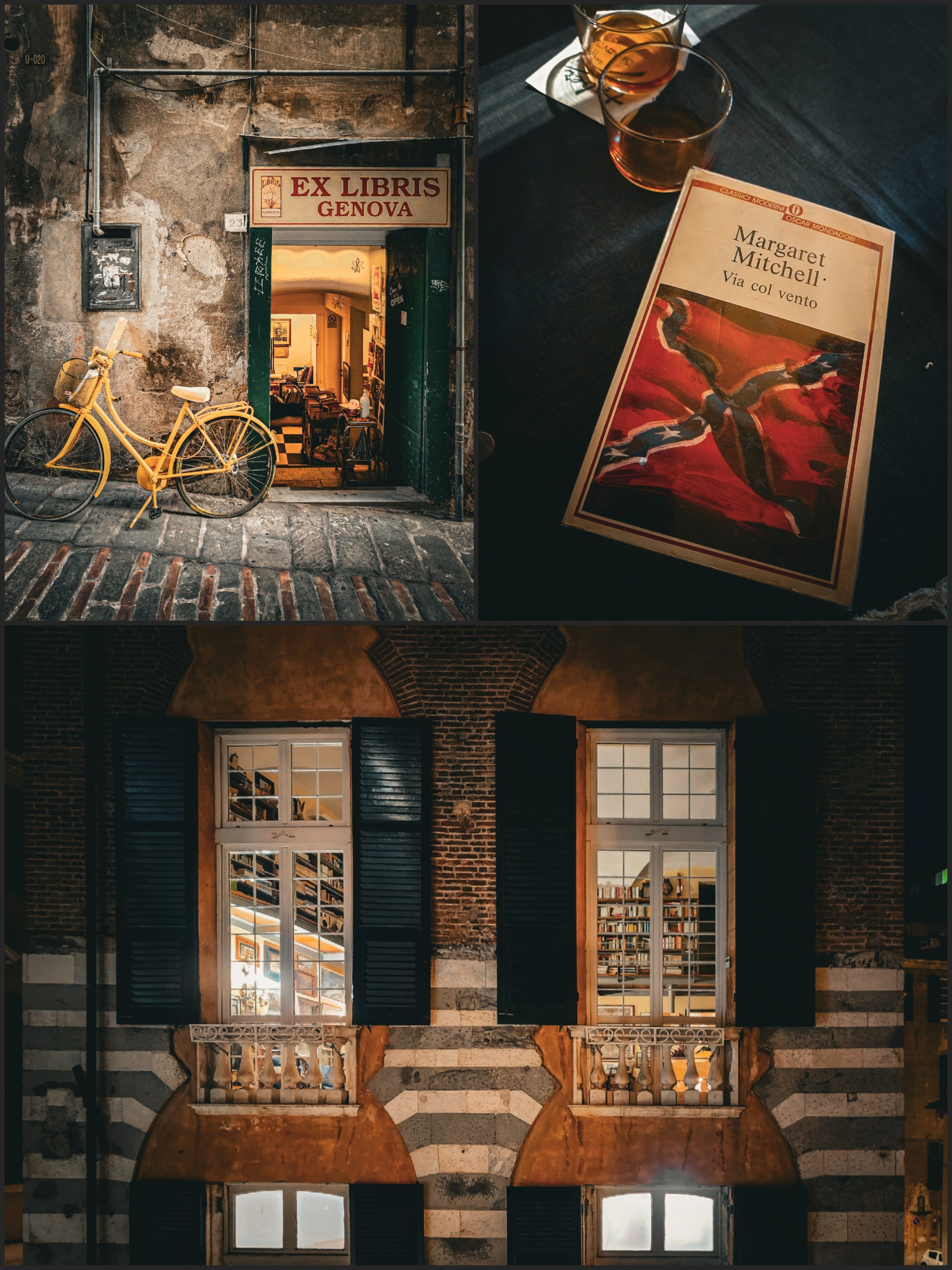
The walk home took twice as long as it should have. I climbed the stairs to the building where a Franciscan cloister once stood. I passed the Latin inscriptions and found my door. The bottle stayed on the bar. I didn’t smuggle out any rice, but I did bring home a dusty bottle of Wild Turkey.
Sources
* All photographs by me.
Beneš, Carrie E., ed. A Companion to Medieval Genoa. Brill, 2018.
———. Jacopo da Varagine’s Chronicle of the City of Genoa. Manchester University Press, 2020.
Bent, J. Theodore. Genoa: How the Republic Rose and Fell. London: C. Kegan Paul, 1881.
Bury, Michael. “The Grimaldi Chapel of Giambologna in San Francesco di Castelletto, Genoa.” Mitteilungen des Kunsthistorischen Institutes in Florenz 26, no. 1 (1982): 85–128.
Castagneto, Pierangelo. “Old and New Republics: Diplomatic Relations between the Republic of Genoa and the United States of America.” In Rough Waters: American Involvement with the Mediterranean in the Eighteenth and Nineteenth Centuries, edited by Silvia Marzagalli, James R. Sofka, and John J. McCusker. Research in Maritime History 44. Liverpool: Liverpool University Press, 2010.
Congress.gov. “Journal of the Senate Executive of the United States, 1796-1797.”
Epstein, Steven A. Genoa & the Genoese, 958–1528. University of North Carolina Press, 1996.
Gale. “Raimondo Luraghi.” Gale Literature: Contemporary Authors. Gale, 2007. Gale Literature Resource Center.
Giannattasio, Bianca Maria. “The Ligurians and Other Alpine Peoples.” In The Oxford Handbook of Pre-Roman Italy (1000–49 BCE).
Jefferson, Thomas. “Notes of a Tour into the Southern Parts of France, &c., 3 March–10 June 1787.” Founders Online, National Archives. Original source: The Papers of Thomas Jefferson, vol. 11, 1 January–6 August 1787, edited by Julian P. Boyd, 415–464. Princeton: Princeton University Press, 1955.
Lerda, Valeria Gennaro. “Teaching Southern History in Italy.” American Studies International 31, no. 1 (April 1993).
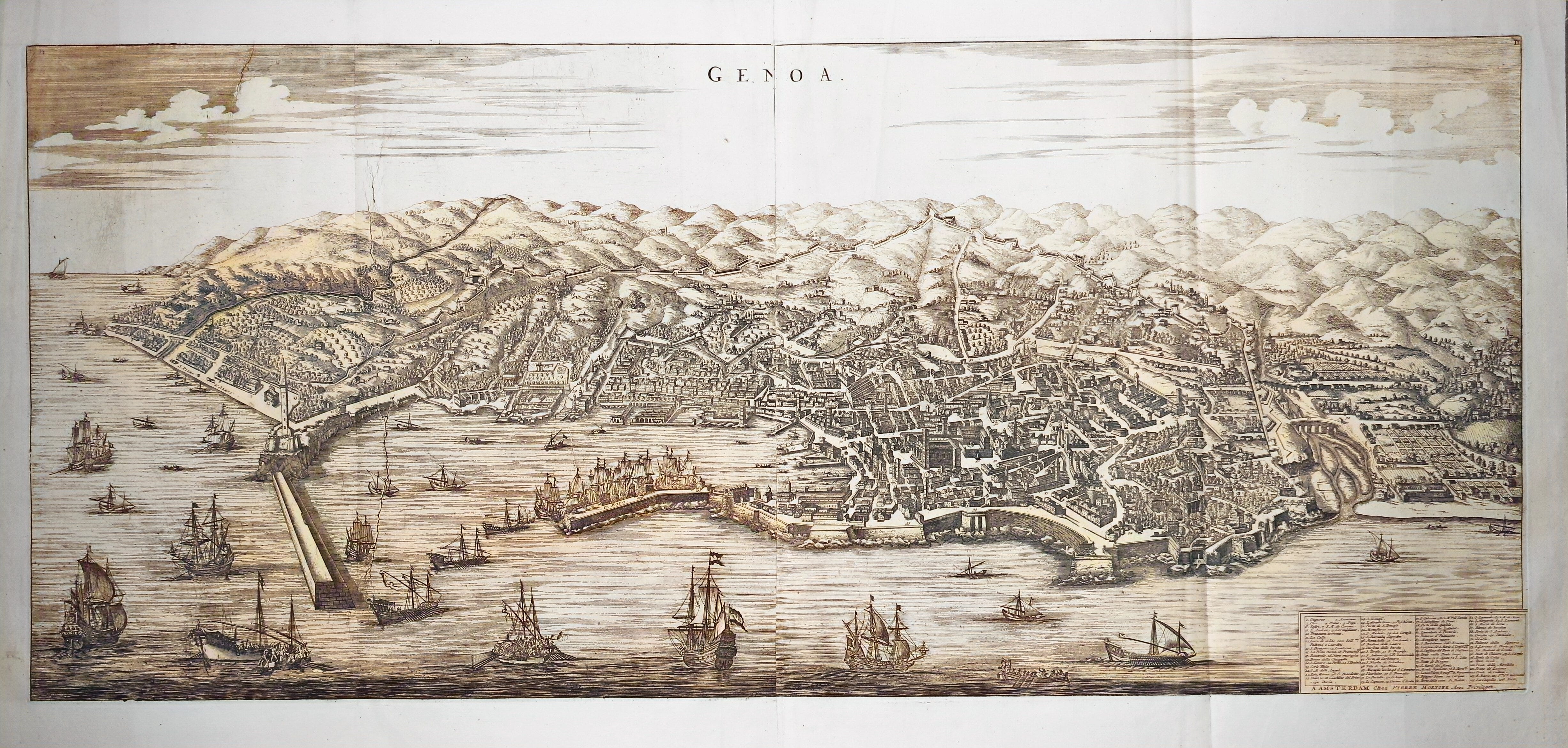
Mortier, Pierre. Genoa. 1704. Map. (Title Image)
Pickering, Timothy. “Timothy Pickering to George Washington, c. 17 February 1797.” Founders Online, National Archives. Original source: The Papers of George Washington, Presidential Series, vol. 21, 22 September 1796–3 March 1797, edited by Adrina Garbooshian-Huggins, 711–714. University of Virginia Press, 2020.
Scrivano, Simona, Laura Gaggero, and Elisa Volpe. “Methodological Approach to Reconstructing Lost Monuments from Archaeological Findings: The San Francesco di Castelletto Church in Genoa.” Minerals 9, no. 10 (2019): 569.
Strabo. The Geography of Strabo. Vol. 2.
Thomas, Emory M. “Raimondo Luraghi Remembered.” Civil War History 61, no. 1 (2015): 64–67.
Washington, George. “George Washington to the U.S. Senate, 17 February 1797.” Founders Online, National Archives. Original source: The Papers of George Washington, Presidential Series, vol. 21, 22 September 1796–3 March 1797, edited by Adrina Garbooshian-Huggins, 715–717. University of Virginia Press, 2020.
I was not asked to or paid to write this or mention Cultural Debris Excursions.
Minutia: “Your ideas are terrifying and your hearts are faint. Your acts of pity and cruelty are absurd, committed with no calm, as if they were irresistible. Finally, you fear blood more and more. Blood and time.” Paul Valéry is in the epigraph to Blood Meridian or the Evening Redness in the West by Cormac McCarthy.
Luraghi’s son, Nino Luraghi, was a Professor of Classics at Princeton and now “holds the Wykeham Professorship of Ancient History at Oxford University.”
There a many works on the “Southern Question”: (1) Agrarian Elites: American Slaveowners and Southern Italian Landowners, 1815–1861 by Enrico Dal Lago. Louisiana State University. Press, 2005. (2) The “Questione Meridionale” in Southern Italy by Russell King. University of Durham, 1971. (3) Nations Divided: America, Italy, and the Southern Question by Don H Doyle. University of Georgia Press, 2002. (4) Henry Adams and the Southern Question by Michael O’Brien. University of Georgia Press, 2007. (5) Civil War and Agrarian Unrest: The Confederate South and Southern Italy by Enrico Dal Lago. Cambridge University Press, 2018. (6) The View from Vesuvius: Italian Culture and the Southern Question by Nelson Moe. University of California Press, 2002. (7) The American South and the Italian Mezzogiorno: Essays in Comparative History. Palgrave, 2001. (8) Dixie’s Italians: Sicilians, Race, and Citizenship in the Jim Crow Gulf South by Jessica Barbata Jackson. Louisiana State University. Press, 2020,
Luraghi translation when?
Thanks for sharing. I really appreciate what you post here and the work you do.